
A school-district SOC asks whether AI code-completion inside an IDE on an isolated lab VM still counts as malware generation under purple-team policy. Which classification is most accurate?
Select an answer to reveal the explanation.
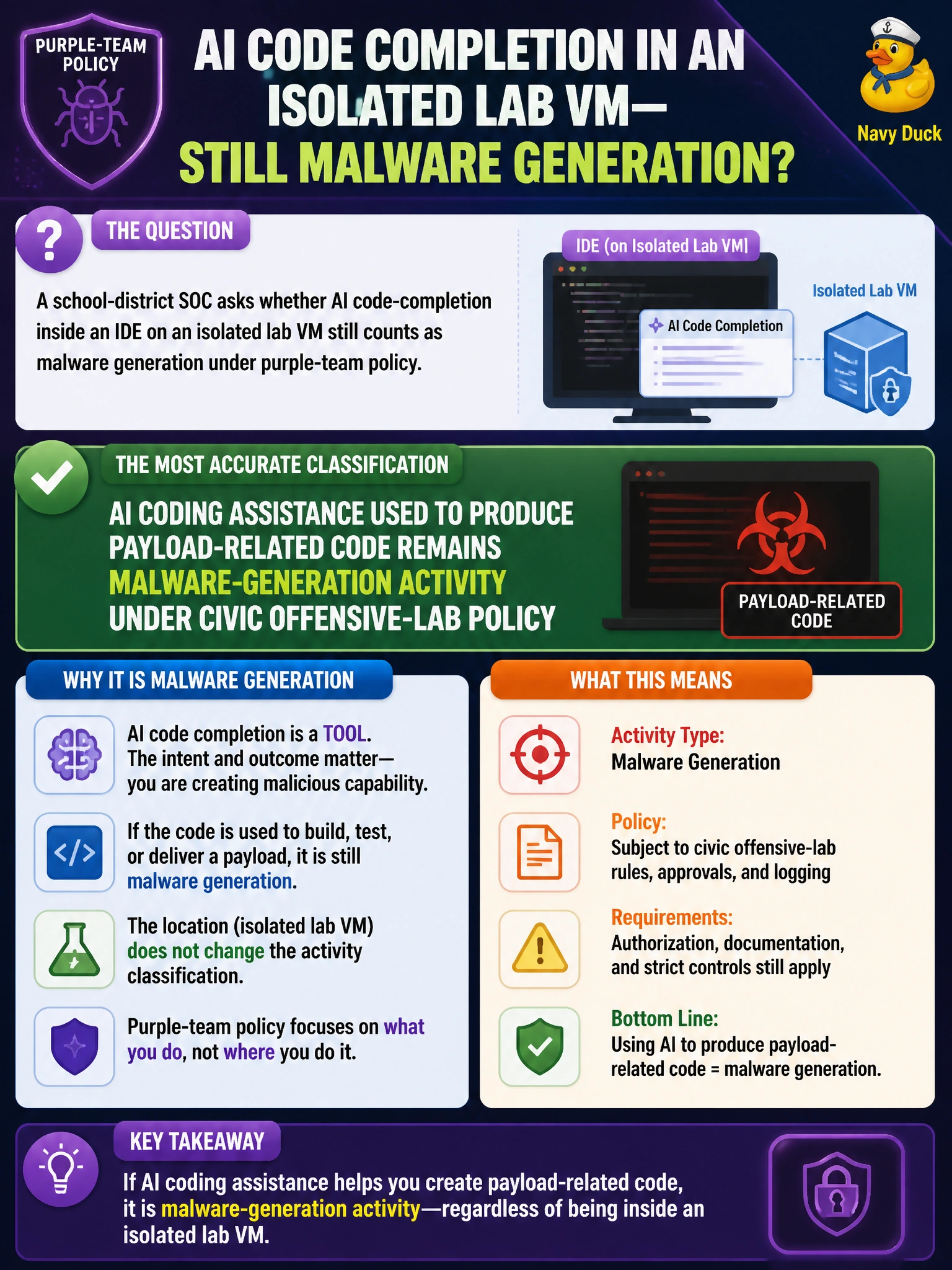
Short Explanation
Whether the helper lives in a chat window or whispers inside the IDE, if it is helping build payload-ish code in the school lab, policy still calls that malware-generation work. Offline weights do not grant a free pass—ROE and review still apply.
Full Explanation
AI coding assistance inside an IDE on an isolated school-district lab VM still counts as malware-generation activity under civic purple-team policy when it is used to produce payload-related code. The delivery surface—chatbot versus inline completion—does not change the nature of the work: generative help that scaffolds loaders, obfuscation, persistence stubs, or other payload logic remains offensive-lab malware generation and must inherit the same purpose, ROE, isolation, review, and destruction controls. Claiming IDE completion is always out of scope because only chatbots can generate malware samples confuses UI with activity class and creates a loophole for the most convenient coding path. Limiting policy to staff who copy-paste finished binaries from public web LLMs ignores source-level generation and iterative IDE assistance that never produces a prebuilt binary yet still creates attack tooling. Exempting AI assistance on lab VMs merely because model weights are stored offline addresses connectivity but not authorization, human review, or artifact handling; offline weights do not grant a free pass. Exam caveat: GOAA tests whether candidates classify AI-assisted payload work by function and policy coverage, not by whether the assistant lived in a browser tab. Operational check: update school purple-team policy language to cover IDE copilots and local models; require the same pre-prompt gates and artifact wipe for IDE-assisted payload work as for chat-based generation.