
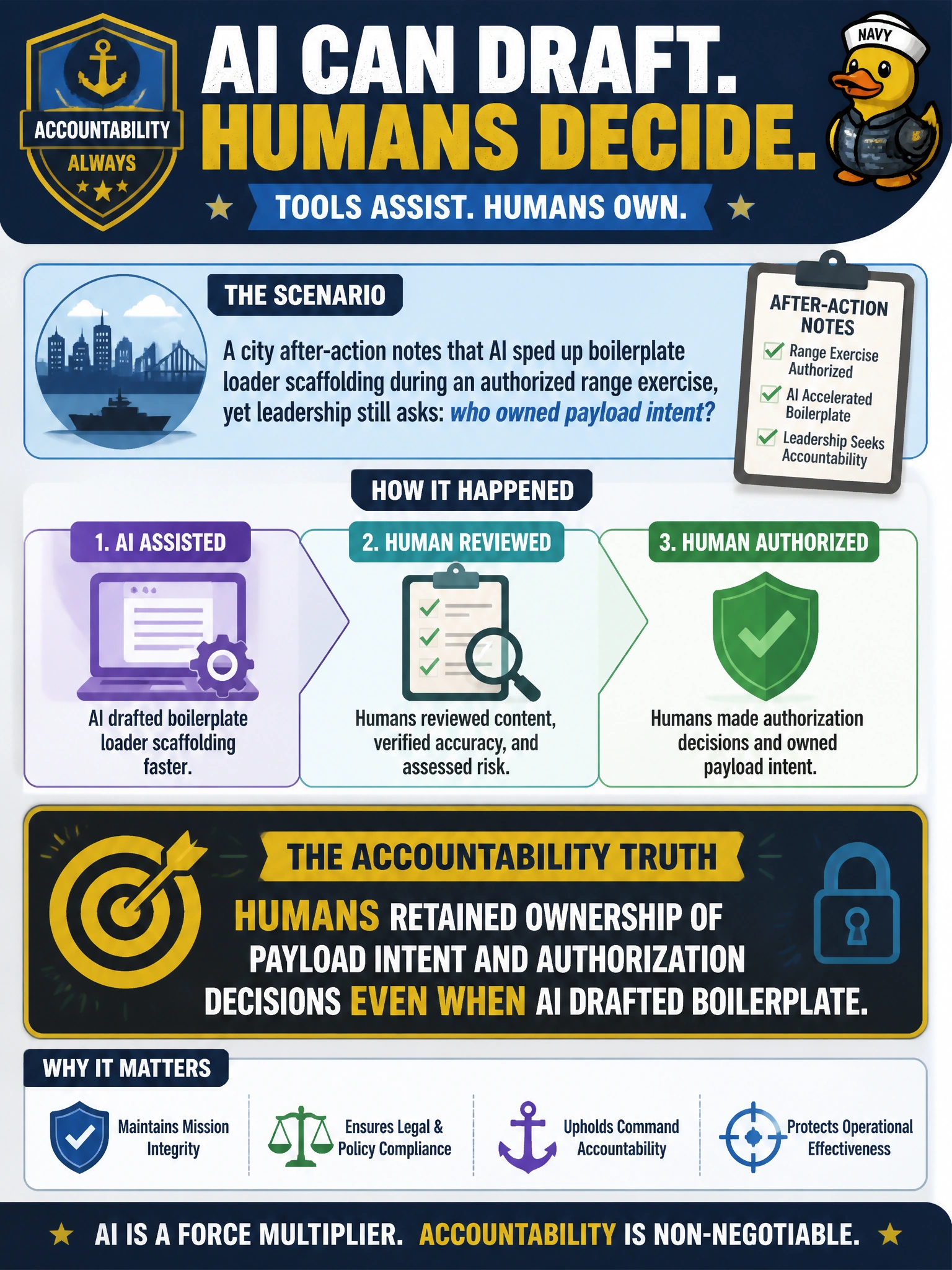
A city after-action notes that AI sped up boilerplate loader scaffolding during an authorized range exercise, yet leadership still asks who owned payload intent. Which accountability statement is correct?
Select an answer to reveal the explanation.
Short Explanation
The LLM can type the boring scaffolding faster than coffee cools, but it does not sign the ROE. People still decide what the sample is for and whether it is allowed. Speed is not a substitute for ownership.
Full Explanation
Even when AI accelerates boilerplate loader scaffolding during an authorized city range exercise, humans retain ownership of payload intent and authorization decisions. Generative drafting can reduce typing time for repetitive stubs, but it does not become the authorizing authority, sign the ROE, define exercise purpose, or decide whether a sample may leave the range. Accountability stays with named municipal personnel who approve scope and accept risk. Treating AI output as authorizing once a senior engineer accepts a generated stub without reading it improperly delegates intent and creates rubber-stamp risk. Shifting accountability to the model vendor whenever generated code compiles on the first try confuses product liability marketing with civic exercise governance. Declaring boilerplate generation always policy-exempt so only novel exploit logic needs a named owner invents a dangerous carve-out: loaders and scaffolding are still payload-adjacent and still require ownership under municipal offensive-lab policy. Exam caveat: GOAA emphasizes human accountability for AI-assisted offensive artifacts in civic labs; speed and compile success are not substitutes for authorized intent. Operational check: after-action notes should name the human owner of payload intent, cite the ROE ticket, and record that AI was used only as a drafting aid under review—not as an authorizing actor.