
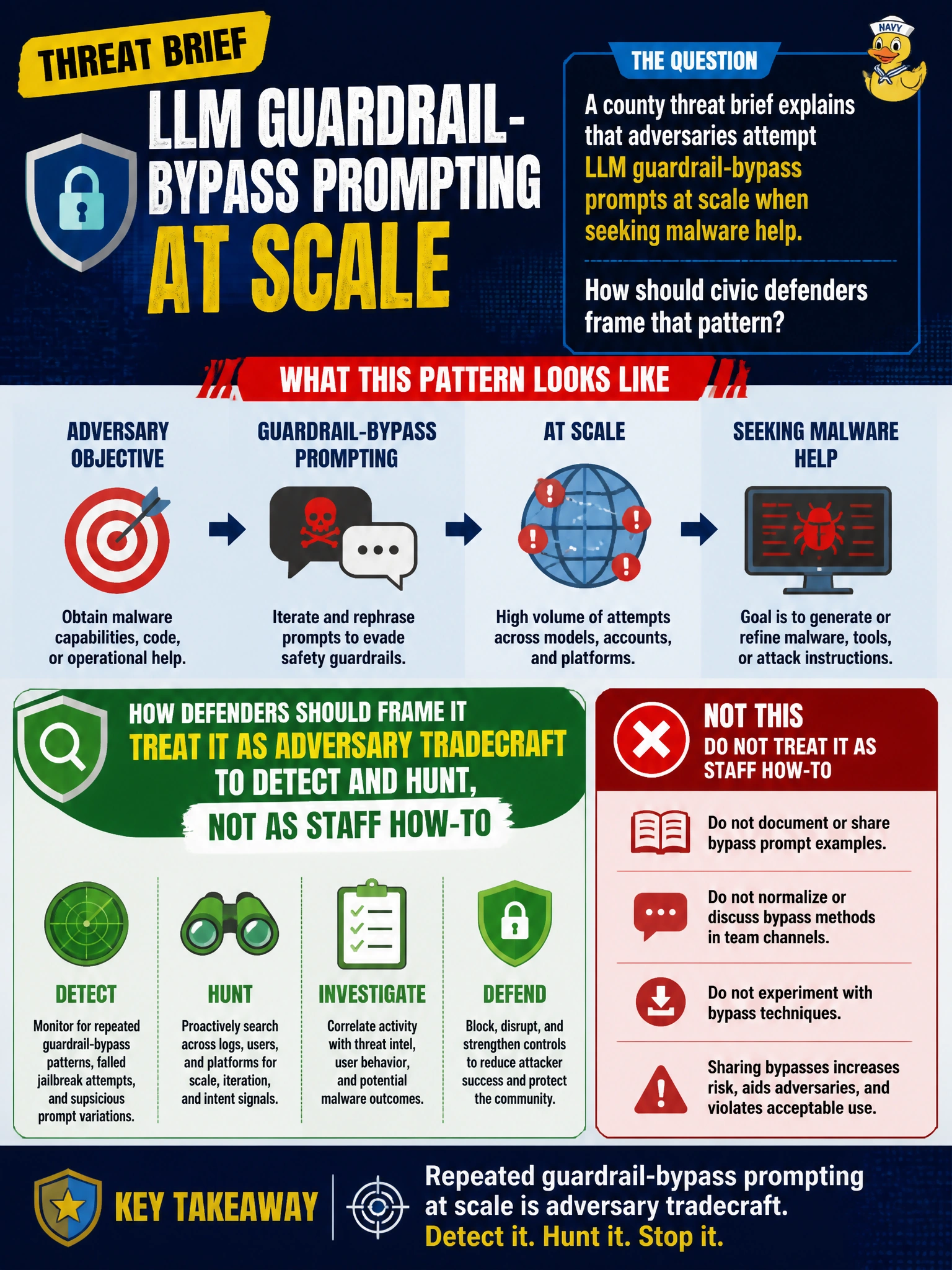
A county threat brief explains that adversaries attempt LLM guardrail-bypass prompts at scale when seeking malware help. How should civic defenders frame that pattern?
Select an answer to reveal the explanation.
Short Explanation
When crooks keep poking the chatbot’s ‘nope’ button with clever role-play, that poking itself is the TTP. Teach SOC folks to spot the pattern. Do not hand out a jailbreak cookbook labeled as training.
Full Explanation
When adversaries repeatedly attempt LLM guardrail-bypass prompts at scale while seeking malware assistance, civic defenders should frame that pattern as adversary tradecraft—something to detect, hunt, and brief—not as a staff how-to for jailbreaking models. The repeated probing, role-play framing, and iterative rephrasing around refusals are themselves TTPs that SOC and threat teams can watch for in telemetry, proxy logs, and threat intelligence. Publishing a public recipe book of the most effective jailbreak phrasings for staff curiosity converts defensive awareness into an offensive cookbook and creates unnecessary risk of misuse inside the municipality. Ignoring guardrail-bypass chatter because municipal AI use policies supposedly never apply to outside attackers misunderstands the brief: the county still needs to recognize the TTP even when the attacker is external, and staff misuse of the same techniques remains a policy concern. Assuming every refused malware request proves a public LLM is permanently safe for offensive labs over-reads a single control behavior and ignores that models, policies, and bypass techniques change over time. Exam caveat: GOAA civic framing emphasizes recognition and detection of AI-enabled adversary techniques rather than teaching students to become more effective jailbreak operators. Operational check: fold guardrail-bypass patterns into the county threat brief and detection use cases; train staff that such chatter is indicator material; keep any authorized lab exploration behind ROE and isolation without distributing bypass cookbooks.