
A fusion center brief explains why Windows Defender sometimes misses a municipal malware sample. Which distinction should analysts draw?
Select an answer to reveal the explanation.
Short Explanation
Hiding a payload in bubble wrap is not the same as inventing a brand-new lock pick. Packing and obfuscation muddy signatures; zero-days are a different animal. Brief the difference so leadership does not overreact or underreact.
Full Explanation
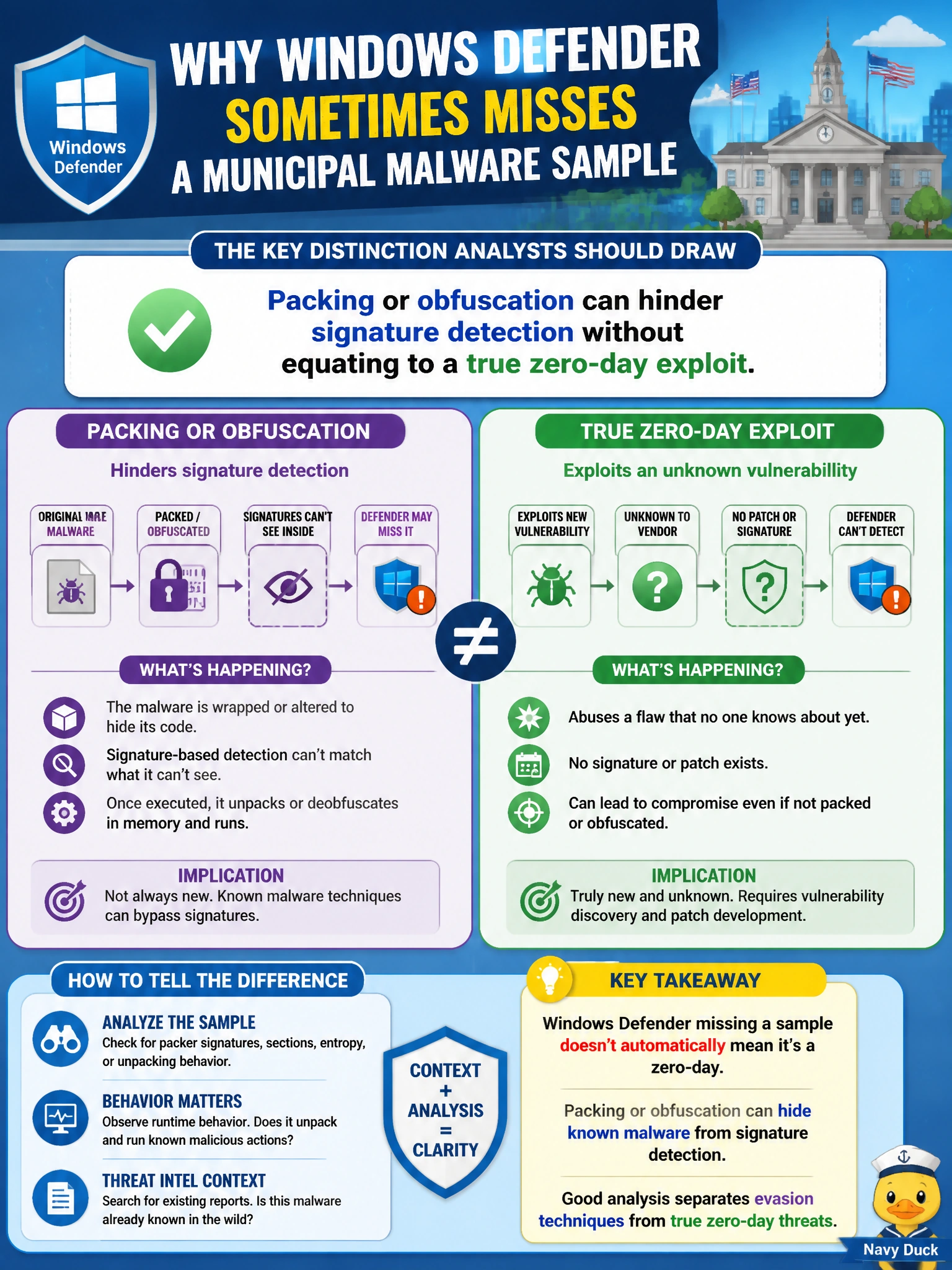
Fusion-center analysts explaining Defender misses on a municipal malware sample should distinguish that packing or obfuscation can hinder signature detection without equating to a true zero-day exploit. Obfuscation and packing are evasion techniques that reduce static or signature effectiveness while the underlying vulnerability story—if any—may be entirely separate. Clear taxonomy keeps remediation, intel reporting, and leadership communication accurate so cities neither underreact to evasion nor overclaim exotic zero-day narratives without evidence.
Every Defender miss does not prove a brand-new zero-day vulnerability was exploited; many misses involve known families that are packed, obfuscated, or simply not yet classified. Packing and obfuscation are not identical to remote code execution against the kernel. Defender misses do not occur only when an endpoint is offline from Microsoft Update forever, though outdated signatures can contribute to detection gaps.
Exam caveat: separate evasion (packing/obfuscation) from exploitation (zero-day) and from update-hygiene issues; exam distractors often collapse these categories.
Operational check for fusion centers: report whether a miss involved packing, obfuscation, configuration gaps, or confirmed exploit novelty; recommend layered behavioral detections; verify update and cloud-protection health on municipal endpoints; and brief leadership with precise language that avoids zero-day inflation.