
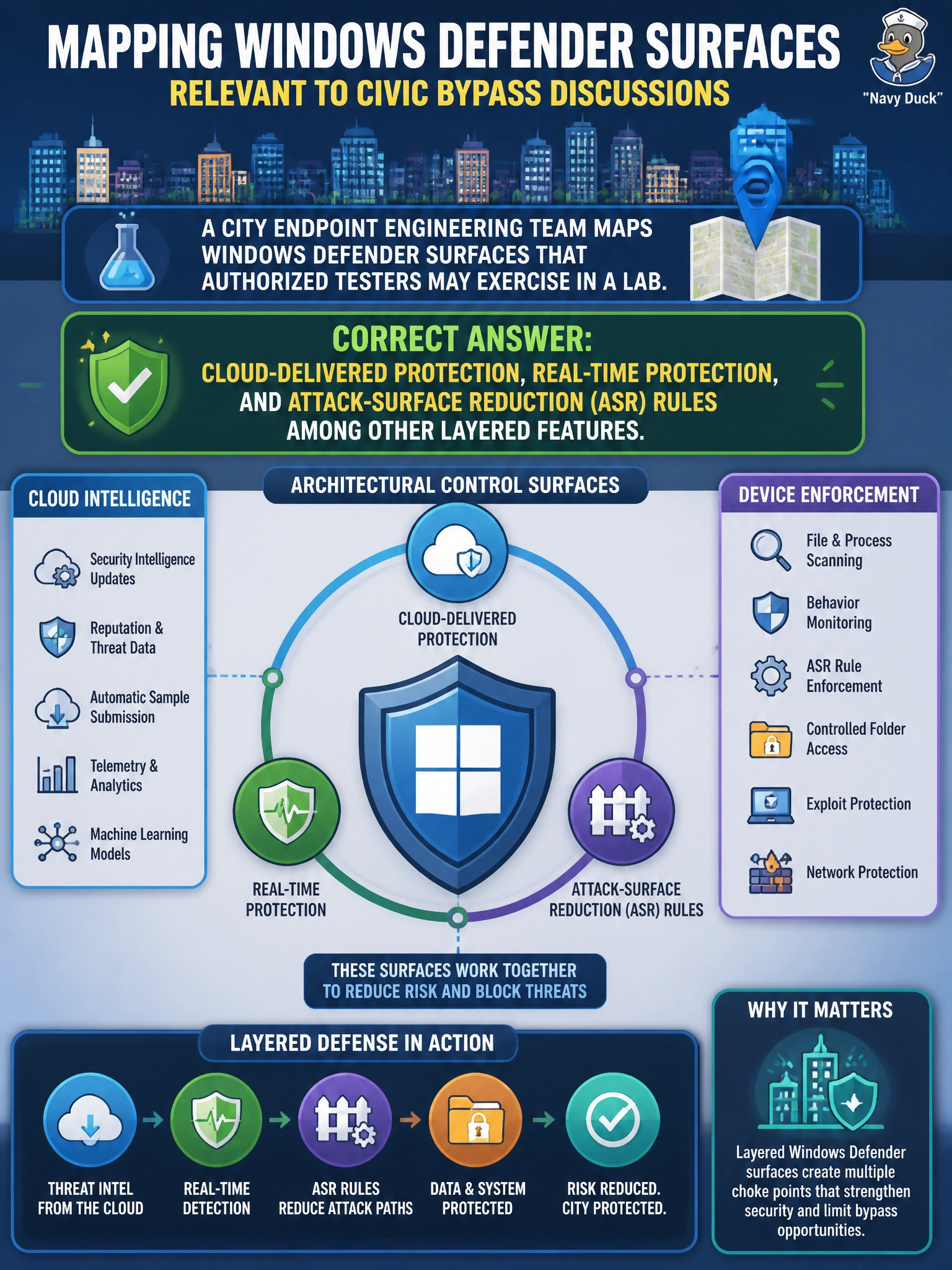
A city endpoint engineering team maps Windows Defender surfaces that authorized testers may exercise in a lab. Which set best reflects architectural control surfaces relevant to civic bypass discussions?
Select an answer to reveal the explanation.
Short Explanation
When testers talk Defender, they mean the living layers—cloud smarts, real-time scanning, ASR rules—not the wallpaper picker. Mapping those surfaces keeps lab tests honest about what production actually runs. Name the controls; do not invent exotic side quests.
Full Explanation
City endpoint engineering teams mapping Windows Defender surfaces for authorized lab testing should inventory layered features such as cloud-delivered protection, real-time protection, and attack-surface reduction (ASR) rules, among other controls. Those surfaces define what purple-team evasion validation can meaningfully exercise and what production civic endpoints actually rely on. Accurate architecture maps keep bypass discussions honest and prevent tests from measuring irrelevant cosmetic settings.
The desktop wallpaper service and theme engine are not Defender control surfaces for bypass discussions. Print Spooler banner text configuration is unrelated to antivirus architecture mapping. BitLocker PIN length alone, without real-time scanning components, addresses disk encryption authentication strength—not the Defender layered protections testers need to understand for civic bypass validation.
Exam caveat: pick the set that names real Defender layers (cloud, real-time, ASR), not OS cosmetics or single unrelated features.
Operational check for endpoint engineering: document lab vs production Defender feature parity; enable ASR and cloud protection where policy allows; scope purple tests to inventoried surfaces; and report gaps against those layers rather than against wallpaper or banner trivia.