
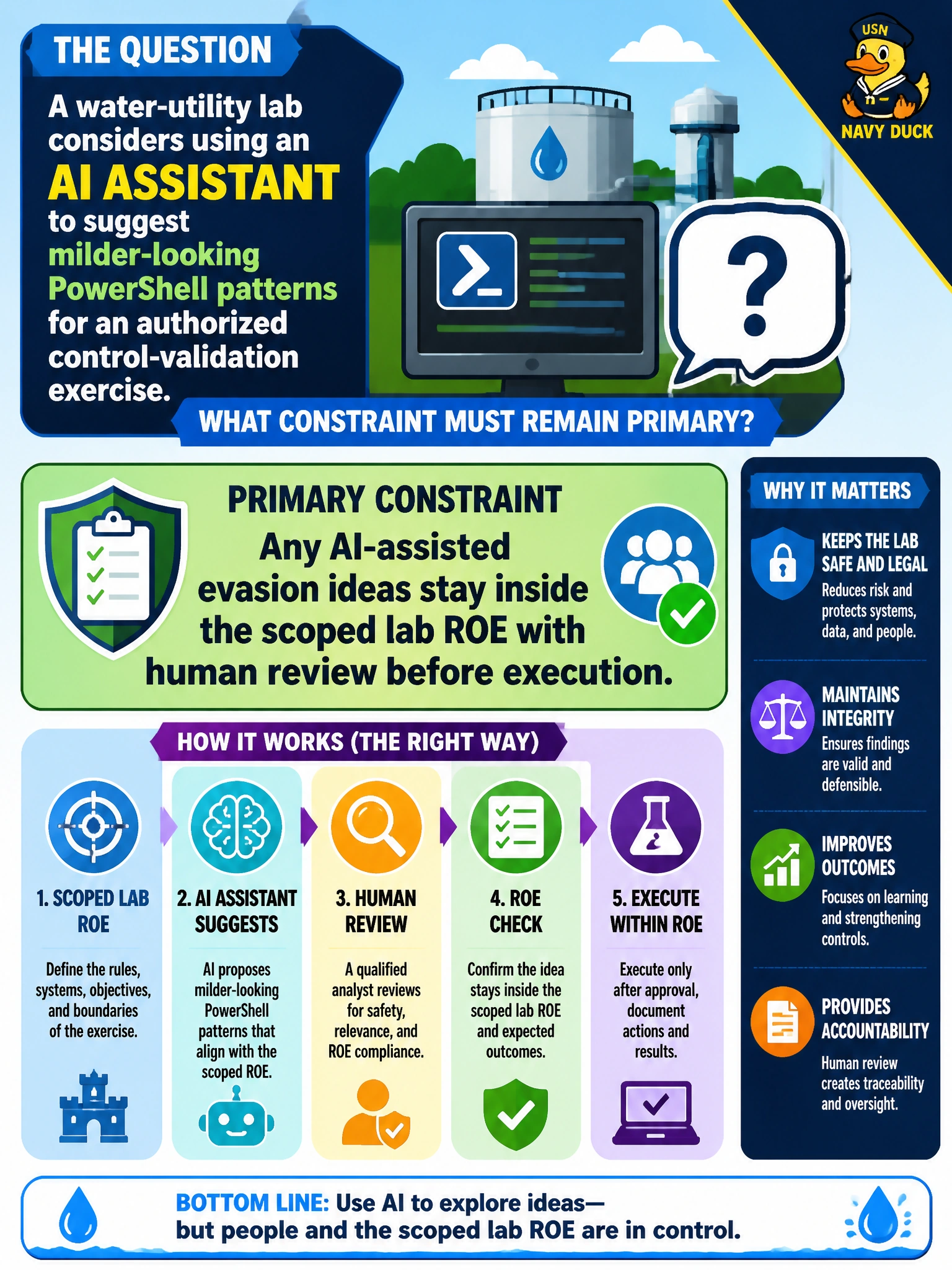
A water-utility lab considers using an AI assistant to suggest milder-looking PowerShell patterns for an authorized control-validation exercise. What constraint must remain primary?
Select an answer to reveal the explanation.
Short Explanation
AI can brainstorm bland-looking scripts, but the water plant is not a sandbox for unchecked ideas. Keep every suggestion inside the written ROE and make a human sign off before anything runs. Production OT and public chat leaks are off-limits.
Full Explanation
When a water-utility lab considers using an AI assistant to suggest milder-looking PowerShell patterns for authorized control validation, the primary constraint is that any AI-assisted evasion ideas stay inside the scoped lab rules of engagement with human review before execution. AI can accelerate drafting of test patterns that probe defensive controls, but civic utility testing remains governed by isolation, written scope, and accountable human approval. Unsupervised offensive automation against OT-adjacent environments is unacceptable.
Running AI suggestions directly on production SCADA jump hosts without review violates isolation and change control and can endanger water operations. Pasting live Defender exclusion lists into public AI chats leaks sensitive defensive configuration and can expose municipal weaknesses. Treating ROE as optional to accelerate purple-team scheduling subordinates safety and legality to convenience.
Exam caveat: AI-assisted testing questions almost always hinge on ROE, human review, and production isolation—not speed.
Operational check for water utilities: keep AI ideation in approved tools and logged sessions; require human review before any lab execution; never paste production exclusions or OT network details into public models; confine tests to isolated ranges; and document that ROE remains mandatory even when AI shortens drafting time.