
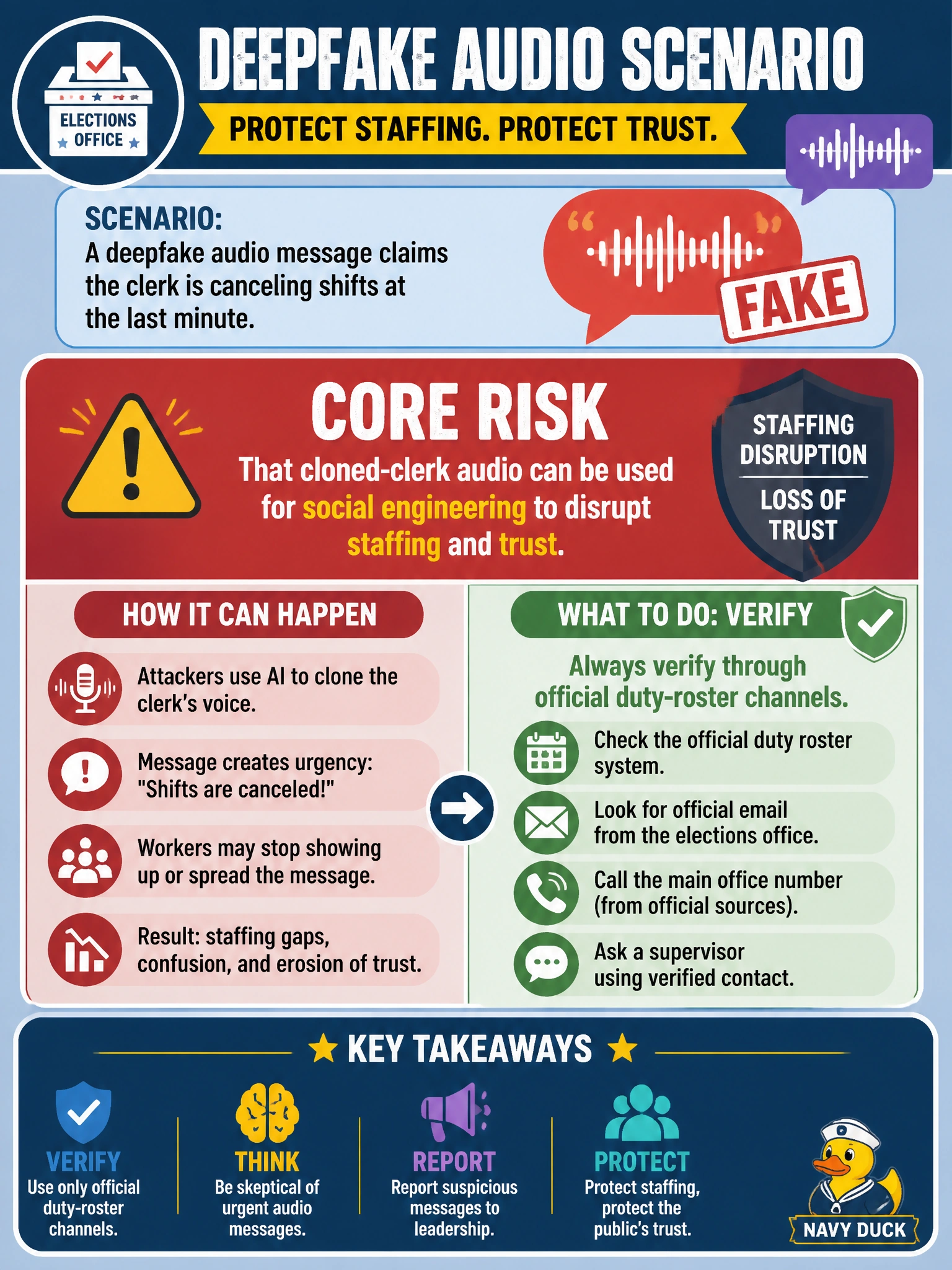
A county elections office prepares poll-worker supervisors for a scenario where a deepfake audio message claims the clerk is canceling shifts at the last minute. What should staff treat as the core risk?
Select an answer to reveal the explanation.
Short Explanation
A fake cancelation call is sabotage dressed up as a familiar voice. Poll staffing chaos is the prize, not a clever audio demo. Confirm shifts on the official roster channel before anyone stays home.
Full Explanation
For county elections offices preparing poll-worker supervisors, the core risk of a deepfake audio message claiming the clerk is canceling shifts at the last minute is social engineering that can disrupt staffing and public trust. Cloned-clerk audio can convince workers to stay home or abandon posts, creating operational chaos and credibility damage even when ballots and paper processes remain intact. Staff must verify cancelation claims through official duty-roster channels before changing election-week assignments.
Claiming deepfake audio cannot affect election operations because polls are paper-only ignores human staffing and trust as attack surfaces. Treating any cancelation that uses the clerk's first name as automatically authentic is unsafe under voice-clone threat models. Ignoring all communications from the clerk's office on election week is operationally harmful; the correct posture is verify-through-official-channels, not total communications blackout.
Exam caveat: election deepfake items frequently target process disruption and trust, not necessarily ballot-tabulation software. Staffing social engineering is a valid civic impact path.
Operational check for elections supervisors: maintain authenticated roster channels; require dual confirmation for last-minute cancelations; brief poll workers that familiar voices can be forged; preserve suspected audio for investigation; and coordinate public messaging so rumor of mass cancelations does not spread unverified.