
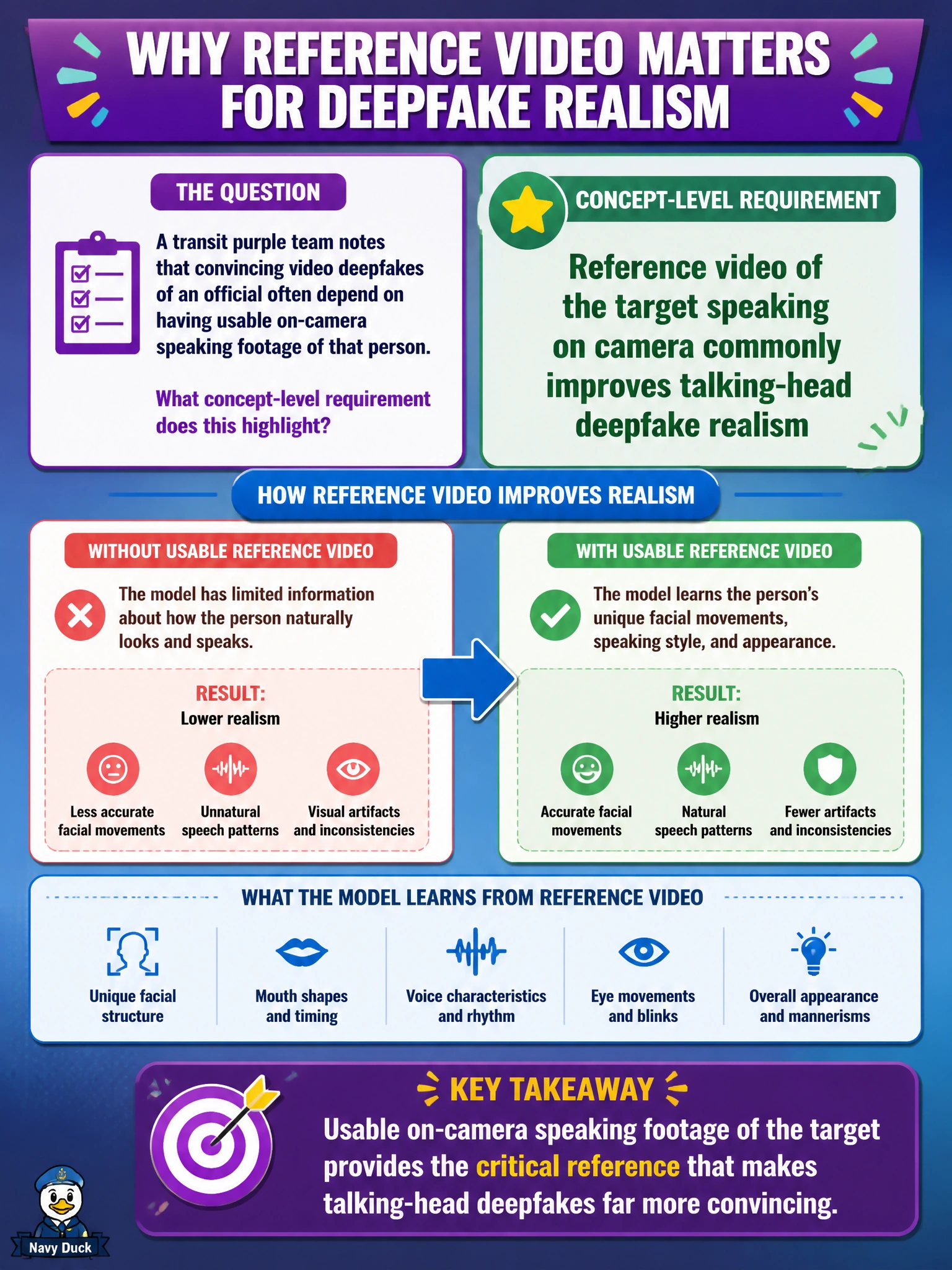
A transit purple team notes that convincing video deepfakes of an official often depend on having usable on-camera speaking footage of that person. What concept-level requirement does this highlight?
Select an answer to reveal the explanation.
Short Explanation
You cannot convincingly puppet someone on video if you have never seen how they move and talk on camera. Reference footage is the raw clay for talking-head fakes. Job titles alone do not animate a face.
Full Explanation
Transit purple-team observations that convincing video deepfakes of an official often depend on usable on-camera speaking footage highlight a concept-level requirement: reference video of the target speaking commonly improves talking-head deepfake realism. Mouth motion, head movement, lighting, and speech-correlated facial dynamics are learned or driven from available media. Job title alone does not animate a face; physical Secure Enclave access is not the typical prerequisite discussed at this concept level; and handwritten signatures do not supply talking-head motion data.
Requiring physical access to an official's smartphone Secure Enclave misstates how most talking-head pipelines work and overfits to device compromise narratives. Claiming only handwritten signatures are needed confuses document forgery with video reenactment. Asserting that reference media is irrelevant once an attacker knows a job title ignores the media-dependence of high-realism video deepfakes.
Exam caveat: many items separate identity knowledge from media availability. Realism for talking-head fakes tracks reference footage quality and quantity more than title familiarity.
Operational check for transit and municipal communications teams: reduce unnecessary high-quality speaking footage exposure where policy allows; watermark and monitor official video distribution; train staff that viral clips of leaders can become training fuel for forgeries; and verify unexpected 'director on camera' directives through known-good channels regardless of visual polish.