
A city CISO asks awareness trainers whether GAN-based face generation differs from simple Photoshop compositing when explaining synthetic-identity risk to clerk staff. What distinction is most accurate?
Select an answer to reveal the explanation.
Short Explanation
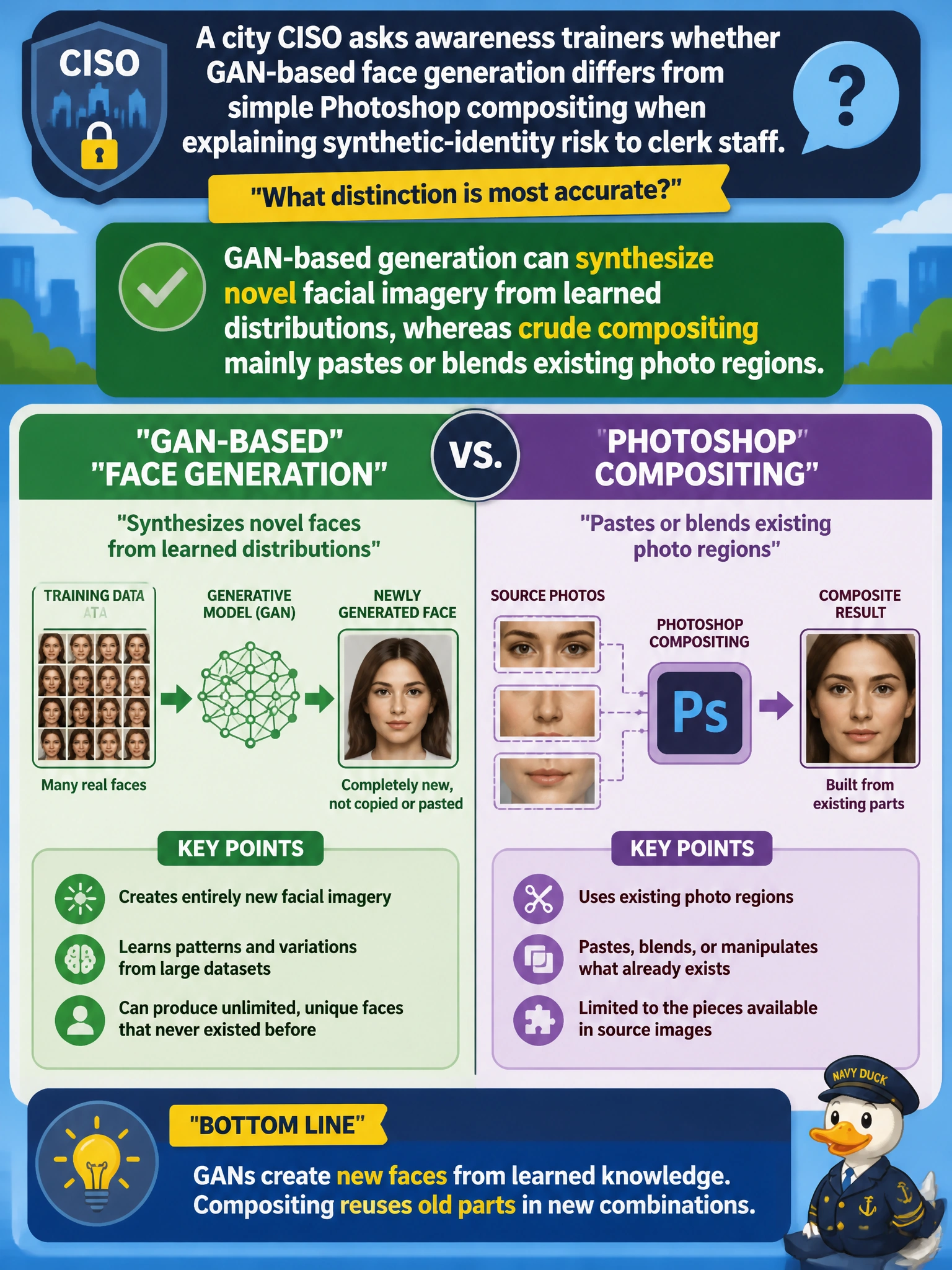
Old-school cut-and-paste edits rearrange real pixels; GANs can dream up a face that never sat for a photo. Clerk staff need both concepts, but the generative path is why 'looks real' stopped meaning 'is real.' Awareness fidelity improves when trainers name that difference.
Full Explanation
When a city CISO asks awareness trainers how GAN-based face generation differs from simple Photoshop compositing for synthetic-identity risk, the accurate distinction is that GAN-based generation can synthesize novel facial imagery from learned distributions, whereas crude compositing mainly pastes or blends existing photo regions. Clerk staff need both concepts, but generative models explain why a face can look photographic without corresponding to a real enrolled person. Training fidelity improves when awareness modules name that generative path instead of treating all fake faces as cut-and-paste edits.
Saying Photoshop compositing and GANs are legally identical techniques with no training difference collapses useful technical distinctions that help staff understand modern synthetic identity. Claiming GANs only produce audio waveforms and cannot create faces is factually wrong; GANs are widely associated with image synthesis. Asserting that Photoshop always detects deepfakes automatically and that compositing risk is obsolete misstates tooling and leaves residual compositing fraud unexplained.
Exam caveat: awareness questions often contrast classical editing with generative synthesis. Pick the conceptual difference—novel generation versus region pasting—not a legal sameness claim or an audio-only myth.
Operational check for municipal trainers: use approved examples with disclosure; explain that 'looks real' is not 'is real' for clerk identity checks; keep demos consented and policy-compliant; and route suspected synthetic identity cases to verification procedures rather than visual intuition alone.