
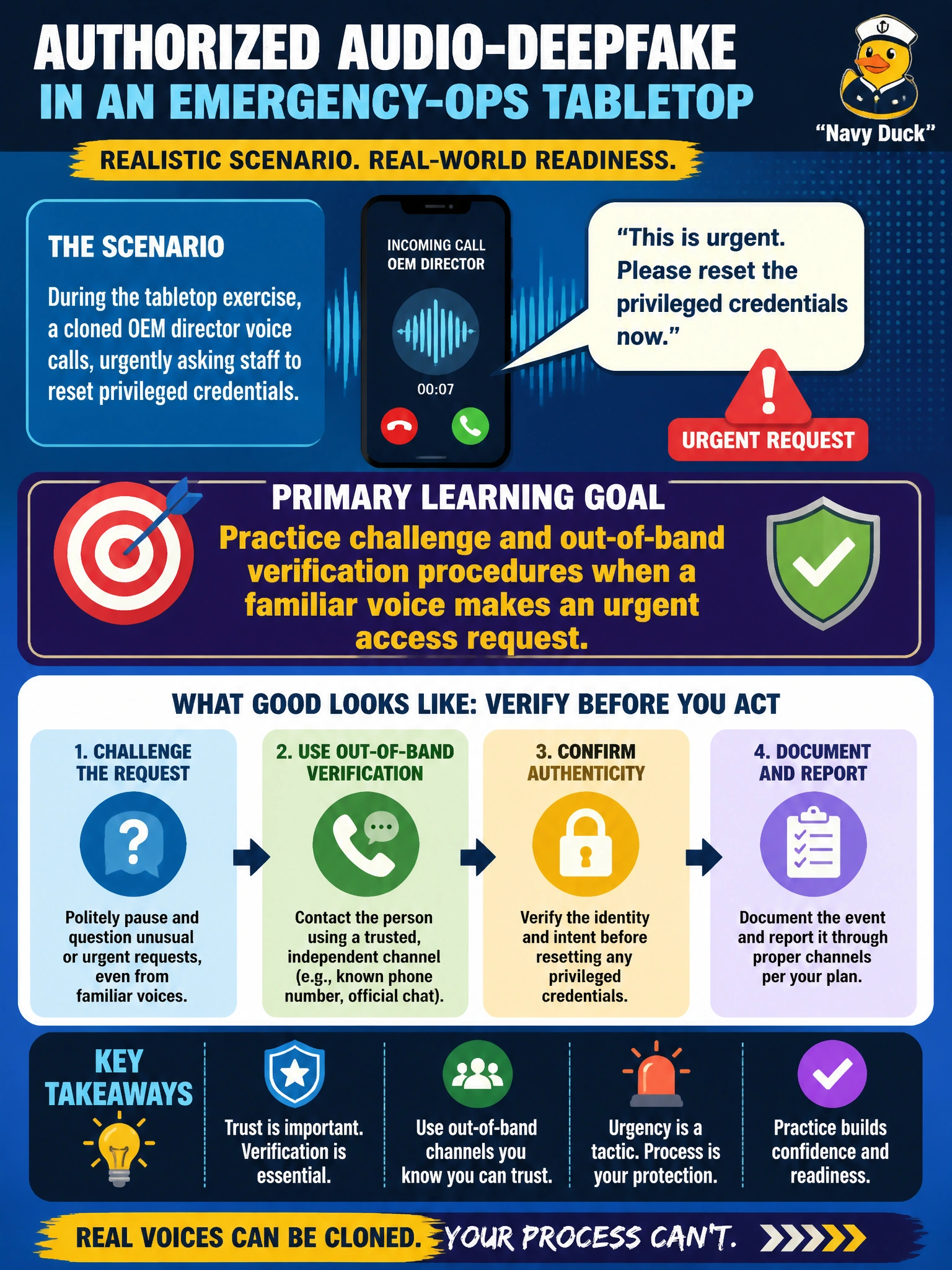
An emergency-ops tabletop uses a cloned OEM director voice that calls asking staff to reset privileged credentials. What is the primary learning goal of that authorized audio-deepfake element?
Select an answer to reveal the explanation.
Short Explanation
This drill helps you slow down when a familiar voice makes an urgent request for privileged access. Challenge and verify out of band on a known-good channel; stress is never a reason to drop MFA.
Full Explanation
An emergency-operations tabletop using a cloned OEM director voice to request a privileged credential reset teaches staff to challenge the caller and verify the request out of band. The authorized deepfake simulates a high-pressure social-engineering attempt so you practice slowing down, refusing credential changes based on voice alone, and confirming through known-good channels while preserving MFA. The goal is defensive behavior under voice-clone pressure, not producing better forgeries. Bypassing MFA when an executive sounds distressed teaches the opposite of resilient access control and increases the risk of municipal compromise. Publishing the clone sample on social media can expose training artifacts, confuse the public, and enable secondary misuse. Replacing OEM phone trees with unauthenticated chatbots removes verification structure rather than strengthening it. Exam caveat: authorized deepfake drills typically test verification culture and MFA discipline, not whether urgency justifies trusting a voice or weakening controls. Practical check: define challenge phrases and callback rosters before drills, keep clones within the rules of engagement and labeled training environments, never disable MFA because a voice sounds stressed, and measure success by correct verification actions rather than by how many people were fooled without recovery coaching.