
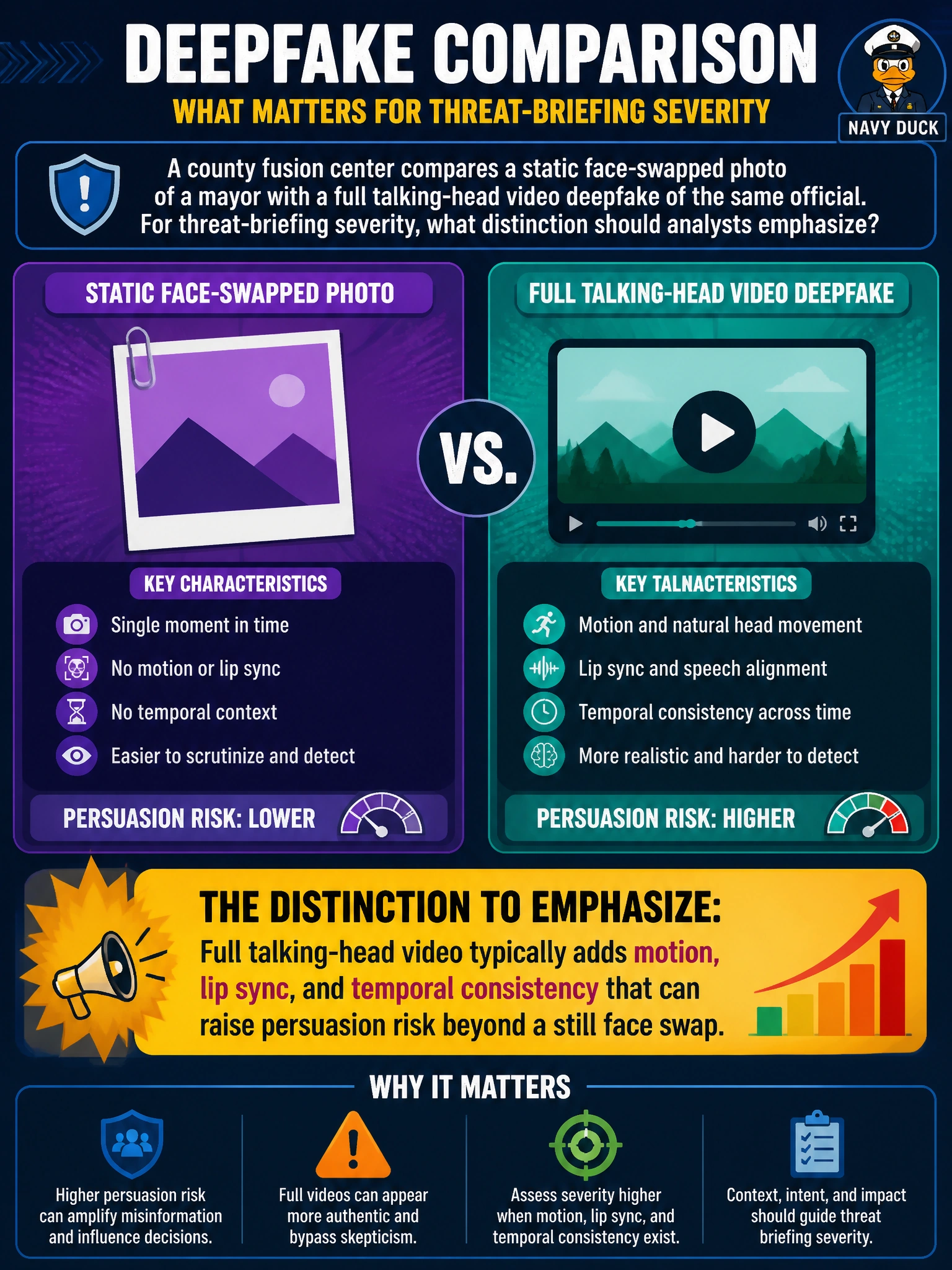
A county fusion center compares a static face-swapped photo of a mayor with a full talking-head video deepfake of the same official. For threat-briefing severity, what distinction should analysts emphasize?
Select an answer to reveal the explanation.
Short Explanation
A swapped still is a fake ID photo; a talking-head clip is a fake news segment—both bad, but the moving one usually packs more punch. Analysts should brief that video adds lip sync and motion cues that boost persuasion. Severity tracking should separate still-image from full video cases.
Full Explanation
For county fusion-center threat briefings, analysts should emphasize that a full talking-head video deepfake of a mayor typically adds motion, lip synchronization, and temporal consistency that can raise persuasion risk beyond a static face-swapped photo. Both artifacts misuse likeness, but video often packs stronger credibility cues for residents and staff because it resembles familiar news or press-briefing formats. Accurate modality classification helps responders choose verification steps, public-communications playbooks, and severity framing without treating every likeness forgery as identical.
Claiming static face swaps always require more compute than full video pipelines is not a reliable severity distinction and often reverses typical complexity expectations. Asserting that talking-head video cannot be used for social engineering is false; video deepfakes are frequently used for persuasion and impersonation. Treating both modalities as identical in sophistication and civic impact erases useful triage differences that fusion centers need when briefing leadership.
Exam caveat: related does not mean equivalent. Severity and playbook routing often hinge on whether the artifact is still image versus motion video with lip sync.
Operational check for fusion centers: tag incidents by modality (still vs video); escalate high-visibility talking-head forgeries affecting mayoral trust with public-affairs coordination; verify claims through official channels before amplifying; and brief that still swaps remain serious for documents and badges even when video usually carries higher mass-persuasion risk.