
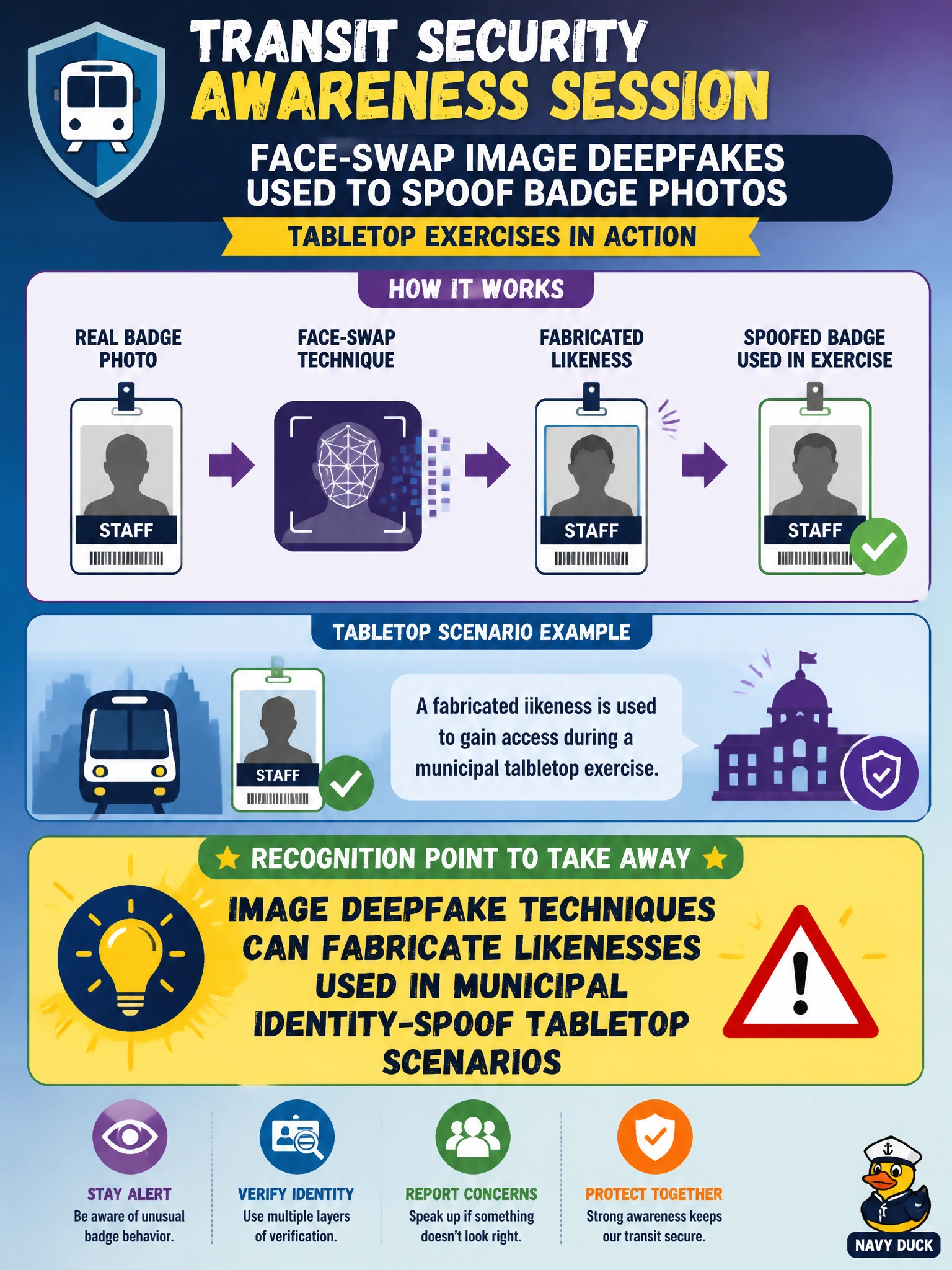
A transit security awareness session shows face-swap image deepfakes used to spoof badge photos in tabletop exercises. Which recognition point should staff take away?
Select an answer to reveal the explanation.
Short Explanation
A face-swapped badge photo is the digital cousin of a fake ID at the turnstile. Transit staff should recognize image deepfakes as an identity-spoof medium—not wave them off as ‘just a funny meme.’
Full Explanation
A transit security awareness session showing face-swap image deepfakes used to spoof badge photos in tabletop exercises should leave staff with the recognition that image deepfake techniques can fabricate likenesses used in municipal identity-spoof tabletop scenarios. A face-swapped badge photo is the digital cousin of a fake ID at the turnstile; staff must treat the medium as identity-spoof risk, not a harmless meme.
Asserting badge photos can never be forged by any digital means in municipal systems is a false absolute that awareness training exists to dismantle. Saying face-swap images only affect radio frequencies on bus yard repeaters relocates the issue to RF engineering incorrectly. Treating image deepfakes as identical to network port scans for triage confuses media forgery with scanning events and drives the wrong playbook.
Exam caveat: face-swap badge spoofs → image deepfake identity risk; “never forgeable,” RF-only, and port-scan triage are wrong takeaways.
Operational check: include image-deepfake badge spoofs in transit tabletops, require secondary identity checks at sensitive access points, train guards and SOC analysts to escalate suspicious credential imagery under an identity-spoof category—not as scanning noise—and keep exercise images clearly watermarked as training artifacts.