
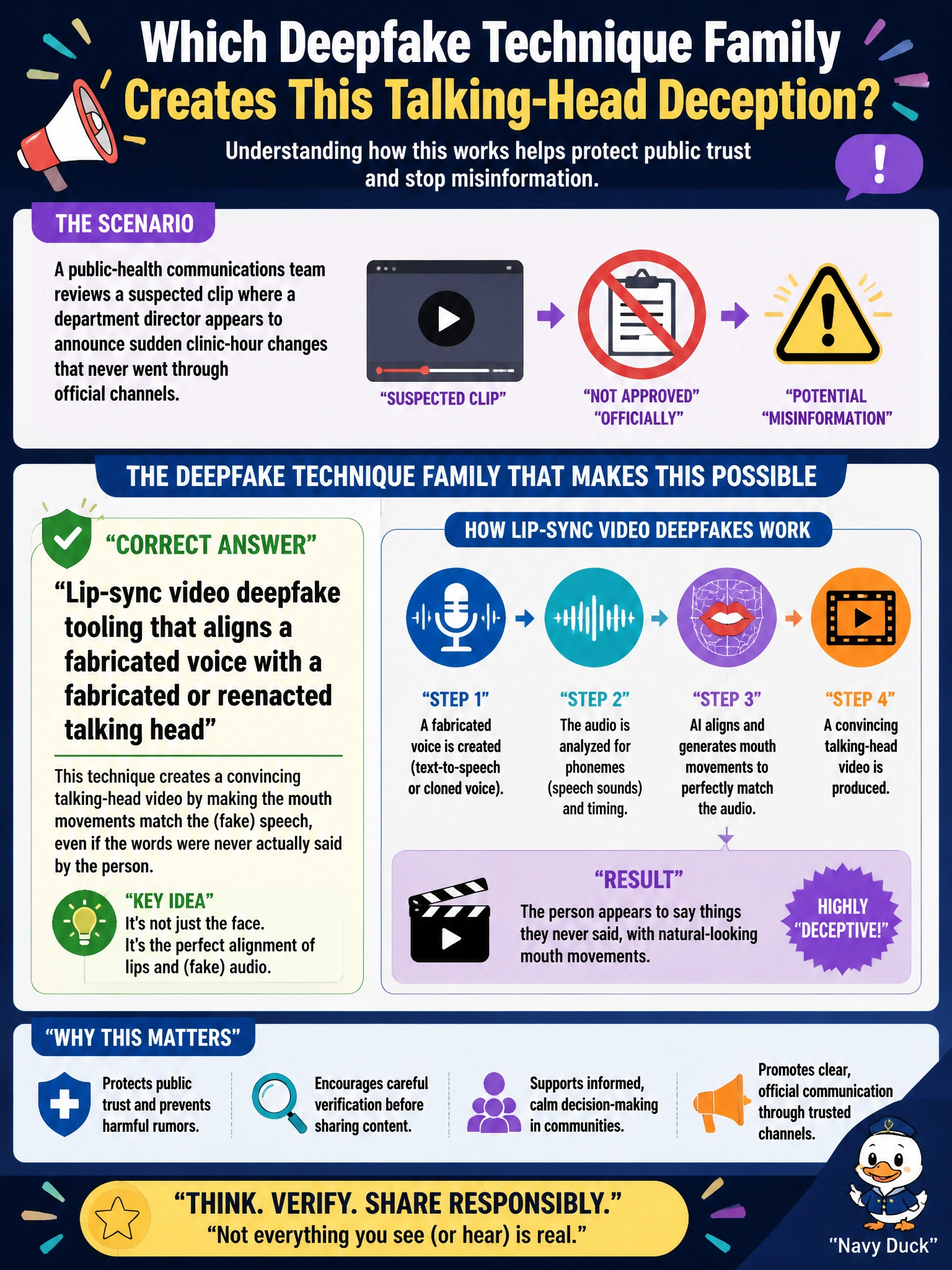
A public-health communications team reviews a suspected clip where a department director appears to announce sudden clinic-hour changes that never went through official channels. Which deepfake technique family most directly enables that talking-head deception?
Select an answer to reveal the explanation.
Short Explanation
Think of a puppet whose mouth is glued to someone else's soundtrack—that is lip-sync video deepfake risk in a nutshell. Clinic-hour announcements that look like the director speaking on camera are classic talking-head deception, not a still photo swap or an SMS replay. Staff should treat sudden on-camera policy claims as verify-first events.
Full Explanation
Lip-sync and related talking-head video deepfake pipelines are the technique family that most directly enables a fabricated clinic-hour announcement that appears to show a public-health director speaking on camera. These tools align attacker-chosen audio with fabricated or reenacted facial and mouth motion so the clip presents as a coherent visual statement from a trusted civic official. For residents and front-line staff, synchronized lip motion and talking-head framing raise credibility far above an unlabeled audio clip or a still flyer, which is why sudden policy claims delivered as on-camera video demand immediate verification through official public-health channels before hours, staffing, or clinic access change.
Audio-only voice cloning without synchronized mouth motion can impersonate the director by phone or voicemail, but it does not produce the talking-head video artifact described in the stem. Static badge-photo face swaps support still forgeries such as flyers or ID images; they lack temporal lip sync and do not explain a moving announcement clip. Network packet replay of an emergency SMS gateway is a messaging-control-plane issue and does not create a director talking-head visual at all.
Exam caveat: modality classification matters. Questions often tempt candidates to pick any 'deepfake' answer or any 'city communications' answer; the stem here is specifically a video talking-head deception, so the correct family is lip-sync or talking-head video tooling, not adjacent audio or still-image techniques.
Operational check for municipal public-health teams: treat unexpected on-camera director announcements as verify-first events; confirm through known-good duty phones, authenticated portals, or published official schedules; preserve the clip for analysis; and avoid amplifying unverified hours changes to the public until authentication succeeds.