
A municipal SOC compares token-prediction chat models with discriminative classifiers used for malware-family labels. Which contrast is correct?
Select an answer to reveal the explanation.
Short Explanation
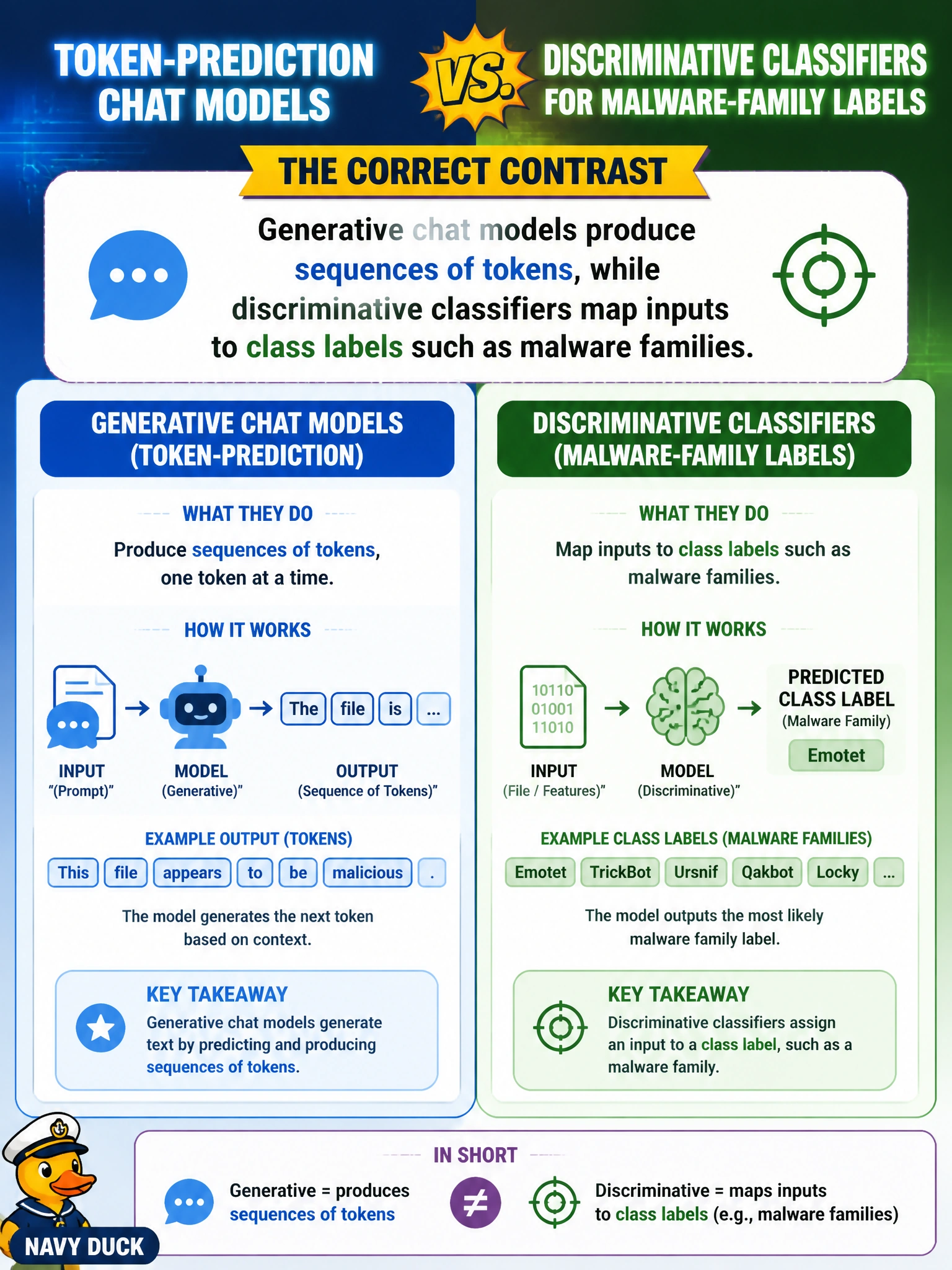
The chat model is a storyteller predicting the next word; the malware classifier is a sorting hat that stamps ‘family X.’ Different tools—don’t swap their nameplates on the SOC wall.
Full Explanation
A municipal SOC comparing token-prediction chat models with discriminative classifiers used for malware-family labels should hold that generative chat models produce sequences of tokens, while discriminative classifiers map inputs to class labels such as malware families. Chat models predict fluent text for summarization and assistants; classifiers stamp discrete categories for detection and triage. Different tools belong on different parts of the SOC wall.
Claiming both model types can only output deepfake audio and never text labels invents a media-only limitation that matches neither pattern. Saying discriminative classifiers always require GANs before they can label anything creates a false dependency. Declaring token-prediction models cannot be used in any security operations workflow ignores common SOC uses such as ticket summarization and playbook Q&A under policy.
Exam caveat: generative = token sequences; discriminative = class labels; neither is “deepfake-only,” and classifiers do not require GANs.
Operational check: use classifiers for malware-family and alert labeling where labeled training data exists, use generative models for narrative tasks under AI acceptable-use rules, and avoid swapping nameplates so detection engineering and assistant governance stay correctly scoped.