
A county CIO asks which fundamentals topic covers why vector similarity search can surface ‘near’ but wrong policy passages in a civic RAG system. Which explanation is best?
Select an answer to reveal the explanation.
Short Explanation
Nearest neighbor isn’t the same as “the right ordinance.” The search finds cousins in meaning-space, so governance still needs humans (and good chunking) to catch near-miss policy pulls.
Full Explanation
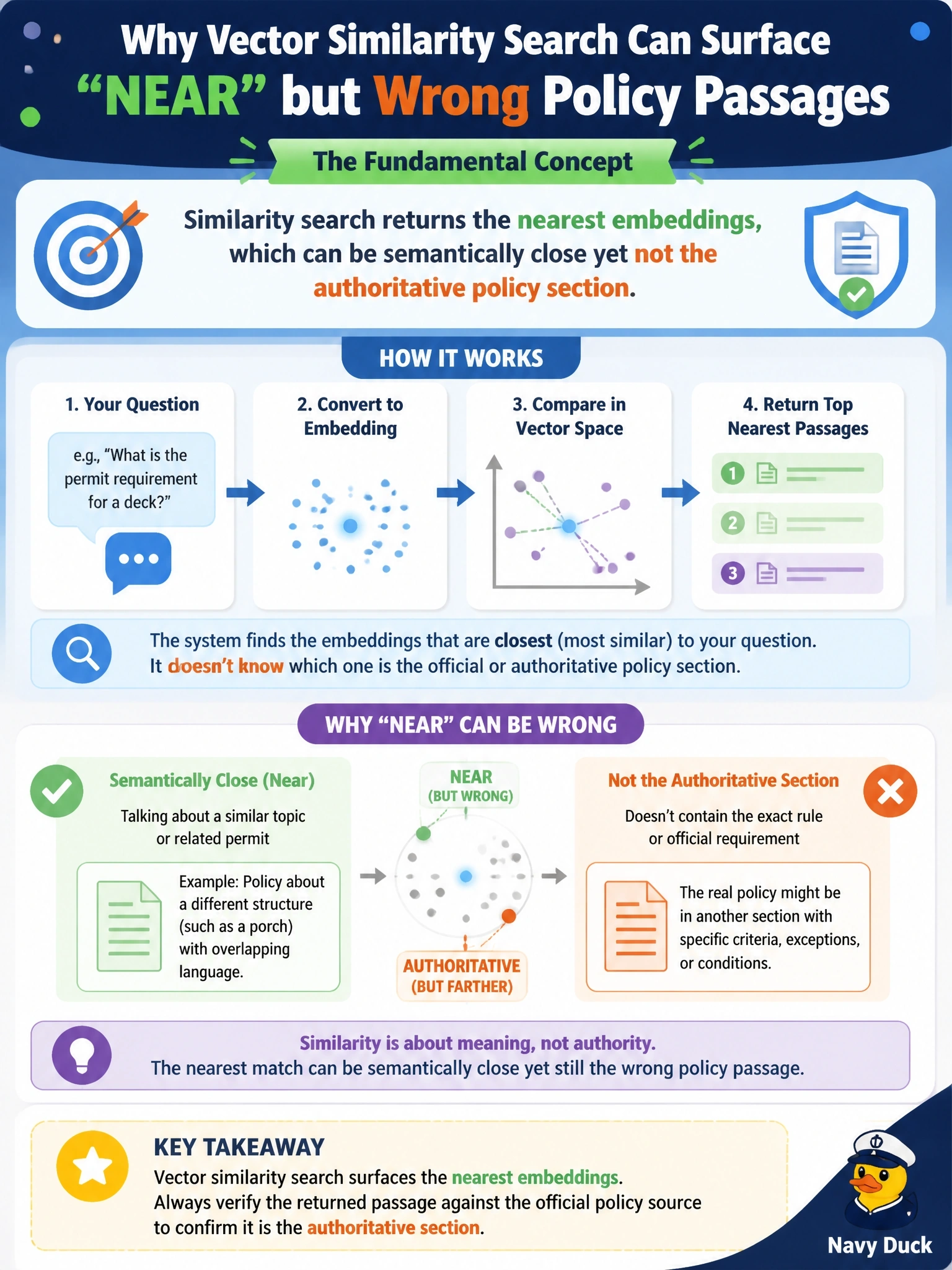
A county information officer asking why vector similarity search can surface “near” but wrong policy passages should understand that similarity search returns the nearest embeddings, which can be semantically close yet not the authoritative policy section. Embedding proximity correlates with meaning relatedness, not guaranteed legal authority. Retrieval-augmented generation error modes include plausible near-misses that still misstate policy—core artificial-intelligence fundamentals content for municipal governance.
The claim that wrong passages prove retrieval-augmented generation never uses embeddings in municipal systems is backward; near-misses happen because embeddings are used. The claim that vector databases always guarantee exact legal citation matches with zero error oversells retrieval as perfect authority matching. The claim that near-miss retrieval only happens when the city disables all domain-name resolvers invents an unrelated networking cause.
Exam caveat: nearest neighbor ≠ correct ordinance; near-miss retrieval is an expected retrieval-augmented generation risk, not proof that embeddings are unused or that domain-name resolution is the root cause.
Operational check: tune chunking and metadata filters (title, effective date, jurisdiction), require human review for policy answers that bind residents or staff, log retrieved passage identifiers for audit, and brief the county information officer that similarity search needs governance overlays—not blind trust in top-1 vector hits.