
A library consortium prototypes RAG over public-meeting minutes and must explain chunking and embeddings to IT governance. Which description is most accurate?
Select an answer to reveal the explanation.
Short Explanation
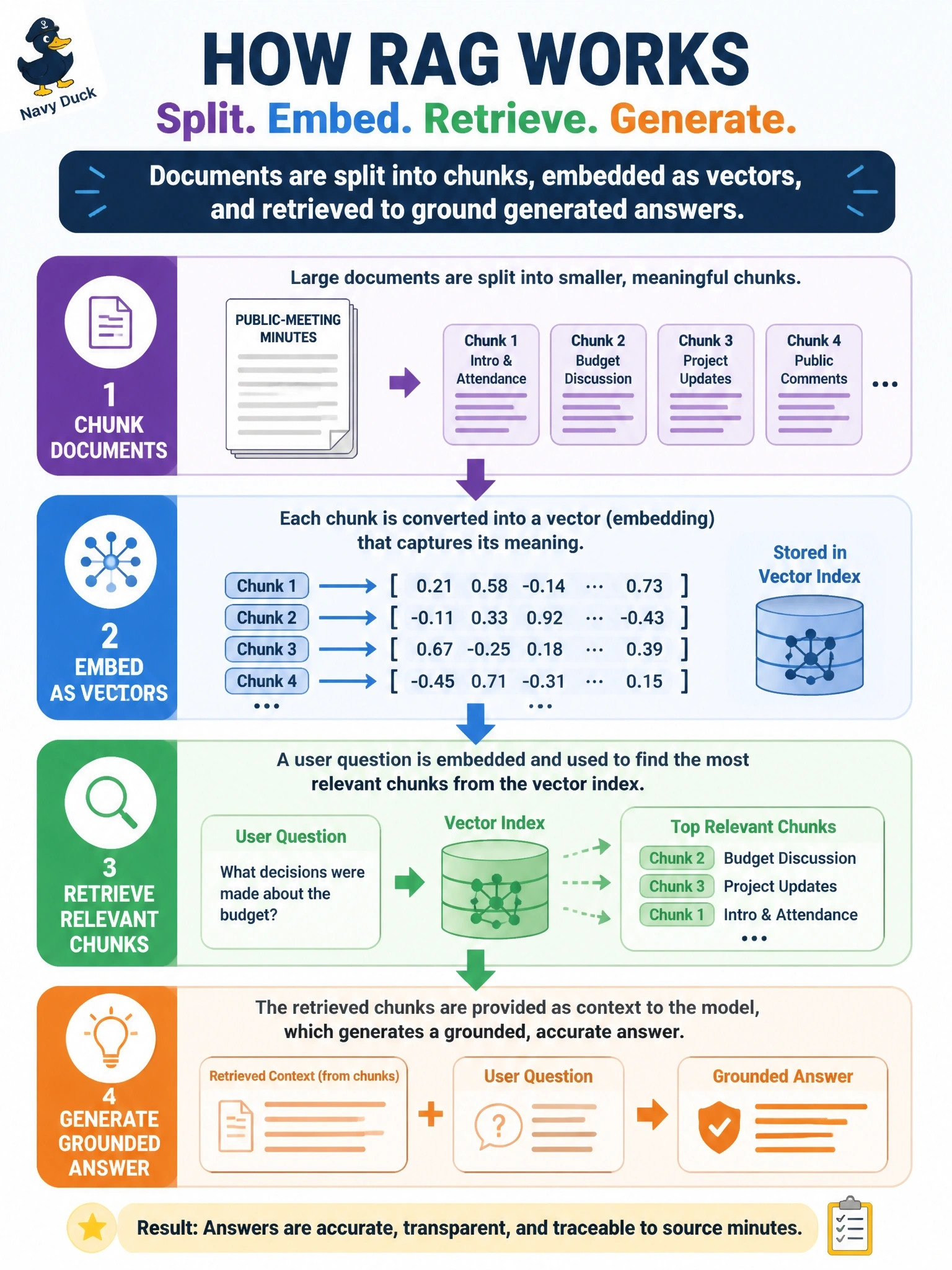
You split the minutes into chunks, turn each chunk into a vector embedding, and retrieve the closest chunks to ground the answer. That's the RAG assembly line IT governance needs to see.
Full Explanation
The accurate description is that documents are split into chunks, embedded as vectors, and retrieved to ground generated answers. Chunking creates manageable passages; embeddings map those passages into vector space; similarity search returns near neighbors that the generator cites. That assembly line is what IT governance needs to understand before approving the pilot. The claim that embeddings convert minutes into bitmap deepfake frames for social media invents a synthetic-media pipeline unrelated to RAG. The claim that chunking deletes all minutes so the model cannot retrieve anything reverses the purpose of chunking. The claim that RAG pipelines only run on air-gapped printers with no software stack is nonsense architecture and not a fundamentals description. Exam caveat: RAG fundamentals = chunk → embed → retrieve → generate; deepfake bitmaps, deleting corpora, and printer-only RAG are distractors. Operational check: define chunk size and overlap for minutes, version embeddings when minutes are corrected, require citation of retrieved segments in answers, keep canonical minutes in the records system, and brief IT governance on retrieval quality metrics, including near-miss risk, before public launch.