
A city threat-intel unit explains that poisoning a model is adversarial ML while AI-written phishing is offensive AI tradecraft. Which statement reinforces that distinction?
Select an answer to reveal the explanation.
Short Explanation
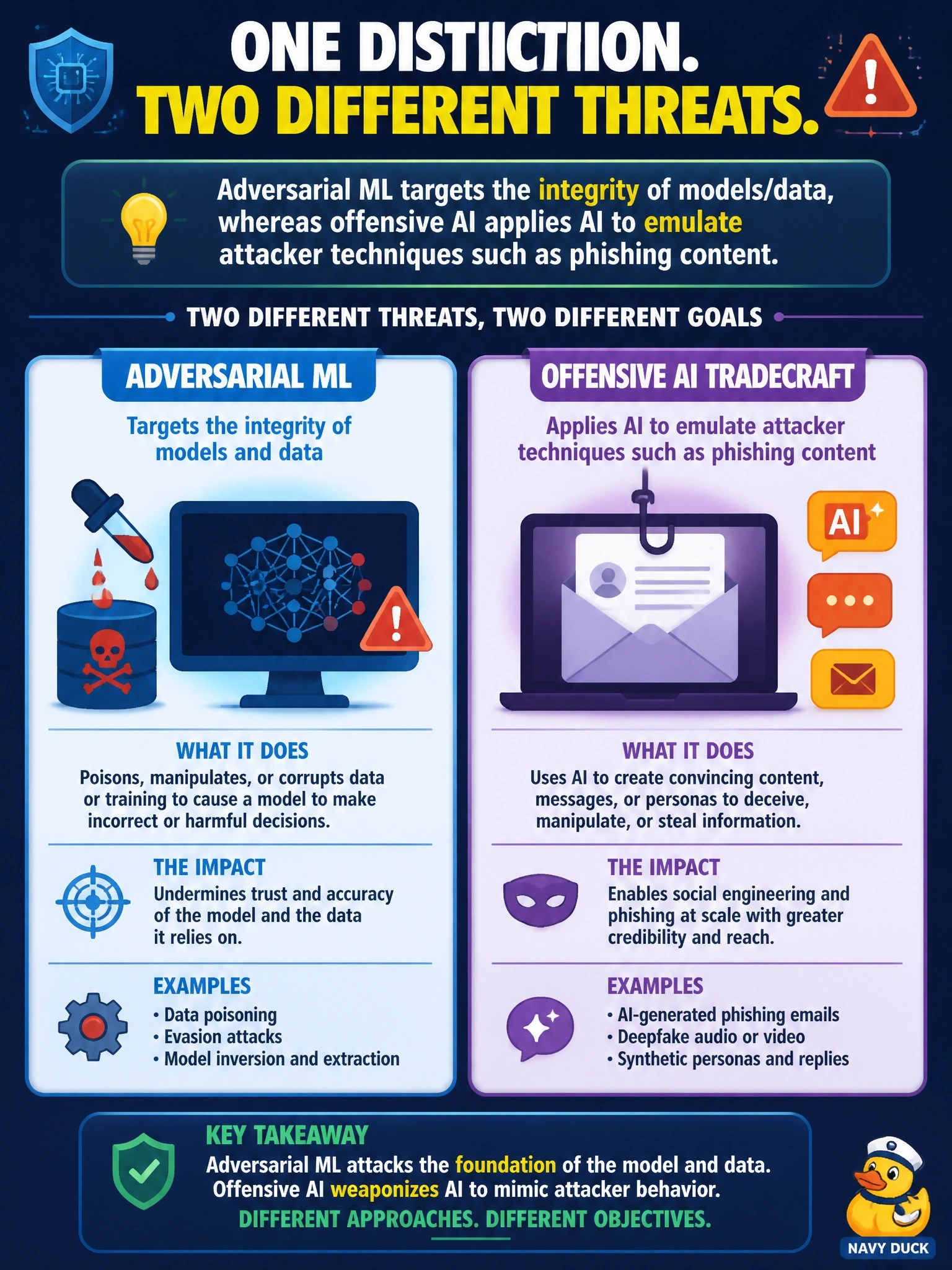
Poison the training set and you’ve attacked model integrity—that's adversarial ML. Use AI to draft an authorized phishing lure and you're doing offensive AI tradecraft. Keep those two lanes separate.
Full Explanation
The city threat-intel unit correctly teaches that poisoning a model is adversarial ML while AI-written phishing is offensive AI tradecraft: adversarial ML targets the integrity of models and data, whereas offensive AI applies AI to emulate attacker techniques such as phishing content. Poisoning corrupts training or fine-tuning pipelines so the model behaves badly; AI-aided lure drafting under authorization exercises social-engineering emulation. Same SOC, two vocabulary lanes.
The statement that poisoning and AI-written phishing are both only Windows Defender configuration tasks erases both concepts. The statement that offensive AI exclusively means vector-database index rebuilds for 311 FAQs confuses retrieval operations with attacker emulation. The statement that adversarial ML is unrelated to AI security and only covers HVAC firmware abandons the model-integrity meaning of the term.
Exam caveat: adversarial ML → attacks on model/data integrity; offensive AI → AI-enabled adversary emulation (e.g., phishing content); do not synonymize with Defender config or HVAC.
Operational check: label model-poisoning scenarios under ML threat models and MLOps controls, run AI-aided phishing content generation only inside purple-team ROE, and keep the two terms separate in playbooks, ticketing categories, and board briefings.