
A municipal legal-tech pilot uses a GAN demo to illustrate synthetic ID-photo risk to clerk staff. Which AI-fundamentals concept is being taught?
Select an answer to reveal the explanation.
Short Explanation
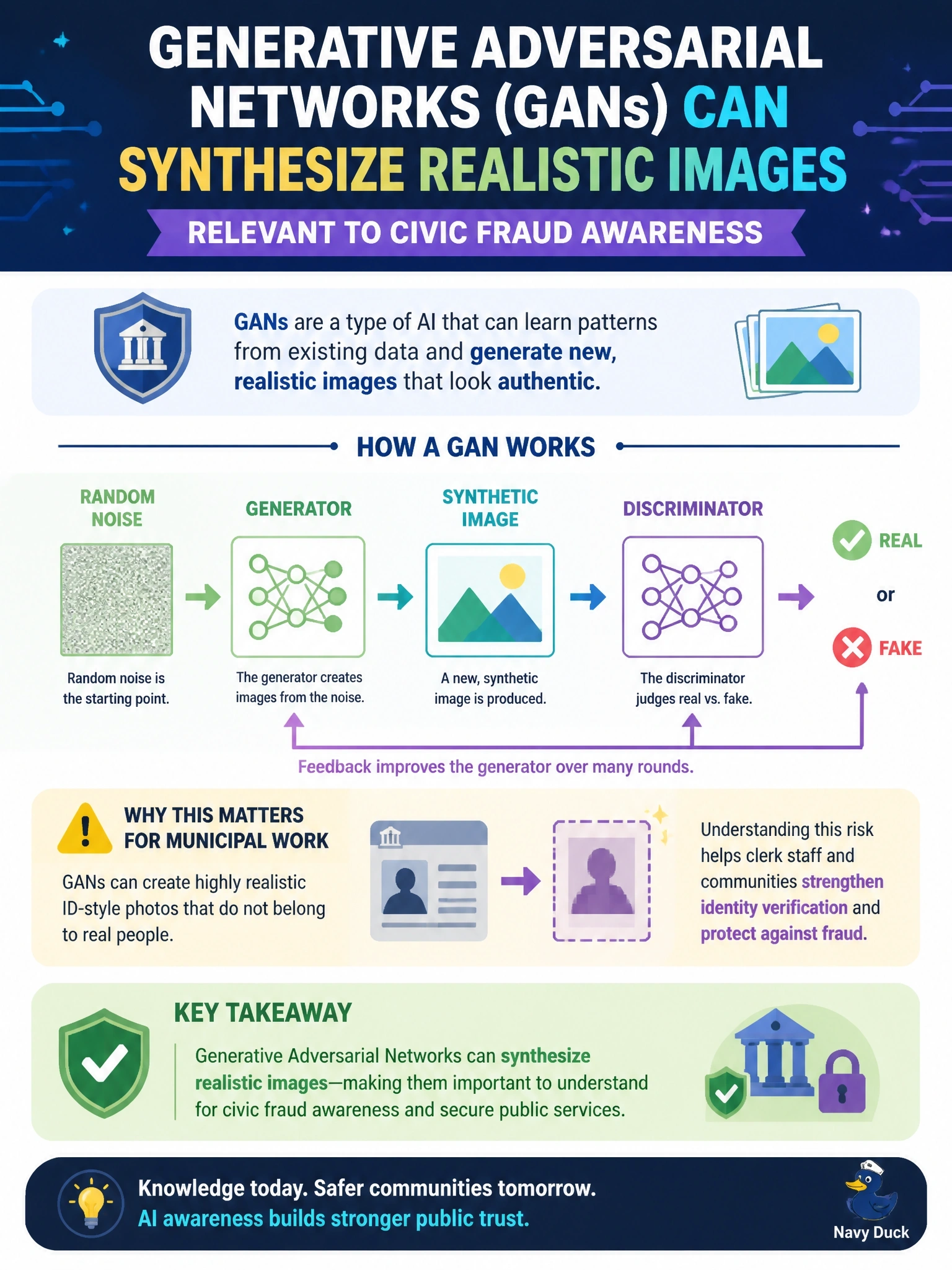
The demo’s point is simple: GANs can invent a face that looks camera-real. You need that mental model so a synthetic ID photo doesn’t slide by as ‘just another bad photocopy.’
Full Explanation
A municipal legal-tech pilot using a GAN demo to illustrate synthetic ID-photo risk is teaching that generative adversarial networks can synthesize realistic images relevant to civic fraud awareness. Clerks need a mental model that camera-real faces can be invented so a synthetic ID photo is not dismissed as a mere bad photocopy. That AI-fundamentals concept is the point of the demo.
Treating RAG vector stores as if they physically issue driver’s licenses at the counter confuses retrieval infrastructure with credential issuance. Claiming that GANs only optimize SQL indexes for the clerk case-management database invents an unrelated database-tuning role. Asserting that custom GPTs are the only technology capable of creating any image ignores image-synthesis families such as GANs and diffusion models.
Exam caveat: clerk awareness items on synthetic IDs map to GAN/generative image risk, not RAG licensing desks, SQL tuning, or the idea that only custom GPTs make images.
Operational check: pair the GAN awareness demo with verification procedures (secondary ID checks, liveness where appropriate, escalation paths), forbid using the demo pipeline to produce real credentials, and record the training as fraud-awareness fundamentals rather than production identity issuance.