
A city purple team labels an AI that helps craft authorized phishing lures as offensive AI, not merely ‘AI security automation.’ Why is that classification appropriate?
Select an answer to reveal the explanation.
Short Explanation
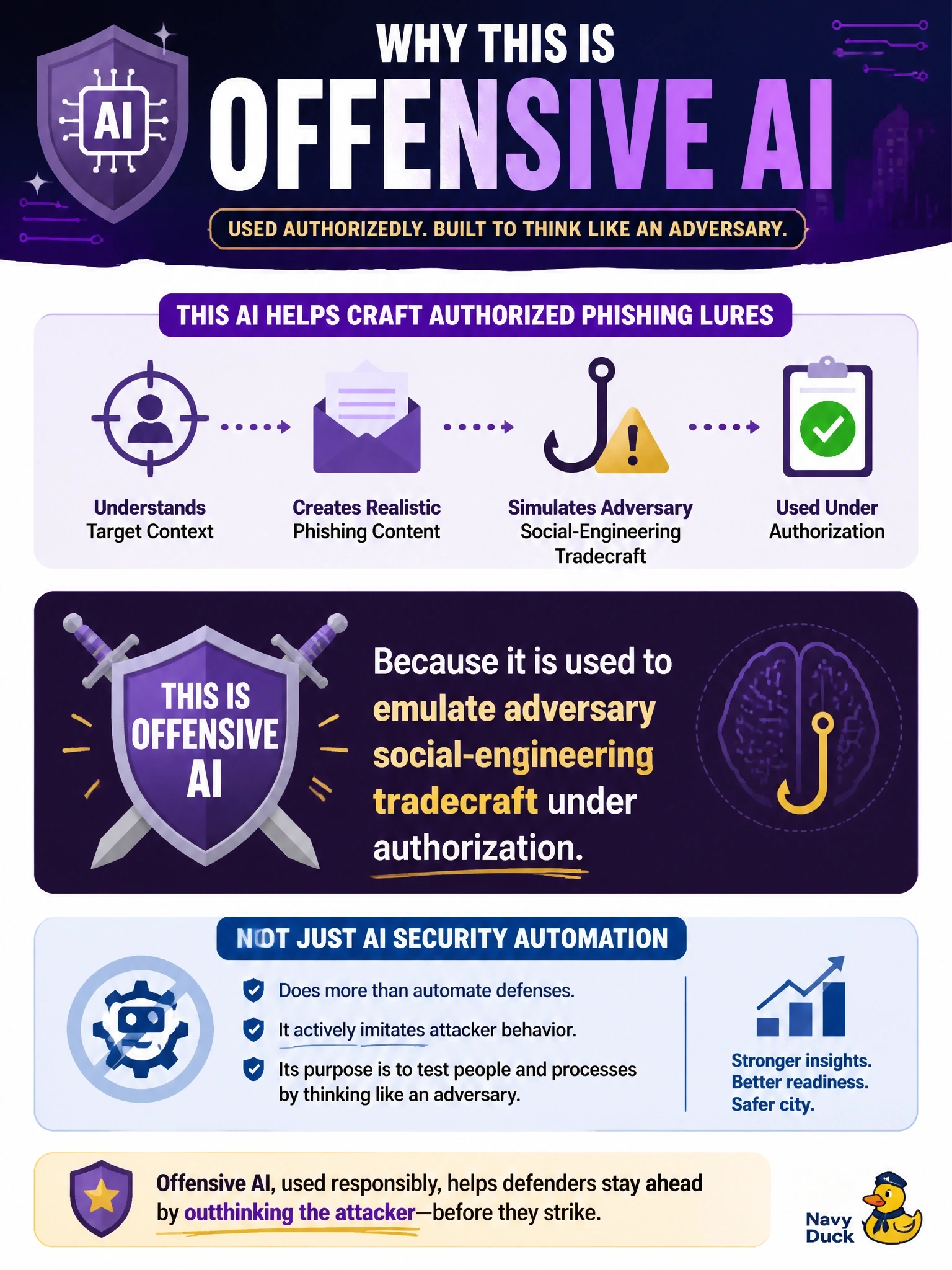
If the tool is helping you play the bad guy’s phishing game on purpose—with a signed ROE—that’s offensive AI emulation, not ordinary AI security automation.
Full Explanation
A city purple team correctly labels an AI that helps craft authorized phishing lures as offensive AI because the system is used to emulate adversary social-engineering tradecraft under authorization. Offensive AI is not merely generic 'AI security automation'; it specifically applies AI techniques to attacker-like tasks inside a written ROE. That classification keeps charter language and risk acceptance aligned with what the tool actually does. The claim that phishing-lure drafting is exclusively a GAIPS platform-hardening task misplaces the work into defensive platform engineering. The claim that any AI that writes SIEM correlation rules is automatically offensive AI over-expands the term to ordinary detection engineering. The claim that offensive AI only refers to heating and cooling controls in city data centers abandons cybersecurity meaning entirely. Exam caveat: authorized AI-aided phishing/lure work is offensive AI emulation; do not confuse it with SIEM rule writing or facilities controls. Operational check: name the capability 'offensive AI' in the purple-team charter, require ROE and legal review before lure generation, keep outputs in controlled repositories, and separate those workflows from defensive automation that closes tickets or tunes correlation rules.