
A school-district SOC asks whether prompt-based summarization of phishing tickets is primarily NLP understanding of existing text or generative composition of new narrative. Which characterization is best?
Select an answer to reveal the explanation.
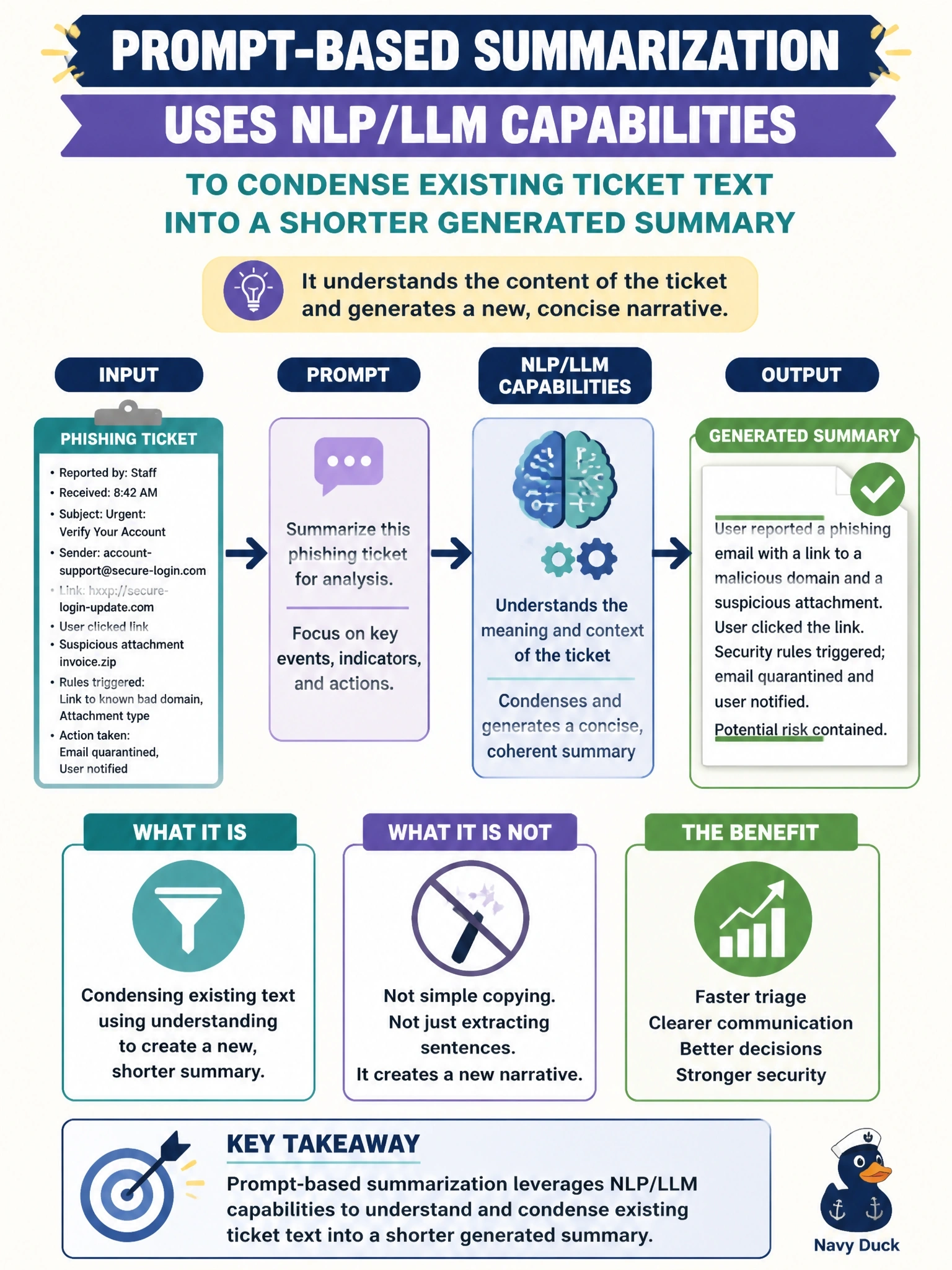
Short Explanation
When you summarize a phishing ticket, you're compressing what analysts already wrote into a shorter note. That's NLP/LLM condensation of existing text, not inventing fake media or decrypting packets.
Full Explanation
The best characterization is the one saying prompt-based summarization uses NLP/LLM capabilities to condense existing ticket text into a shorter generated summary. In a school-district SOC, the model reads what analysts already recorded and composes a compressed narrative; it is understanding-plus-condensation of existing content, not inventing unrelated media. That characterization best answers whether summarization is NLP understanding of existing text versus unrelated generative media tasks.
The claim that summarization never involves language models and is only regex counting denies how modern prompt-based summarizers work, even if regex still helps preprocessing. The claim that phishing-ticket summarization is exclusively a GAN deepfake video task confuses text condensation with synthetic-video pipelines. The claim that ticket summarization is only network packet decryption at the firewall relocates the problem to the wrong layer and tool class.
Exam caveat: school/municipal SOC items on summarization expect LLM/NLP condensation of existing tickets—not regex-only dogma, GAN video, or firewall decryption.
Operational check: feed sanitized ticket text into an approved summarizer under district AI use policy, have humans verify severity and IOCs before escalation, retain the original ticket as source of truth, and never equate a summary with forensic packet evidence.