
A public-health IR desk builds a custom GPT that only answers from approved outbreak playbooks. What fundamental capability is being applied?
Select an answer to reveal the explanation.
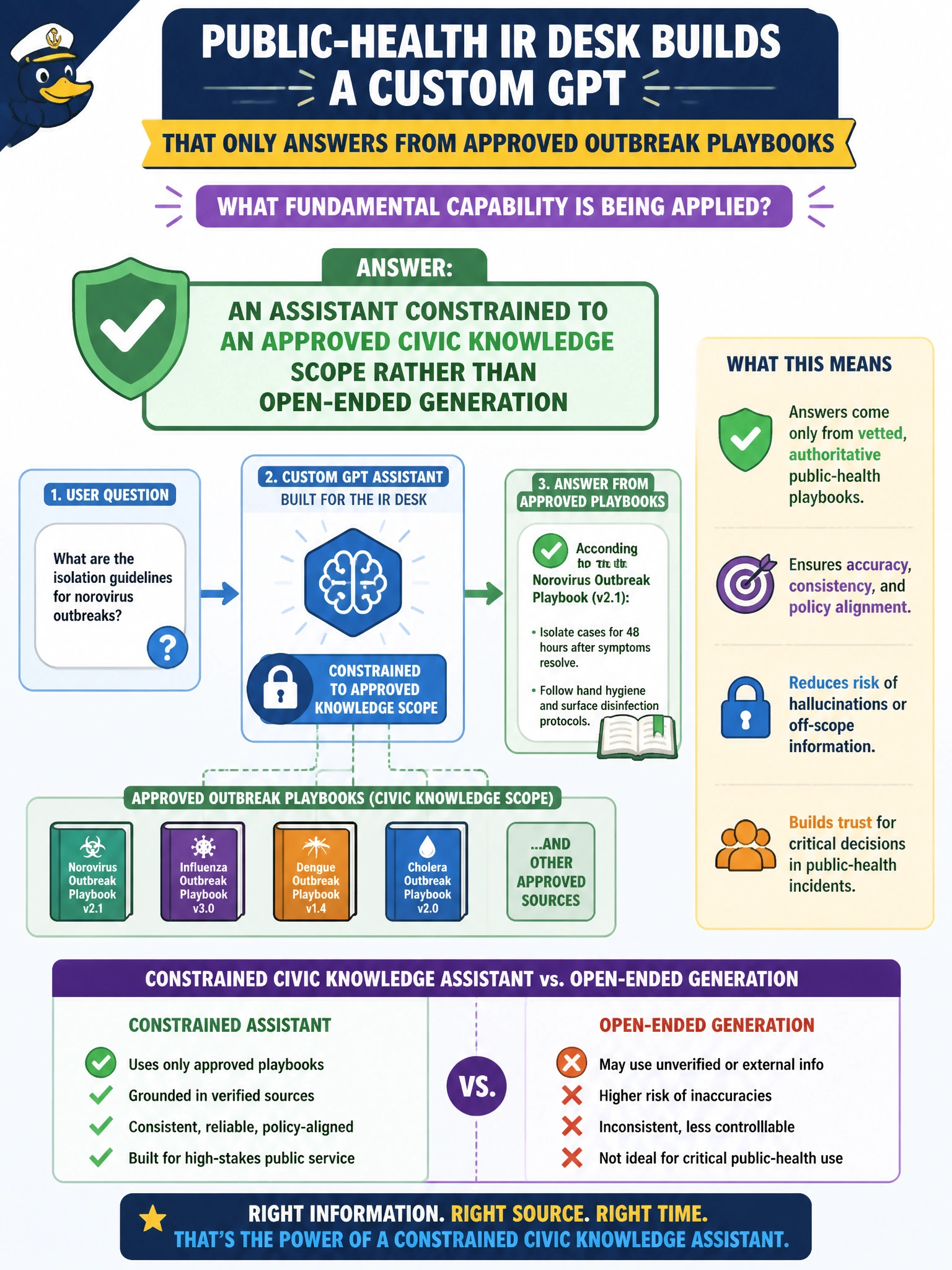
Short Explanation
This is putting guardrails on the intern: they may only answer from the laminated outbreak binder, not from random internet lore. That’s the custom-assistant idea in public-health IR.
Full Explanation
A public-health IR desk building a custom GPT that only answers from approved outbreak playbooks is applying the scoped-assistant pattern: an assistant constrained to an approved civic knowledge scope rather than open-ended generation. Instructions and corpora bound answers to operational playbooks so staff get consistent guidance and reduced hallucination risk during outbreaks. That capability is the fundamentals concept being applied.
Unrestricted web browsing that ignores all municipal knowledge boundaries is the opposite design and increases unreliable advice risk. A GAN pipeline that synthesizes deepfake clinic director videos is a synthetic-media technique unrelated to playbook Q&A. A packet-capture sensor replacing the city’s SIEM correlation engine is a network-detection architecture choice, not a custom-assistant capability.
Exam caveat: “custom GPT” in GOAA civic contexts means scoped knowledge and instructions, not open-web browsing, deepfakes, or SIEM replacement.
Operational check: load only approved outbreak playbooks and SOPs, disable or tightly gate external browsing, require human confirmation for clinical or legal actions, version the knowledge pack with IR leadership sign-off, and retire the assistant’s answers when playbooks are superseded.