
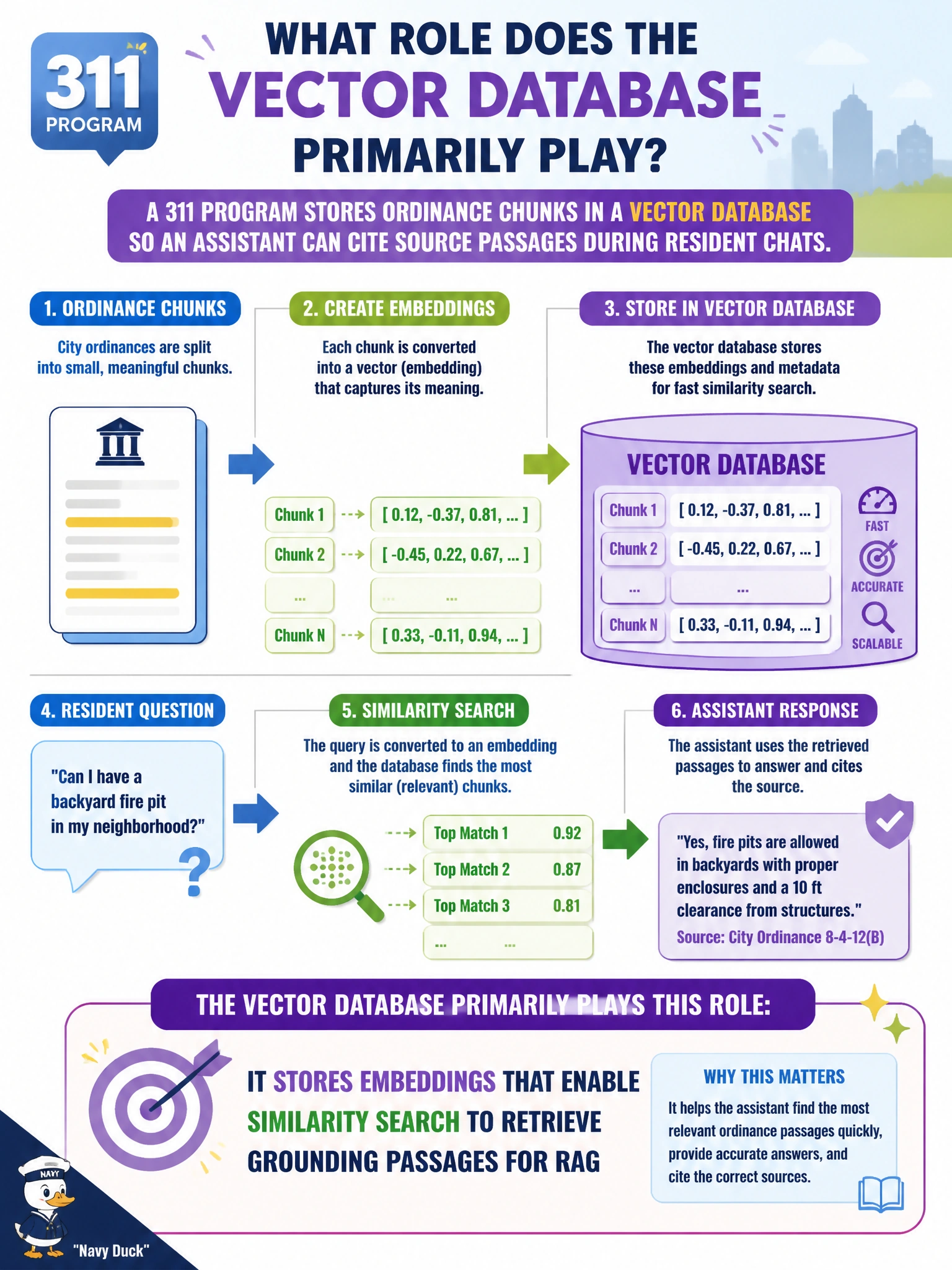
A 311 program stores ordinance chunks in a vector database so an assistant can cite source passages during resident chats. What role does the vector database primarily play?
Select an answer to reveal the explanation.
Short Explanation
The vector DB is the smart card catalog: it doesn’t rewrite the law books, it helps the assistant find the nearest ordinance chunks so answers can point at real pages.
Full Explanation
When a 311 program stores ordinance chunks in a vector database so an assistant can cite source passages, the vector store’s primary role is to hold embeddings that enable similarity search for RAG grounding. Documents are chunked, embedded into vectors, and indexed so a resident query retrieves semantically near passages that the generator can cite. That retrieval layer is what turns a chatbot into a grounded municipal FAQ rather than an unanchored storyteller.
The vector database does not train a brand-new foundation model weights file from scratch each night; embedding and indexing are not foundation pretraining. It does not physically print PDF ordinances for walk-in residents at City Hall; printing is a separate service-delivery channel. It does not replace TLS certificates on the city’s public website edge; certificate management is unrelated infrastructure.
Exam caveat: fundamentals items ask what vector databases do in RAG—store embeddings for similarity retrieval—not retrain models, print paper, or manage TLS.
Operational check for 311 RAG: govern chunking and embedding refresh when ordinances change, monitor near-miss retrieval quality, require answers to surface passage citations, and keep the vector store’s purpose documented so finance or IT does not confuse it with model-training GPU budgets.