
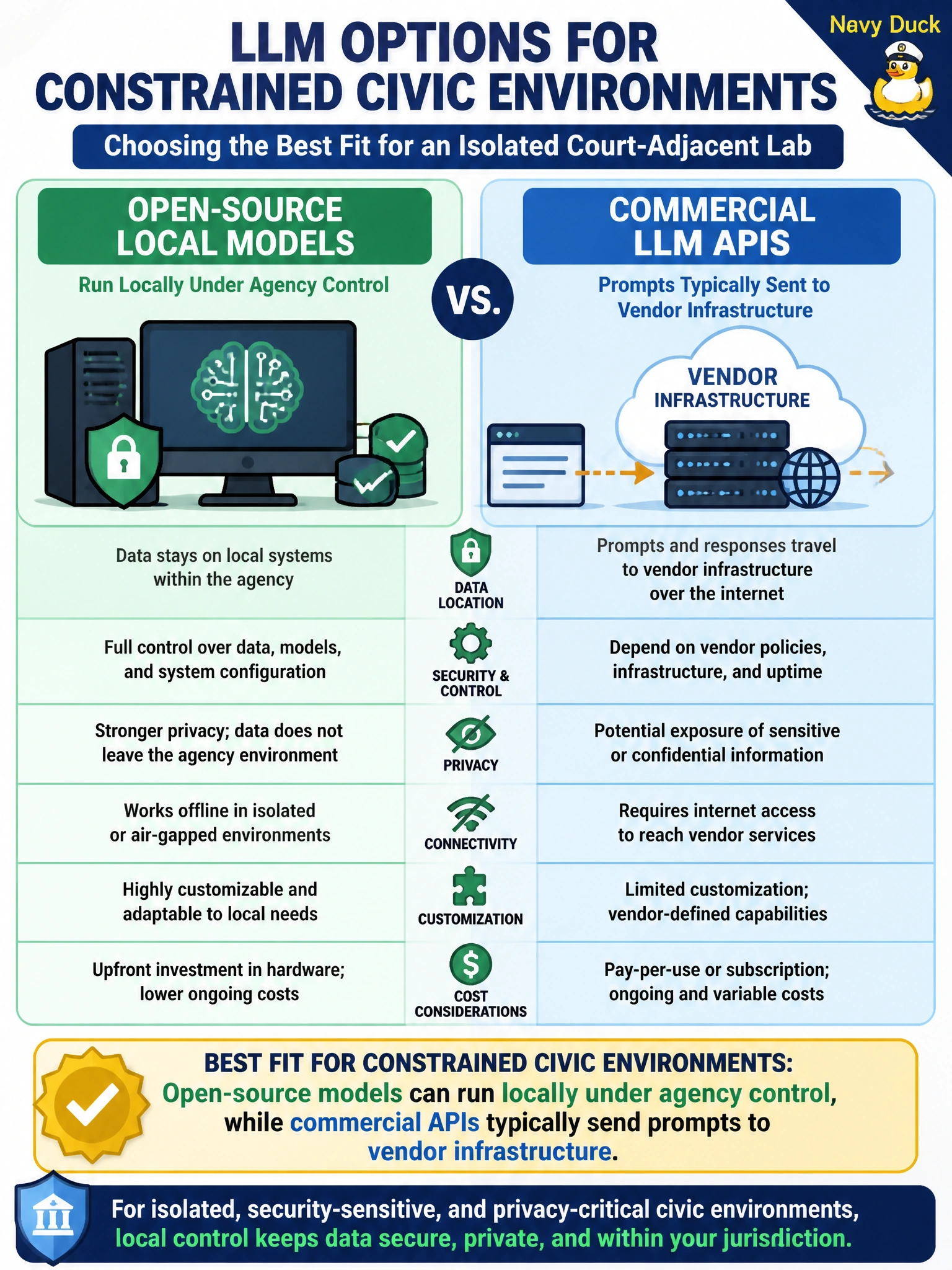
A housing-authority security lead inventories commercial LLM APIs versus open-source local models for an isolated court-adjacent lab. Which comparison best fits constrained civic environments?
Select an answer to reveal the explanation.
Short Explanation
Cloud APIs are like calling an outside call center with your case notes; a local open-source model is like keeping the briefing binder inside the courthouse vault. For an isolated lab, that residency difference matters.
Full Explanation
A housing-authority security lead comparing commercial LLM APIs with open-source local models for an isolated court-adjacent lab must prioritize data residency and control. Open-source (or privately packaged) models can run on agency-controlled hardware so prompts and case-adjacent text never leave the lab. Commercial LLM APIs typically send prompts to vendor infrastructure subject to contracts, logging, and residency terms. That comparison best fits constrained civic environments.
Claiming only commercial cloud APIs can ever run inside an air-gapped municipal lab inverts reality; cloud APIs require external connectivity that air gaps forbid. Asserting open-source models legally forbid any government use under all circumstances is false as a blanket rule and is not how platform selection works. Assuming commercial APIs and local open-source models always share identical data-residency guarantees ignores the core architectural difference the lab is trying to solve.
Exam caveat: constrained civic / court-adjacent scenarios favor local control for sensitive prompts; “identical residency” and “OSS bans government use” are common distractors.
Operational check: document which workloads may use vendor APIs under approved DPAs, default isolated court-adjacent labs to on-prem or air-gapped model stacks, ban pasting sealed or case-sensitive text into public APIs, and re-verify residency whenever the vendor changes subprocessors.