
A water-utility red team debates ‘adversarial AI’ model-poisoning risk versus ‘offensive AI’ techniques used in authorized emulation. Which framing is correct for municipal purple-team language?
Select an answer to reveal the explanation.
Short Explanation
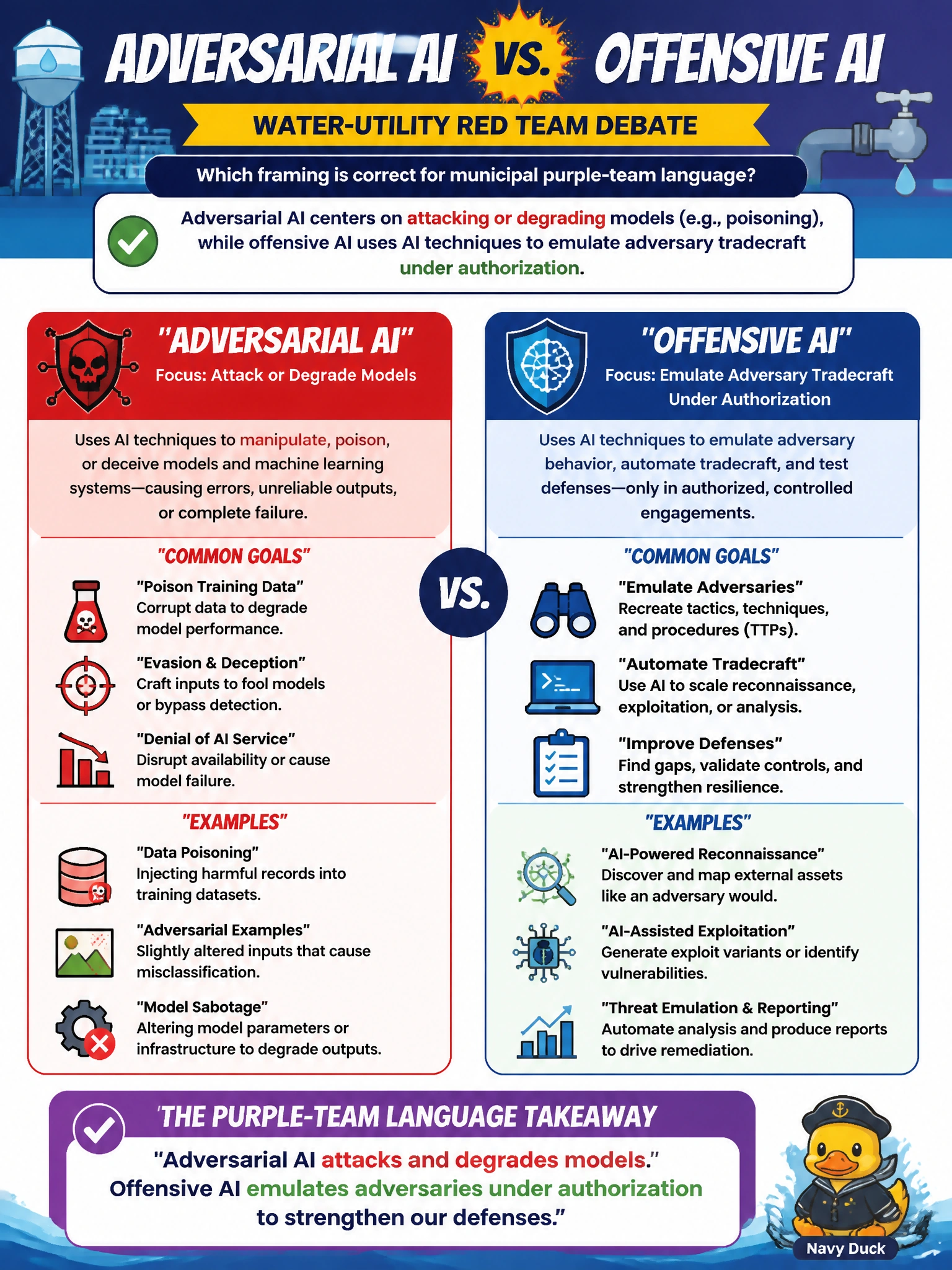
Poisoning the plant’s model is like tainting the recipe book—that’s adversarial ML against the model itself. Offensive AI is the authorized red team using AI the way an adversary might, to test defenses—not the same play.
Full Explanation
Municipal purple-team language must separate adversarial AI from offensive AI. Adversarial AI centers on attacking or degrading models and pipelines—poisoning training data, evasion against detectors, or model extraction. Offensive AI uses AI-enabled techniques to emulate adversary tradecraft during authorized assessments, such as crafting lures or accelerating recon under a written charter. For a water-utility red team debating model-poisoning risk versus authorized emulation, that framing is correct and keeps risk discussions precise.
Reducing offensive AI to training classifiers for ticket routing in the utility help desk describes ordinary automation, not adversary emulation. Treating adversarial AI and offensive AI as synonyms with no meaningful difference blurs whether the city is defending models or emulating attackers. Defining offensive AI exclusively as physical lockpicking of pump-house doors abandons the AI dimension entirely and mislabels traditional physical security testing.
Exam caveat: GOAA civic purple-team vocabulary treats adversarial AI as attacks against models and offensive AI as authorized AI-aided adversary emulation; synonyms are the trap answer.
Operational check: use “adversarial ML/AI” in model-risk and MLOps threat models (poisoning, evasion), reserve “offensive AI” for ROE-bounded emulation tasks, and train water-utility purple teams to name which term applies before scoping an engagement.