
A transit SOC evaluates NLP entity extraction on rider-complaint tickets against a custom GPT that answers from ops playbooks. Which distinction is most accurate?
Select an answer to reveal the explanation.
Short Explanation
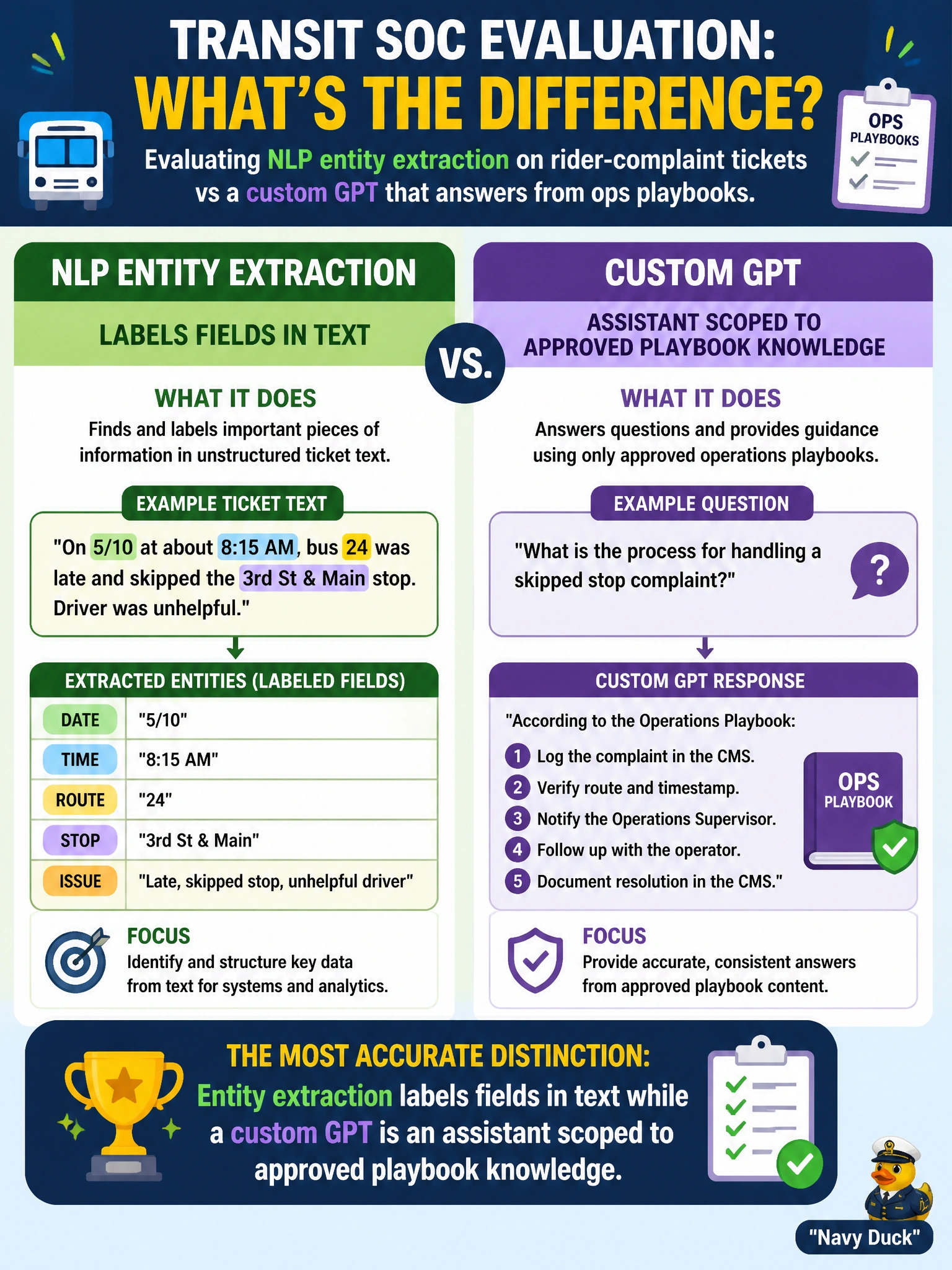
Entity extraction is the highlighter that circles bus-stop names and complaint types. A custom GPT is the shift partner that answers from the approved playbook shelf—not the same tool in a different hat.
Full Explanation
A transit SOC comparing NLP entity extraction on rider-complaint tickets with a custom GPT that answers from ops playbooks must keep field-labeling distinct from scoped assistance. Entity extraction identifies structured spans—stop names, route IDs, complaint categories—inside unstructured text so tickets become queryable. A custom GPT-style assistant is a conversational system constrained to approved playbook knowledge for operational Q&A. The accurate distinction is that entity extraction labels fields while a custom GPT is an assistant scoped to approved playbook knowledge.
Treating entity extraction and custom GPTs as identical because both supposedly require a vector database collapses two jobs; entity extractors need not use vectors, and assistants may use retrieval without becoming field labelers. Claiming custom GPTs can only extract named entities and cannot summarize playbooks invents a false limitation; scoped assistants are commonly used for playbook Q&A and summarization. Declaring NLP entity extraction obsolete and mandating GANs in every SOC swaps a useful structured-NLP tool for an unrelated synthetic-media technique.
Exam caveat: transit and municipal SOC items separate structured NLP (entities, categories) from custom assistants; GANs are not the default replacement for ticket NLP.
Operational check: keep entity extraction on the ticket-intake pipeline for analytics and routing, deploy the custom GPT against an approved ops-playbook corpus with clear scope boundaries, and document that the two systems feed different consumers (structured fields versus conversational guidance).