
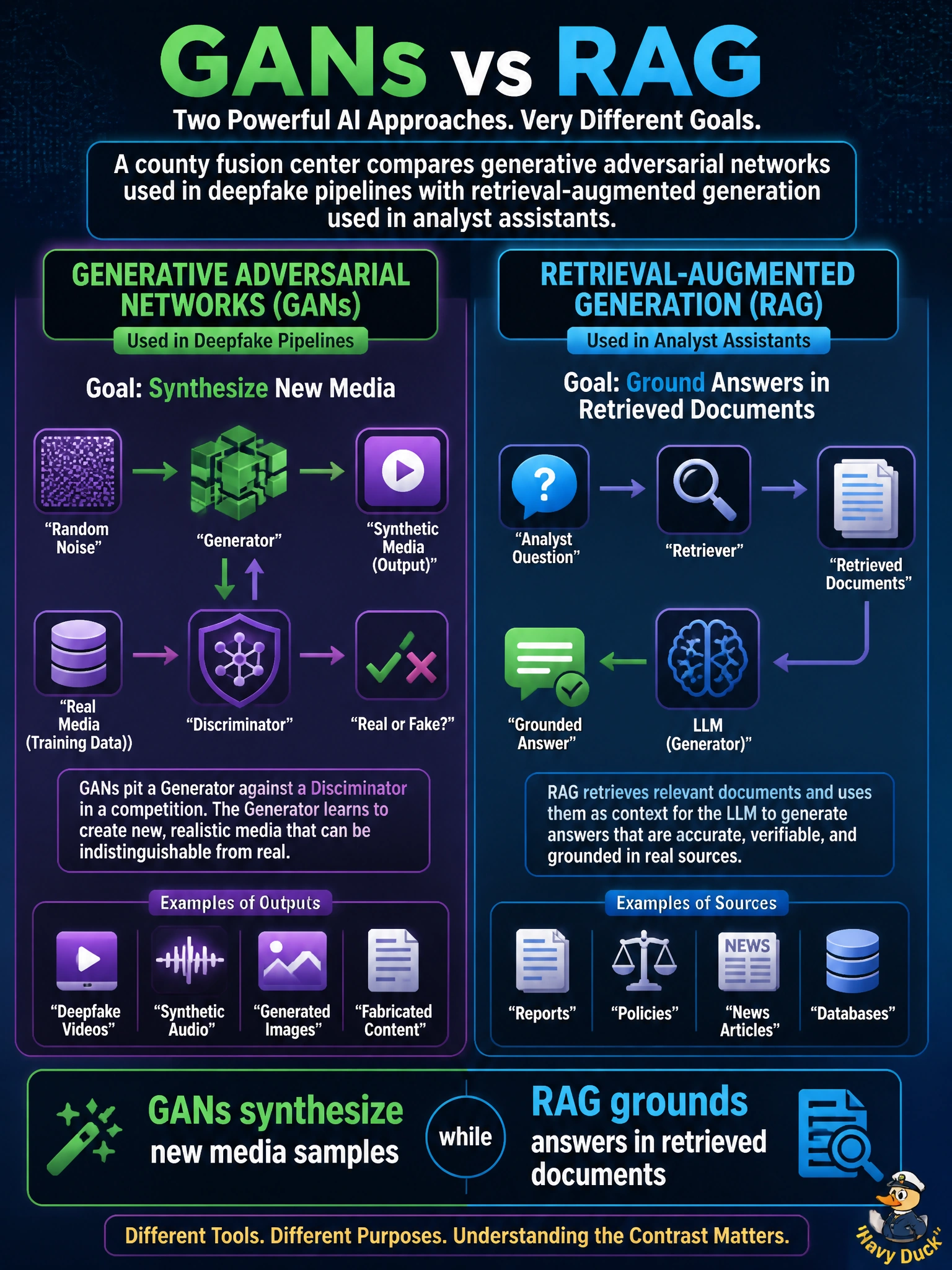
A county fusion center compares generative adversarial networks used in deepfake pipelines with retrieval-augmented generation used in analyst assistants. Which statement best captures the contrast?
Select an answer to reveal the explanation.
Short Explanation
Think of a GAN as a forgery studio that invents new faces or voices, and RAG as a research librarian that pulls real binders before answering. Same ‘AI’ umbrella—totally different jobs for the fusion center.
Full Explanation
At a county fusion center, generative adversarial networks (GANs) and retrieval-augmented generation (RAG) sit under the same “AI” umbrella but solve opposite problems. GANs learn to synthesize realistic media samples and therefore underpin many deepfake creation pipelines analysts must detect. RAG retrieves passages from a knowledge base so an assistant’s answers are grounded in documents rather than invented from parametric memory. The correct contrast is that GANs synthesize new media while RAG grounds answers in retrieved documents.
Claiming both GANs and RAG only classify malware families erases generation and retrieval entirely; classifiers assign labels and are a different model pattern. Asserting that RAG always trains a new foundation model from scratch on county data confuses indexing/retrieval with full pretraining; municipal RAG typically embeds and searches existing corpora without rebuilding foundation weights. Saying vector databases replace GANs as the only civic deepfake creation method misassigns roles: vector stores support similarity search for grounding, they are not deepfake synthesizers.
Exam caveat: fusion-center vocabulary questions expect GANs → synthetic media / deepfake risk, RAG → grounded document answers; do not treat them as interchangeable.
Operational check: brief analysts with separate playbooks—deepfake detection and media forensics for GAN-class threats, corpus governance and citation checks for RAG assistants—and never task a vector database as a substitute for understanding synthetic-media attack paths.