
An incident response team is deciding whether to perform a 'clean rebuild' versus 'clean in place' remediation for a compromised server. What is the primary advantage of a full rebuild from a known good image?
Select an answer to reveal the explanation.
Short Explanation
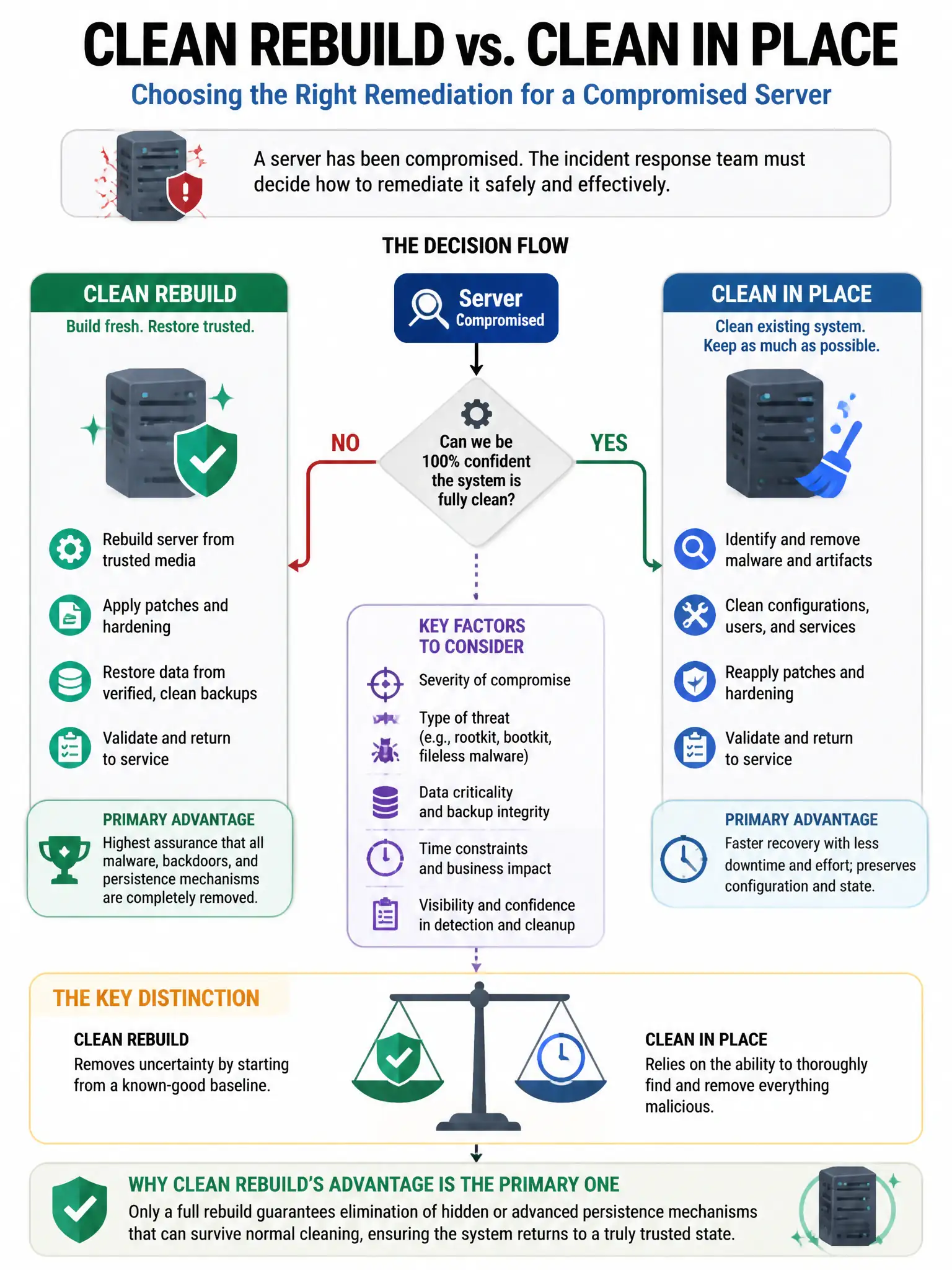
You want the rebuild from a known-good image because it wipes out attacker-installed files, persistence mechanisms, and backdoors with much higher confidence. In-place cleaning only works if you find every hidden piece, and attackers are good at hiding.
Full Explanation
The full rebuild from a known-good image is preferred because it removes attacker-installed files, persistence mechanisms, and configurations with certainty, giving higher confidence that the system is clean. In-place cleaning depends on correctly identifying and removing every piece of malware, which can miss subtle persistence or hidden backdoors. The claim that a rebuild is always faster is wrong because rebuilds are often slower than targeted cleaning, especially on complex systems with many applications. The claim that a rebuild preserves all forensic evidence is wrong because rebuilding destroys forensic evidence; evidence collection must occur before rebuilding. The claim that a rebuild eliminates the need to identify the root cause is wrong because root cause analysis is necessary regardless of remediation approach to prevent recurrence.