
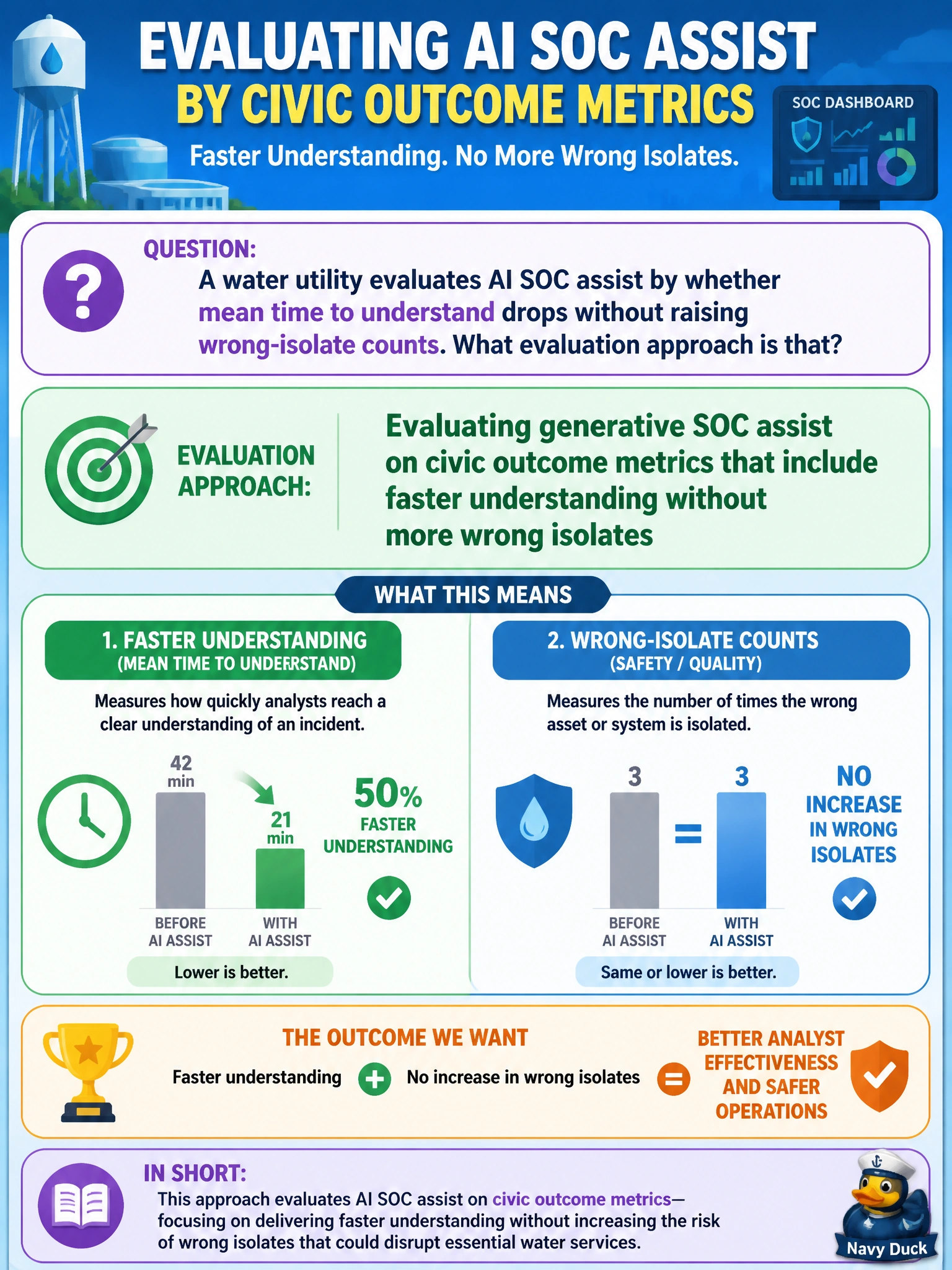
A water utility evaluates AI SOC assist by whether mean time to understand drops without raising wrong-isolate counts. What evaluation approach is that?
Select an answer to reveal the explanation.
Short Explanation
Faster understanding is great—unless wrong isolates climb with it. When you're measuring it, stick with civic outcomes, not fluency metrics for faster summaries without tracking understanding or wrong isolates, not token-overlap scores for understanding, and not efficiency metrics for faster throughput without measuring understanding or wrong isolates. Water utilities need speed and safety on the same scorecard.
Full Explanation
A water utility that evaluates AI SOC assist by whether mean time to understand drops without raising wrong-isolate counts is evaluating generative SOC assist on civic outcome metrics that include faster understanding without more wrong isolates. Speed alone is a partial score; assist that makes analysts “understand” faster while driving erroneous containment harms plant operations and public trust. Pairing comprehension-time improvement with a safety KPI (wrong isolates) forces vendors and internal teams to optimize for useful, safe assistance rather than engagement theatrics.
Why the other options fail by concept: Evaluating generative SOC assist on fluency metrics that reward faster summaries without tracking understanding or wrong isolates prioritizes surface-level polish and summary speed over whether analysts truly understand and avoid wrong isolates. Evaluating generative SOC assist on civic metrics that score faster understanding by playbook token overlap for isolates rewards template-matching over true contextual understanding of the specific water-utility event and safe isolation decisions. Evaluating generative SOC assist on efficiency metrics that track faster throughput without measuring understanding or wrong isolates tracks operational throughput but ignores whether analysts truly understand the incident and avoid wrong isolates.
Exam caveat: define “understand” with observable markers (time to first accurate hypothesis, time to confirmed entity list) so the metric cannot be gamed by skipping documentation. Operational check: run a timed evaluation on matched municipal incident pairs with/without assist, compute mean time to understand and wrong-isolate rate, and promote the tool only if understanding improves while wrong isolates stay flat or fall.
Prefer to study offline? Printable PDF study book + test engine ($7.50, unofficial). These questions stay free here.