
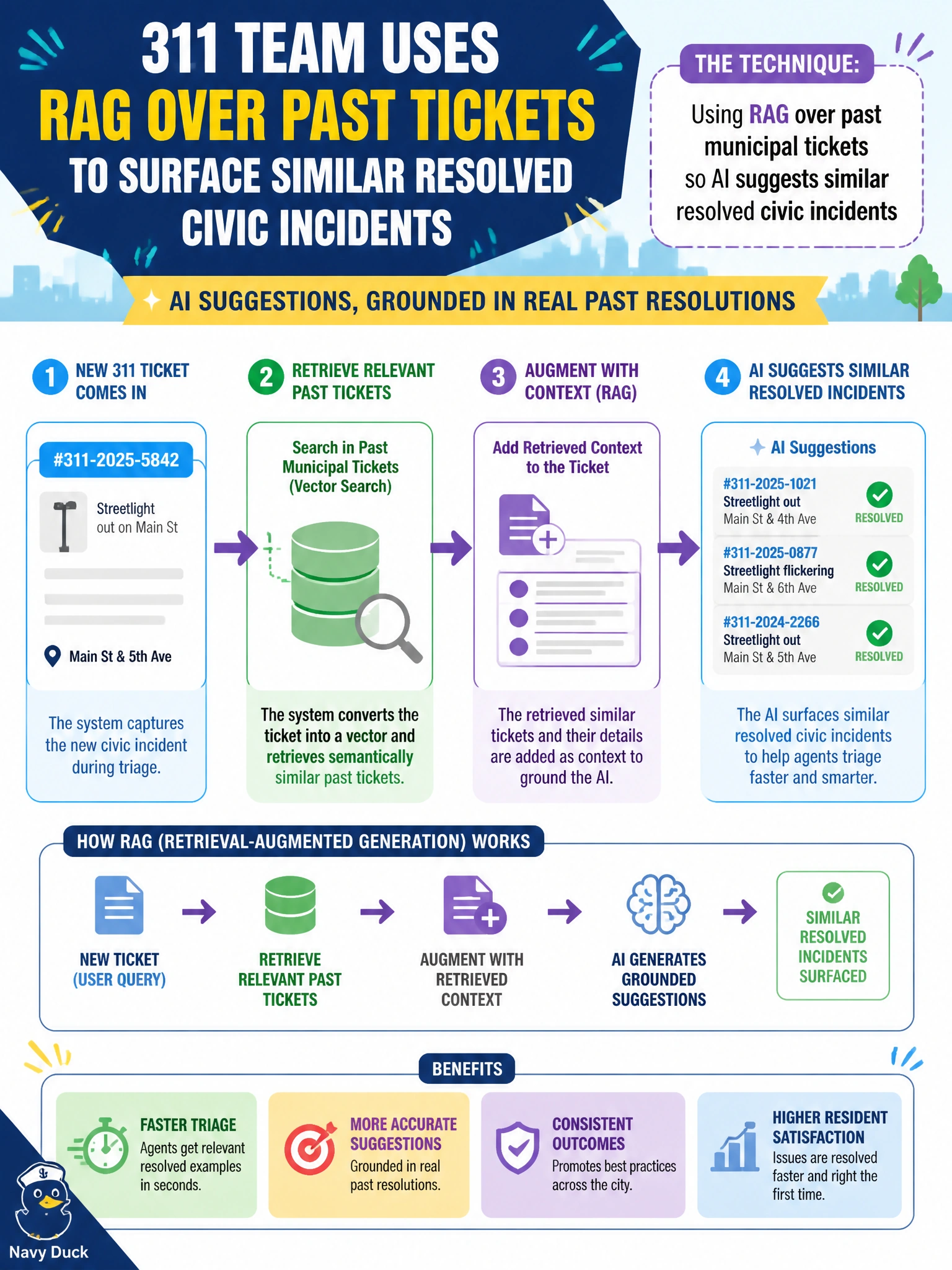
A 311 team grounds AI suggestions in past tickets so similar resolved civic incidents surface during triage. Which technique is that?
Select an answer to reveal the explanation.
Short Explanation
RAG is the filing cabinet for past 311 wins—retrieve similar resolved tickets so AI advice has civic memory. Fine-tuning buries precedent in weights so you’ll not get the matching case back, summarizing condenses history but won’t retrieve the matching case for you, and clustering organizes tickets offline but won’t surface the match for your live triage. Ground the assist in your own case history.
Full Explanation
A 311 team that grounds AI suggestions in past tickets so similar resolved civic incidents surface during triage is using RAG over past municipal tickets so AI suggests similar resolved civic incidents. Retrieval-augmented generation attaches local memory: prior resolutions, workarounds, and escalation paths for analogous 311 security or service tickets inform the model’s suggestions instead of generic internet priors. That technique improves relevance for municipal processes and reduces hallucinated advice disconnected from how the city actually closed similar cases.
Why the other options fail by concept: Fine-tuning model weights on past tickets so AI suggests similar resolved civic incidents bakes precedent into parameters rather than retrieving comparable cases at triage time, so it won’t surface similar resolved incidents when an agent needs them. Summarizing past municipal tickets so AI suggests similar resolved civic incidents condenses history into a summary rather than retrieving comparable cases at triage time, so it won’t surface similar resolved incidents when an agent needs them. Clustering ticket embeddings on past tickets so AI suggests similar resolved civic incidents organizes history into groups offline rather than retrieving a specific match at triage time, so it doesn’t ground a live triage suggestion in the specific resolved ticket that matches the current incident.
Exam caveat: RAG corpora need access control and redaction—past tickets may contain personal data, addresses, or sensitive infrastructure notes that not every triage agent should retrieve. Operational check: index an approved historical ticket set, run RAG-assisted triage on sample live-like cases, confirm suggested similars cite real municipal ticket IDs, and block retrieval from non-approved sources.
Prefer to study offline? Printable PDF study book + test engine ($7.50, unofficial). These questions stay free here.