
A city CISO pilots agentic enrichment first and defers agentic response until audit signs off. What adoption strategy is that?
Select an answer to reveal the explanation.
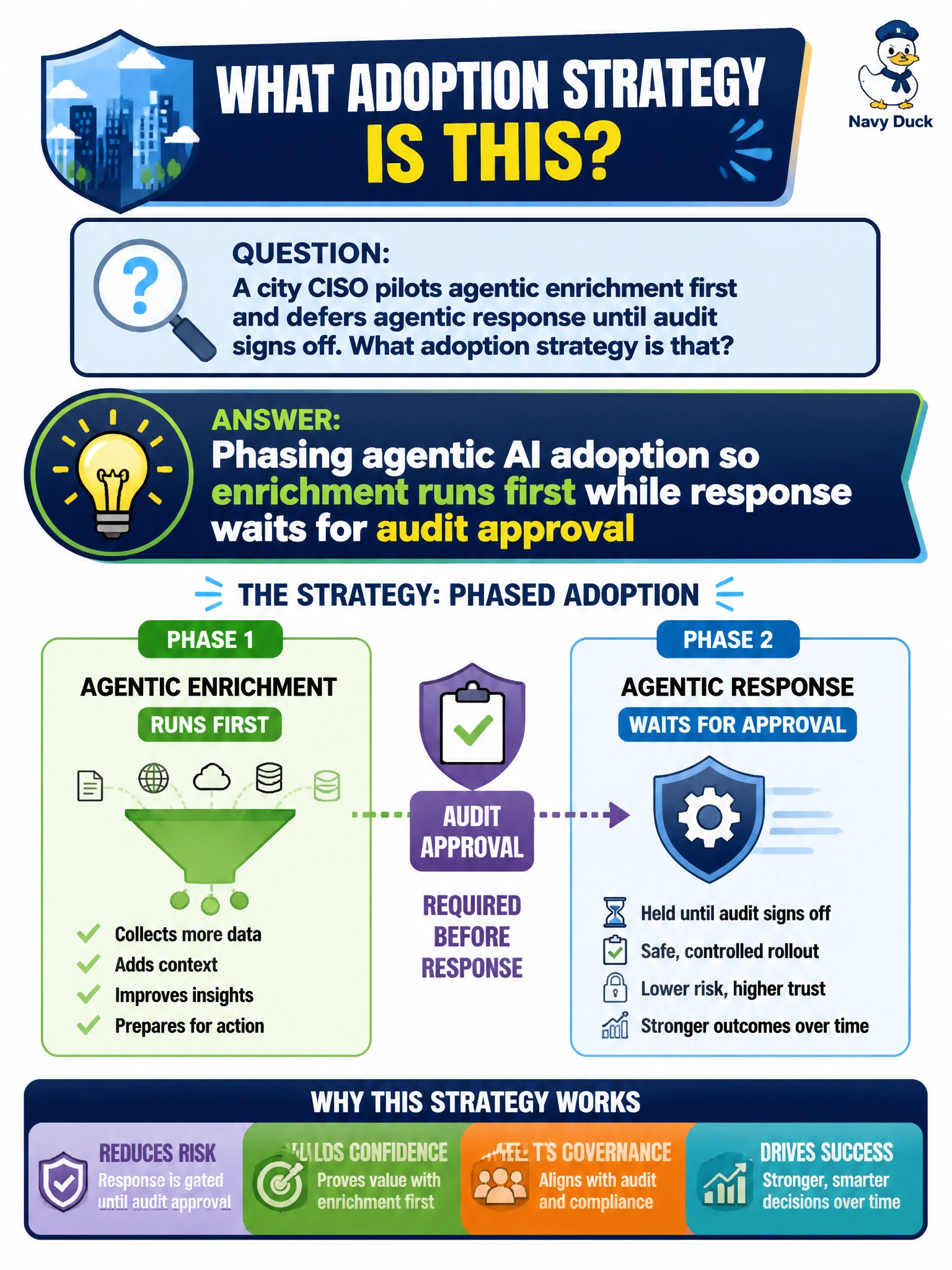
Short Explanation
Enrichment is the reading lamp; response is the power switch—pilot the lamp first and wait for audit before flipping switches. Saying you're centralizing agentic AI governance so audit reviews enrichment and response under shared policy misses that you've phased timing with enrichment first. Phase agentic AI so civic risk stays paced.
Full Explanation
A city CISO who pilots agentic enrichment first and defers agentic response until audit signs off is phasing agentic AI adoption so enrichment runs first while response waits for audit approval. Enrichment (suggesting queries, summarizing entities, pulling related tickets) is lower blast-radius than automating agentic containment, so labeling the pilot as automating agentic containment so response executes first while enrichment awaits audit review reverses the order by putting state-changing action first while the actual pilot keeps response waiting for audit approval. Sequencing lets the municipality gain investigative speed, gather evidence for auditors, and harden controls before granting agents tools that change production state. That staged adoption is a governance strategy, not merely a technical preference.
Why the other options fail by concept: Centralizing agentic AI governance so audit reviews enrichment and response under shared policy mislabels staged timing as organizational placement, because centralization describes where ownership sits under shared policy, not the phased evidence trail civic oversight expects before response is released. Automating agentic containment so response executes first while enrichment awaits audit review reverses the pilot's order, because automating containment authorizes state-changing actions now while the actual strategy keeps enrichment first and response waiting for audit approval. Extending agentic AI copilots so analysts receive drafts while retaining manual approval control describes broadening assistive help with drafts under manual control, not the governance decision to phase enrichment first and hold response until formal audit sign-off, so it swaps measured proof for a feature-expansion label.
Exam caveat: enrichment can still leak sensitive data into model context; phase-one pilots need DLP, logging, and retention rules even without response tools. Operational check: document the enrichment-only pilot scope for audit, collect outcome metrics and access logs, and require formal sign-off before any agentic response/containment tool permissions are enabled in the city tenant.
Prefer to study offline? Printable PDF study book + test engine ($7.50, unofficial). These questions stay free here.