
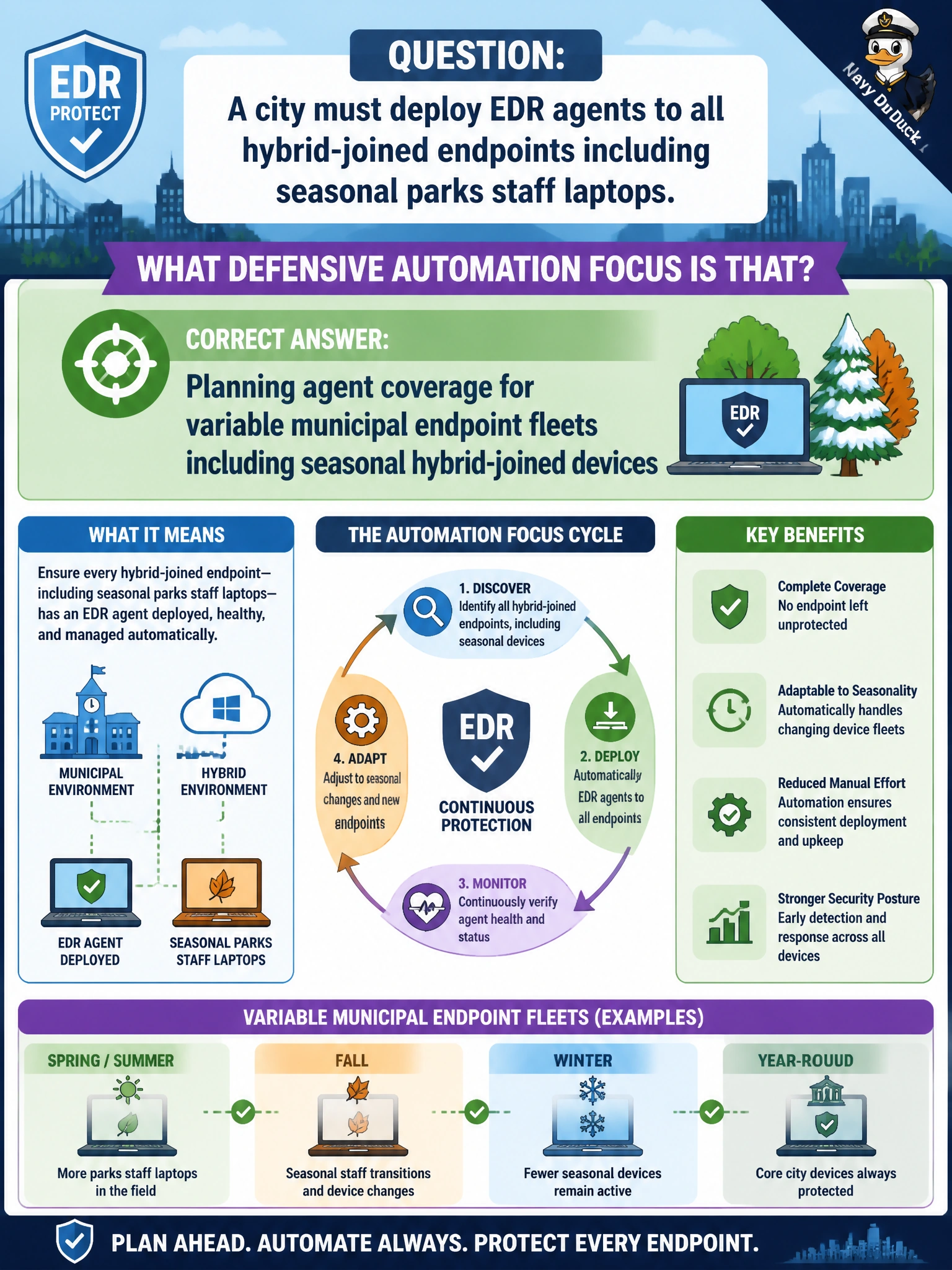
A city must deploy EDR agents to all hybrid-joined endpoints including seasonal parks staff laptops. What defensive automation focus is that?
Select an answer to reveal the explanation.
Short Explanation
You've got to cover those seasonal parks laptops as part of your variable hybrid fleet, not leave them with less protection. Distributing EDR threat signatures via Entra Connect sync or forwarding EDR detections for triage doesn't install active coverage, and running agents in passive audit mode won't block threats. You'll need full enforcement planned into onboarding for that seasonal fleet.
Full Explanation
Deploying EDR agents to all hybrid-joined endpoints including seasonal parks staff laptops focuses defensive automation on variable municipal endpoint fleets. Seasonal and temporary devices still access city email, files, and apps; attackers do not exempt summer hires. Coverage planning must include onboarding paths for hybrid-joined seasonal laptops—Intune/autopilot packages, GPO/startup scripts, or imaging task sequences—so agent presence is part of issuance, not an optional afterthought when devices are handed out.
Distributing EDR threat signatures via Entra Connect sync to cover seasonal hybrid-joined device fleets confuses identity federation with agent deployment: Entra Connect syncs directory and compliance attributes for hybrid join, but it does not install, license, or plan EDR agent coverage for seasonal laptops, so the coverage gap stays open no matter how current the signatures are. Running EDR agents in passive audit mode on seasonal hybrid-joined devices still leaves the variable fleet without active defense, since detection without blocking does not stop an attacker on a seasonal laptop. Running EDR agents in passive audit mode on seasonal hybrid-joined devices across variable municipal fleets leaves enforcement incomplete: passive mode may log activity for observation but it does not block, isolate, or remediate threats, so seasonal laptops remain unprotected even though an agent is present and the variable fleet is not truly covered. Forwarding EDR detections from variable municipal fleets including seasonal hybrid-joined devices for triage assumes agents are already deployed everywhere that matters; it addresses what happens after an alert fires, not whether seasonal parks laptops ever get an agent in the first place, so it does not plan coverage for the variable fleet at all.
Exam caveat: Seasonal coverage planning starts before hiring season. Work with HR to update your device issuance workflow and Intune/autopilot templates so seasonal staff devices receive EDR as part of onboarding, not as an optional download link.
Operational check: Audit current municipal devices in Intune; classify them by permanent vs. seasonal vs. contractor status; identify which seasonal devices today lack EDR agents; map your issuance template to include EDR for seasonal cohorts; and measure EDR coverage percentage by device class at the end of hiring season.
Prefer to study offline? Printable PDF study book + test engine ($7.50, unofficial). These questions stay free here.