
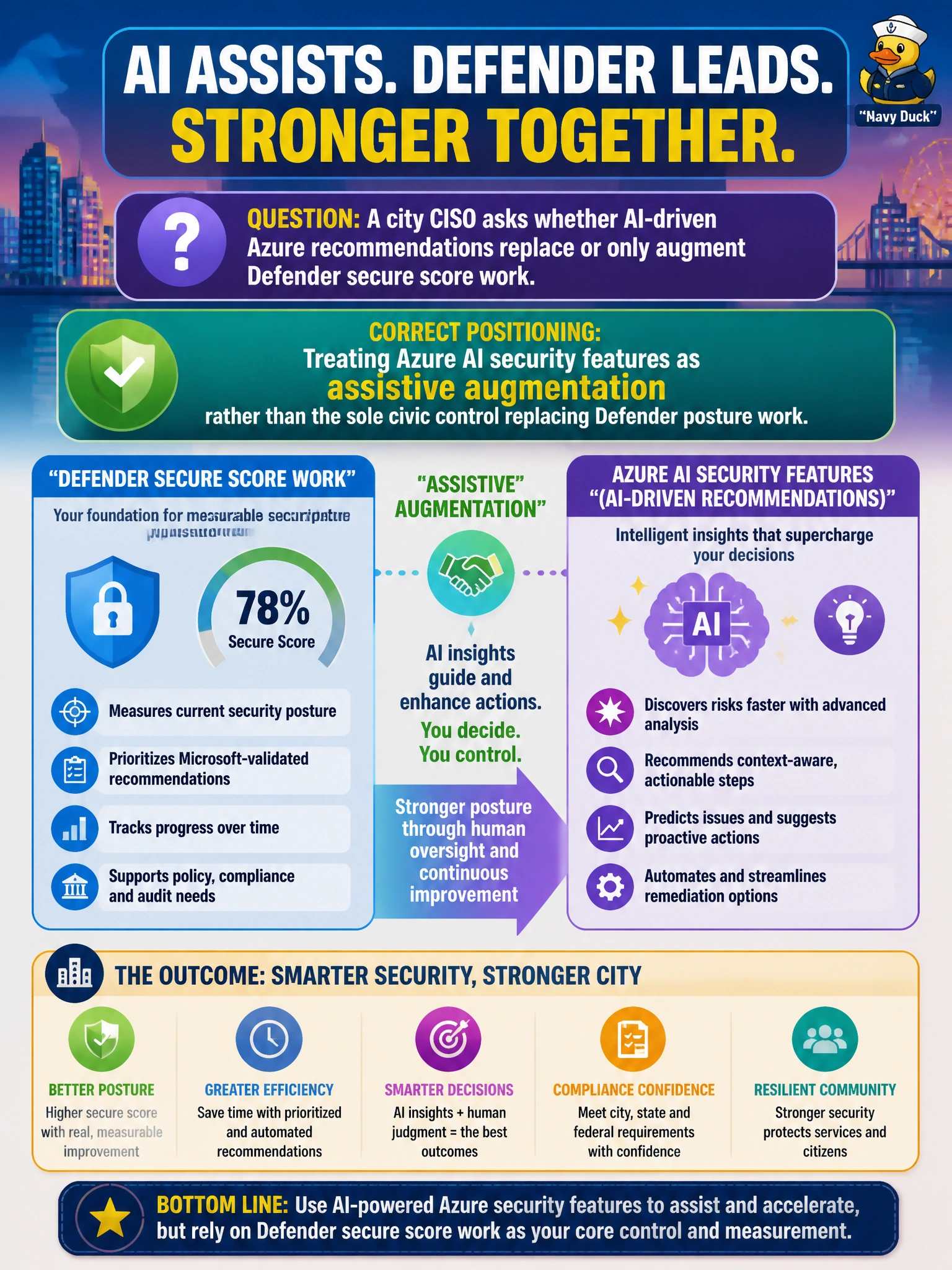
A city CISO asks whether AI-driven Azure recommendations replace or only augment Defender secure score work. What positioning is correct?
Select an answer to reveal the explanation.
Short Explanation
AI recommendations are a helpful co-pilot for your Defender posture—not a pink slip for your secure score program. You'll get the most from Copilot summaries when you're triaging XDR incidents, but you've still got to fix and verify findings before your score moves. Keep augmenting your civic work; don't abandon it.
Full Explanation
Treating AI-driven Azure recommendations as assistive augmentation—not a replacement for Defender secure score work—is the correct positioning for a city CISO. AI can prioritize, summarize, and suggest remediations, but civic posture management still needs owners, SLAs, secure score (or equivalent posture metrics), risk acceptance, and verification that fixes landed in Azure. AI is a force multiplier for the municipal security program, not the program itself.
Treating Copilot for Security summaries as assistive augmentation for secure score reporting rather than Defender XDR triage work misplaces the augmentation: Copilot summaries assist XDR investigation and triage, they do not raise or report secure score, and secure score reporting must still reflect verified remediation and reassessed recommendations. Treating Defender for Cloud AI detections as assistive augmentation for Defender XDR response rather than secure score hardening work misassigns the tool: Defender for Cloud AI prioritizes posture hardening and secure score remediation, it does not drive XDR incident response, and XDR response still requires separate triage and containment. Treating Azure AI remediation queues as assistive augmentation for secure score exception tracking rather than posture remediation work confuses the workflow: prioritized queues assist actual posture remediation with owner action and verification, they do not govern exceptions, and exception tracking still requires documented justification, named owner, and risk acceptance.
Exam caveat: Vendors may market AI as transformative; exam-correct framing is augmentation with human oversight, measured against existing controls (Defender, Policy, Sentinel). Watch for questions that treat Copilot for Security summaries as assistive augmentation for secure score reporting rather than Defender XDR triage work—summaries aid triage and are not secure score controls, and accepted risk still requires a named civic owner.
Operational check: Keep Defender secure score and recommendation workflows as primary posture tracking; allow AI to draft prioritization for human review; require owner and ticket for remediations; and report to leadership using metrics (open critical recommendations, MTTR), not AI sentiment.
Prefer to study offline? Printable PDF study book + test engine ($7.50, unofficial). These questions stay free here.