
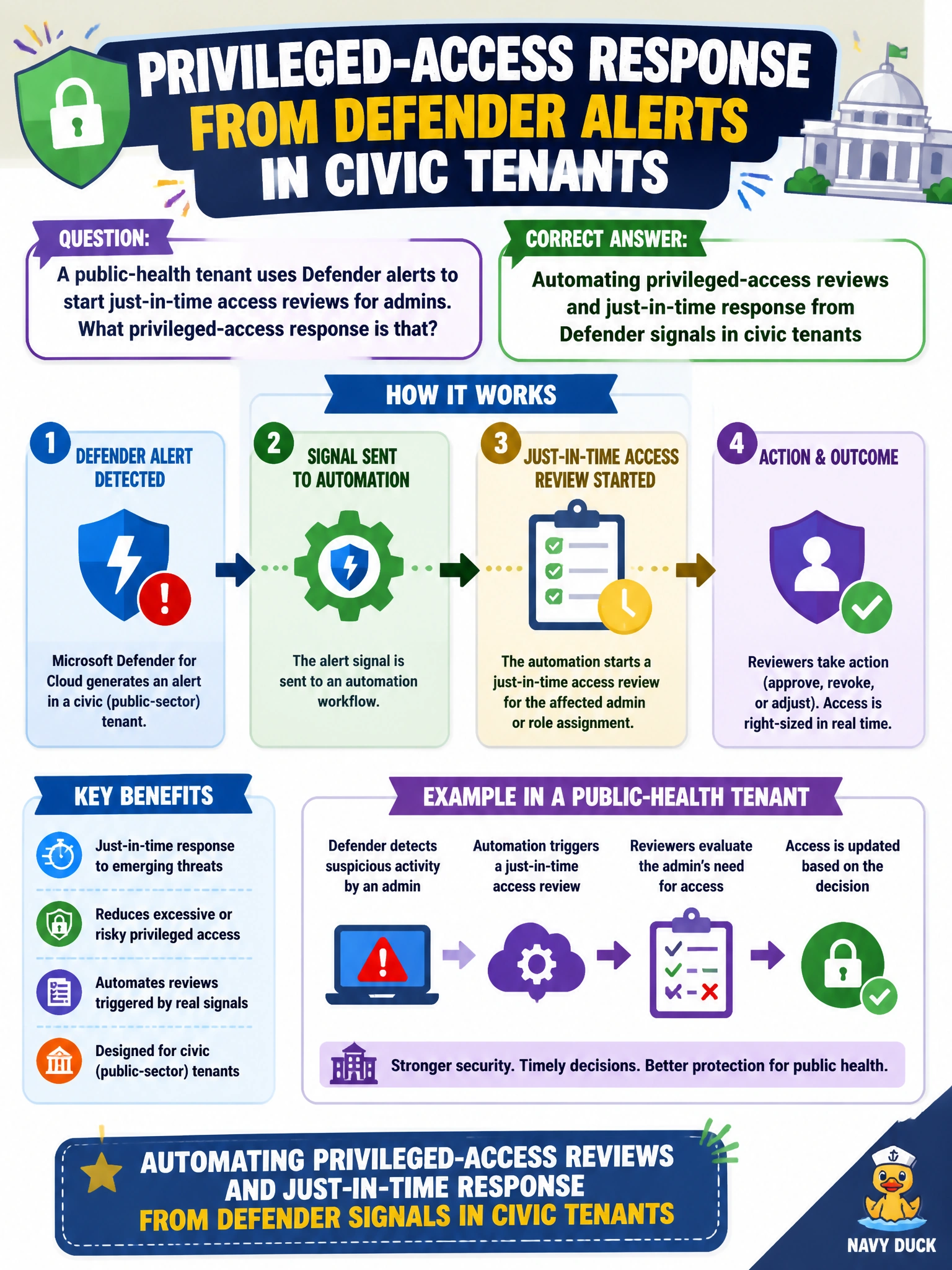
A public-health tenant uses Defender alerts to start just-in-time access reviews for admins. What privileged-access response is that?
Select an answer to reveal the explanation.
Short Explanation
When Defender flags a weird admin path, you'll start the JIT access review — Secure Score won't do it because it's just your posture benchmark. Device tags just group your devices and exposure score just measures your patch vulnerability, so they won't trigger your Defender-driven privileged-access review.
Full Explanation
Using Defender alerts to start just-in-time access reviews for admins is a privileged-access response pattern: Defender signals that indicate suspicious privilege use, anomalous admin sign-ins, or risky elevation become the trigger to open JIT access workflows and access reviews in a public-health tenant. That shortens standing privilege lifetime when risk is elevated, forces human or automated revalidation of who still needs Global Admin or privileged roles, and aligns with Zero Trust for civic directories that handle protected health-related data and outbreak systems.
Automating privileged-access reviews and just-in-time response from Defender Secure Score in civic tenants confuses posture measurement with threat response: Secure Score is an aggregate configuration benchmark, not a real-time Defender privilege-risk alert, and does not trigger JIT access workflows or reduce standing privilege when risk is elevated. Automating privileged-access reviews and just-in-time response from Defender device tags in civic tenants confuses device grouping with identity threat response: device tags are static classification labels for filtering and scoping devices, not suspicious privilege use, and do not open JIT access reviews or revoke standing admin rights when Defender detects risk. Automating privileged-access reviews and just-in-time response from Defender exposure score in civic tenants uses the wrong signal source for this pattern: exposure score measures organizational vulnerability exposure from missing patches and misconfigurations, not Defender-triggered active privilege abuse, and by itself does not open JIT access workflows and privileged-access reviews for admins.
Exam caveat: JIT and Privileged Identity Management (PIM) reduce standing access but still require eligible assignments, MFA/approval on activation, and monitoring of activation logs. Defender alerts should integrate with identity governance—not replace RBAC design. Also separate break-glass accounts (tightly controlled) from day-to-day admin paths.
Operational check: Map high-severity privilege-related Defender (or identity protection) alerts to automation that opens a PIM access review or revokes active standing sessions pending review; verify that admin roles use eligible, time-bound assignments triggered by Defender signals rather than Defender exposure score for vulnerability exposure; audit Global Admin count quarterly; and respond to Defender risk detection with JIT workflows triggered by Defender signals instead of Defender device tags for device grouping or Defender Secure Score for posture measurement.
Prefer to study offline? Printable PDF study book + test engine ($7.50, unofficial). These questions stay free here.