
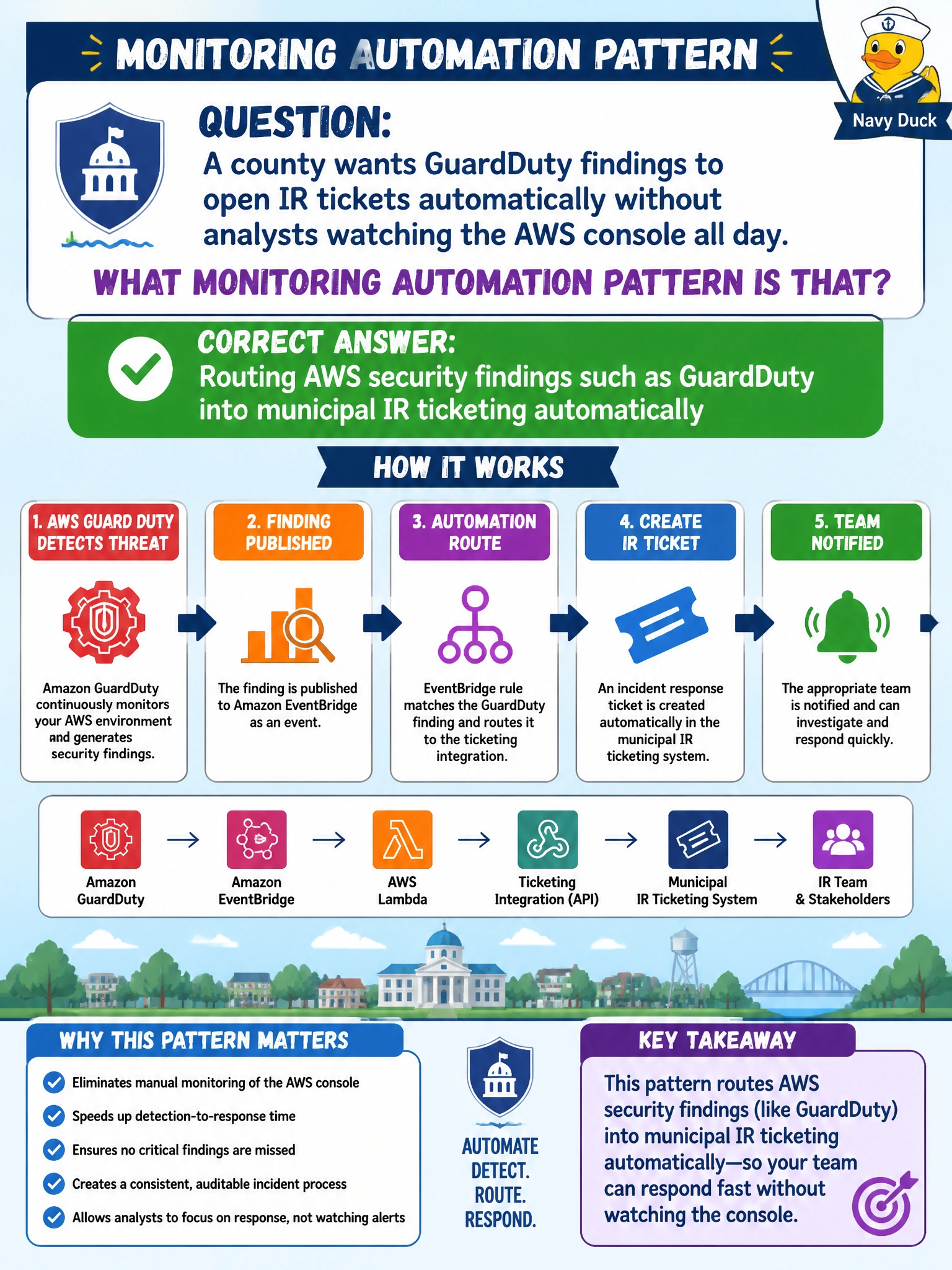
A county wants GuardDuty findings to open IR tickets automatically without analysts watching the AWS console all day. What monitoring automation pattern is that?
Select an answer to reveal the explanation.
Short Explanation
GuardDuty should knock on the ticket queue door—not make analysts babysit the console. Auto-route findings into IR ownership. You'll get delayed, lossy tickets if you wait for S3 Created events on GuardDuty archives, count GuardDuty logs with metric filters, or poll GuardDuty insight snapshots on a timer.
Full Explanation
Routing AWS security findings such as GuardDuty into municipal IR ticketing automatically connects county cloud detection to owned response work without requiring analysts to babysit the AWS console. Event-driven intake—EventBridge, Lambda, or SOAR connectors—opens tickets with severity, resource context, and assignment so account-takeover, reconnaissance, and other GuardDuty findings enter the same IR queue as other civic alerts. That monitoring automation pattern scales county coverage and preserves accountability when staff cannot refresh consoles continuously.
Triggering municipal IR ticketing automatically from S3 Created events on GuardDuty archives fails because it waits for batched finding exports to land in storage instead of routing the live GuardDuty finding event; archive delivery is delayed, requires file parsing, and loses immediate severity, resource context, and assignment for owned IR work. Creating municipal IR ticketing automatically via CloudWatch metric filters on GuardDuty logs fails because metric filters count matching log lines and alarm on thresholds rather than opening one ticket per GuardDuty finding; aggregation strips finding detail and produces noisy, delayed alarms instead of accountable per-finding ownership. Polling GuardDuty insight snapshots into municipal IR ticketing automatically on schedule fails because scheduled polling drags snapshots on a timer instead of pushing each finding as it fires; gaps between polls add delay and risk missed or duplicate tickets without real-time EventBridge intake.
Exam caveat: Prefer automatic routing of GuardDuty (and similar) findings into IR ticketing when the stem emphasizes not watching the console all day. Triggering ticketing from S3 Created events on GuardDuty archives, creating ticketing via CloudWatch metric filters on GuardDuty logs, and polling GuardDuty insight snapshots on schedule are not equivalent to direct event-driven ticketing intake.
Operational check for county IR: enable a GuardDuty-to-ticketing integration in a non-production account, inject or wait for a test finding, confirm a ticket opens with correct severity and ownership, verify quiet hours still create tickets, and ensure triggering from S3 Created events on GuardDuty archives, creating via CloudWatch metric filters on GuardDuty logs, or polling GuardDuty insight snapshots on schedule are not used as the primary municipal intake design.
Prefer to study offline? Printable PDF study book + test engine ($7.50, unofficial). These questions stay free here.