
A county purple team stores credentials used by offensive automation in a secrets vault separate from everyday production admin accounts. Why is that practice important?
Select an answer to reveal the explanation.
Short Explanation
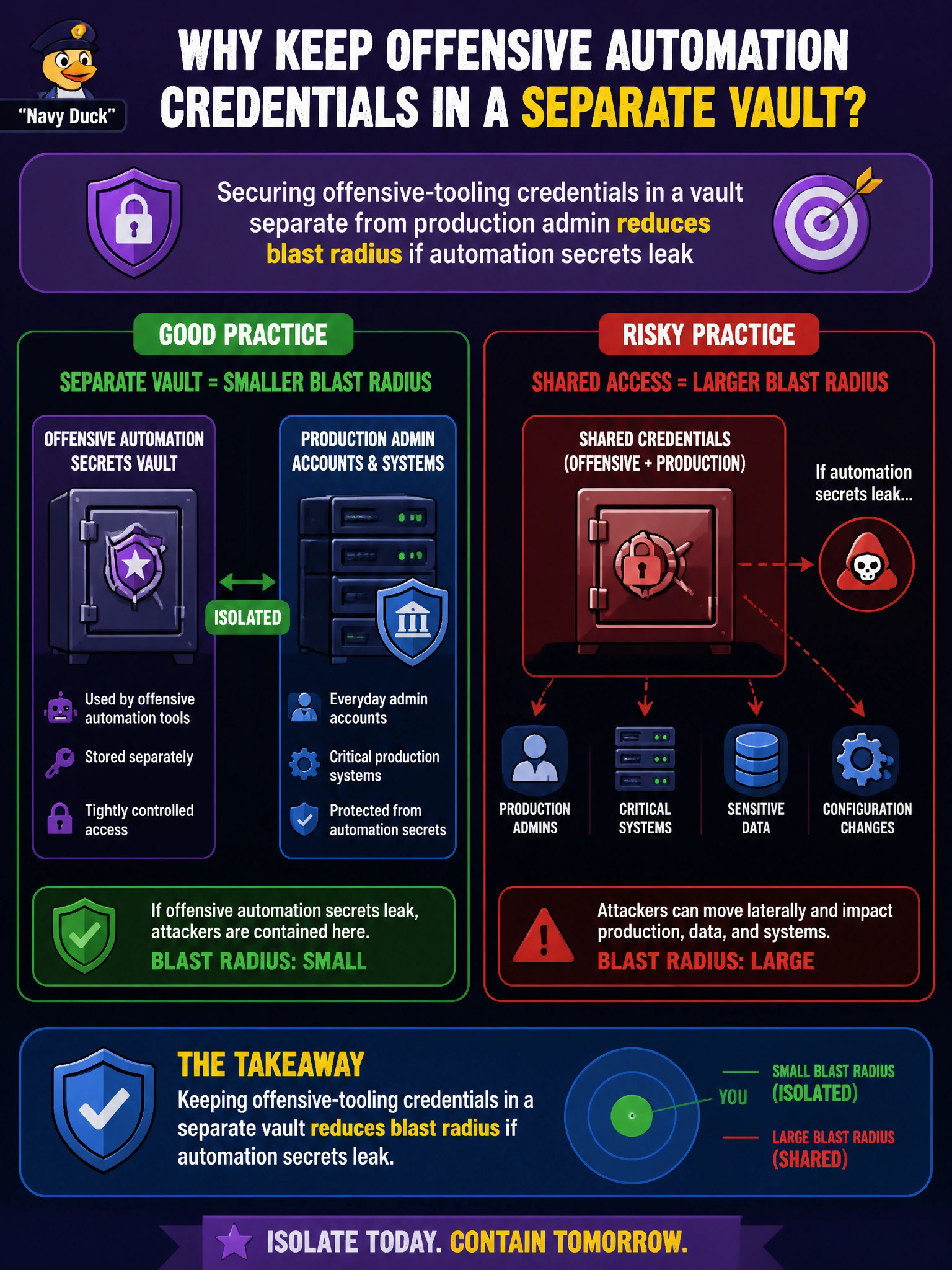
Lab attack-bot passwords do not belong on the same sticky note as production domain admin. A separate vault shrinks the blast radius if something leaks. Vaulting isn’t about preserving chain of custody for your evidence, rotating your everyday admin sessions, or extending admin audit retention.
Full Explanation
County purple teams that store credentials used by offensive automation in a secrets vault separate from everyday production admin accounts are practicing blast-radius isolation for secrets. Emulation tooling often needs passwords, API keys, or service principals; if those secrets leak or are mishandled, separation prevents automatic compromise of production domain administration. Vaulting also centralizes rotation, audit, and least-privilege issuance for lab automation identities.
The correct practice works because offensive-tooling credentials are high-value and high-risk. Isolating them from day-to-day prod admin accounts means a leaked automation secret does not equal “keys to the county.” Separate identities also make SIEM attribution clearer when distinguishing purple activity from genuine admin work.
Claiming that storing emulation credentials in a vault separate from production admin preserves forensic chain of custody for automation evidence confuses secret isolation with evidence handling; separation contains blast radius, it does not document collection or ensure admissibility.
Arguing that separating offensive-tooling secrets from production admin applies automated short-lived token rotation to active everyday admin sessions confuses isolation with lifecycle management; vault separation protects automation secrets, it does not rotate production admin sessions.
Suggesting that keeping automation secrets in a dedicated vault extends production admin audit retention to cover detailed emulation events confuses credential storage with log management; a separate vault does not change how long production admin audits are retained.
Exam caveat: Separate vaulted offensive secrets from production admin credentials—treating that separation as forensic chain-of-custody preservation, automated rotation of everyday admin sessions, or extended admin audit retention is almost always wrong.
Operational check: Create dedicated automation identities, store secrets only in the vault, deny prod DA reuse in pipelines, and rotate on a fixed schedule with access logs reviewed.
Prefer to study offline? Printable PDF study book + test engine ($7.50, unofficial). These questions stay free here.