
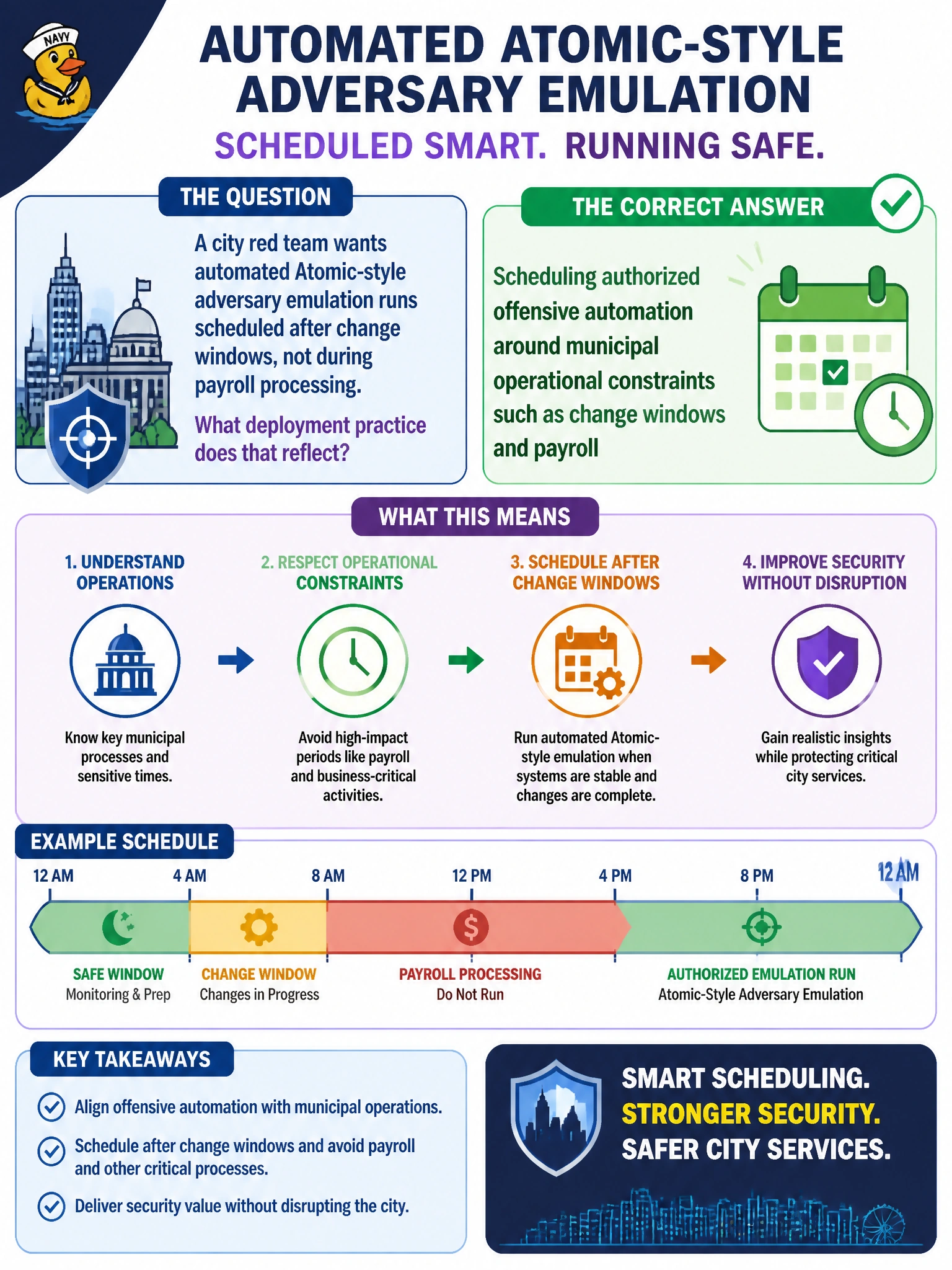
A city red team wants automated Atomic-style adversary emulation runs scheduled after change windows, not during payroll processing. What deployment practice does that reflect?
Select an answer to reveal the explanation.
Short Explanation
Even authorized Atomic runs need a calendar that respects payroll and change windows—like mowing the lawn after the parade, not during it. Safe deployment means picking quiet, approved slots. Scheduling inside those windows means you'll hit payroll head-on, so you won't stay clear of it.
Full Explanation
City red teams that schedule automated Atomic-style adversary emulation after change windows rather than during payroll processing are practicing safe deployment against municipal operational constraints. Authorized offense still consumes shared infrastructure and can create alert noise, performance load, or accidental impact. Aligning jobs to change calendars and avoiding payroll peaks protects civic business continuity while still validating controls.
The correct practice works because timing is a first-class safety control for automation. Change windows provide expected maintenance context; payroll avoidance protects critical availability. The emulation remains authorized and useful without maximizing collateral disruption.
Scheduling authorized offensive automation inside municipal operational constraints such as change windows and payroll fails because it places runs inside constrained periods rather than around them; scheduling inside payroll still hits payroll processing instead of placing emulation after change windows and outside payroll processing. Working inside constraints does not satisfy scheduling runs around municipal operational constraints.
Scheduling authorized offensive automation during municipal operational windows such as change windows and payroll operations fails because it runs during constrained periods rather than around them; running during payroll operations still impacts payroll processing instead of scheduling runs after change windows and outside payroll processing.
Scheduling authorized offensive automation from municipal operational constraints such as change windows and payroll alerts fails because it treats constraints as a source point rather than scheduling boundaries to work around; scheduling from alerts does not sequence emulation after change windows or outside payroll processing.
Exam caveat: Safe municipal offensive automation includes when and where—not only which ATT&CK technique.
Operational check: Bind CI/schedulers to change-calendar APIs or approved windows, block payroll-critical host groups by default, and require exception approval for any off-window run.
Prefer to study offline? Printable PDF study book + test engine ($7.50, unofficial). These questions stay free here.