
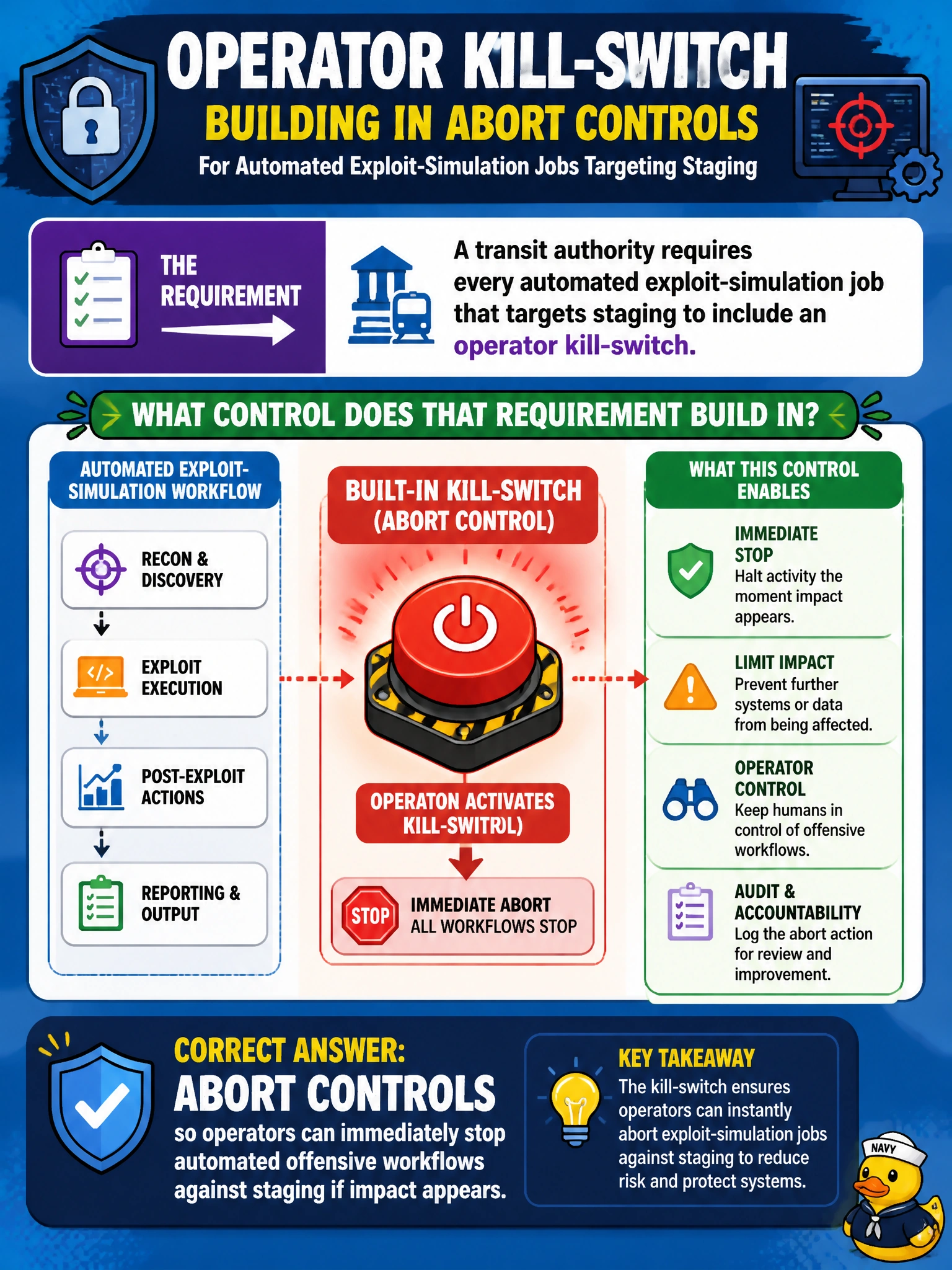
A transit authority requires every automated exploit-simulation job that targets staging to include an operator kill-switch. What control does that requirement build in?
Select an answer to reveal the explanation.
Short Explanation
A kill-switch is the big red stop button on the simulation ride—transit ops need to yank it if staging starts to wobble. Jobs that only approve, audit, or throttle without a stop button are the opposite of safe automation. Build abort in before you press go.
Full Explanation
Transit authorities that require an operator kill-switch on every automated exploit-simulation job targeting staging are building abort controls into offensive automation. Kill-switches let operators stop workflows immediately when unexpected impact, runaway loops, or staging instability appears. For civic labs adjacent to operational systems, stoppability is as important as start authorization.
The correct control works because automation failures are inevitable at some rate. Abort capability converts a potential staging outage into a short, managed interruption. It also supports accountability: someone can intervene without waiting for the job to “finish by design.”
Approval controls requiring lead authorization before automated offensive workflows launch against staging fail by governing whether a job may start rather than whether operators can stop it once running—the opposite of a kill-switch requirement.
Audit controls recording operator actions and tool output from automated offensive workflows against staging fail by capturing what happened rather than giving operators a way to halt the job mid-run—the opposite of a kill-switch requirement.
Throttle controls limiting exploit traffic rate from automated offensive workflows against staging during execution fail by slowing traffic rather than providing a way to stop the job entirely—the opposite of a kill-switch requirement.
Exam caveat: Kill-switch / abort control is a recurring safe-automation theme—prefer jobs with a halt path over ones that only authorize, log, or throttle without letting operators stop them.
Operational check: Test the kill-switch in staging until abort is confirmed within an agreed timebound, ensure operators have visibility dashboards, and block any pipeline that lacks a halt path before enabling it.
Prefer to study offline? Printable PDF study book + test engine ($7.50, unofficial). These questions stay free here.