
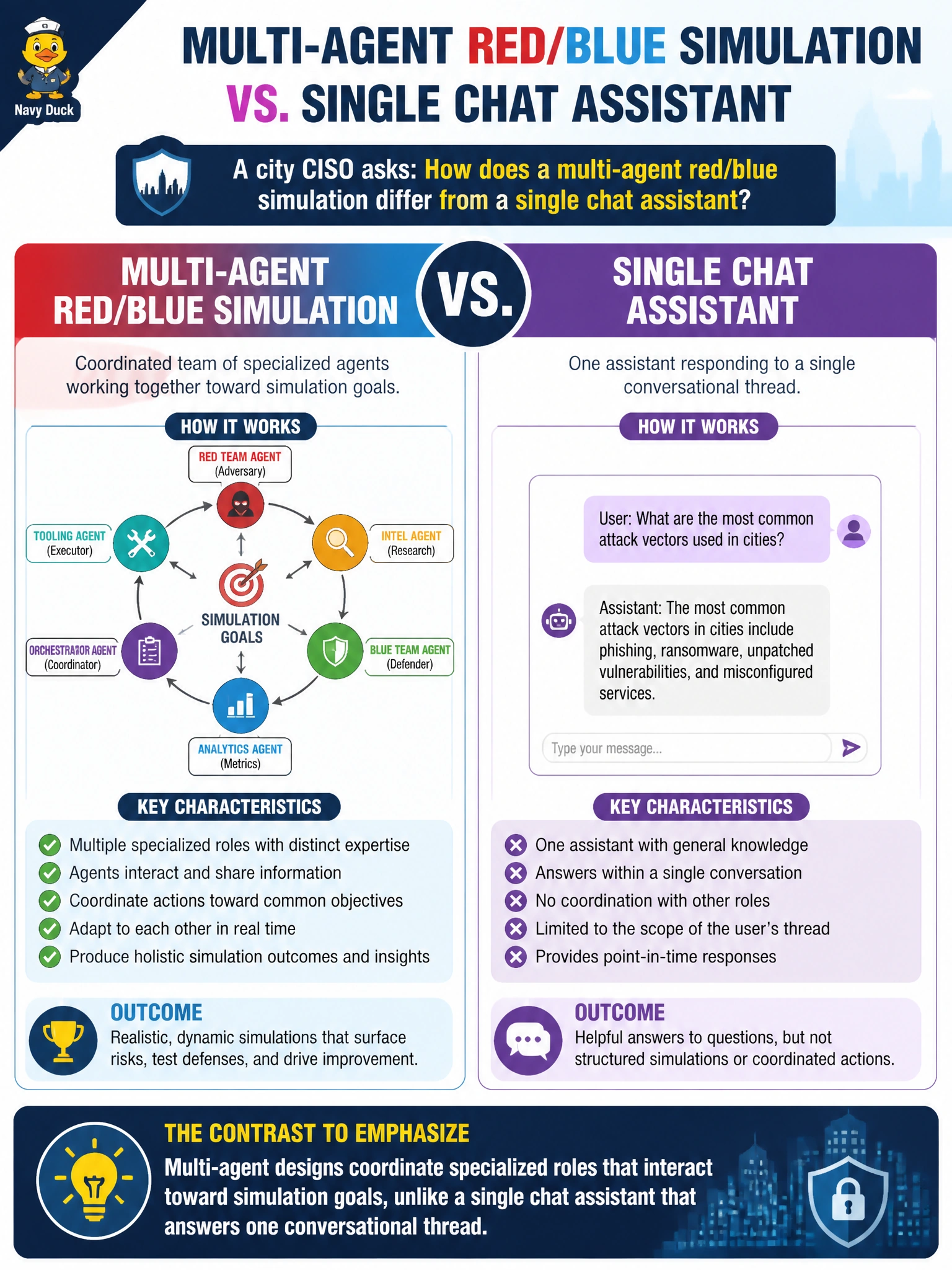
A city CISO asks how a multi-agent red/blue simulation differs from a single chat assistant. What contrast should the automation lead emphasize?
Select an answer to reveal the explanation.
Short Explanation
You'll see multi-agent red/blue sims are more like a tabletop with assigned roles passing the ball; a single chat assistant is one helpful voice in a thread. You'll brief the CISO it's specialized agents interacting toward goals, not just averaging outputs, sharing one prompt, or stretching context windows.
Full Explanation
City CISOs evaluating purple-team automation need a clear contrast: multi-agent designs coordinate specialized roles that interact toward simulation goals, whereas a single chat assistant answers one conversational thread. Multi-agent red/blue simulations can assign recon, attack, detect, or defend responsibilities to separate agents that exchange state—an architectural pattern closer to a tabletop with roles than to one helpful chatbot.
The correct contrast works because role specialization and interaction are the differentiators. Understanding that difference drives procurement, logging, and safety: multi-agent systems need orchestration, per-role tool scopes, and inter-agent message audit trails that a lone assistant does not.
Multi-agent designs coordinate specialized roles that average outputs toward simulation goals, unlike a single chat assistant that answers one conversational thread mischaracterizes the coordination; interacting agents exchange state and take role-specific recon, attack, detect, or defend actions toward goals, not merely average their outputs.
Multi-agent designs coordinate specialized roles that share one system prompt toward simulation goals, unlike a single chat assistant that answers one conversational thread erases role separation; multi-agent designs require distinct role prompts with per-role tool scopes and controlled message channels, while one shared system prompt describes a single assistant.
Multi-agent designs coordinate specialized roles that expand context windows toward simulation goals, unlike a single chat assistant that answers one conversational thread confuses scaling with architecture; expanding a context window still leaves one conversational thread, whereas multi-agent coordination means separate specialized agents interacting.
Exam caveat: Multi-agent = specialized interacting roles; single assistant = one conversational thread. Watch for options that erase that distinction.
Operational check: If the pilot claims “multi-agent red/blue,” verify distinct role agents, controlled message channels, and separate tool allowlists—not merely a renamed single chatbot.
Prefer to study offline? Printable PDF study book + test engine ($7.50, unofficial). These questions stay free here.