
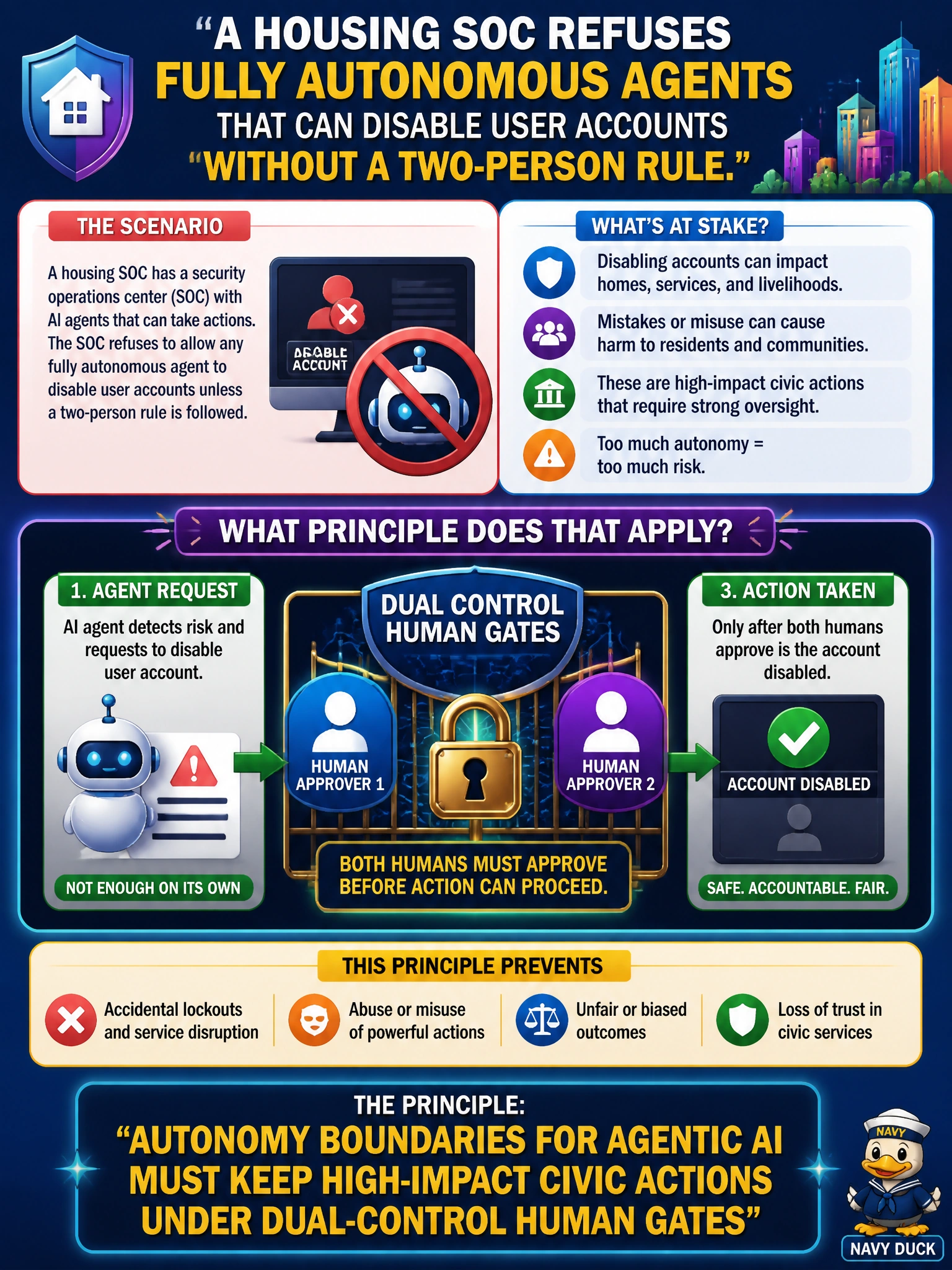
A housing SOC refuses fully autonomous agents that can disable user accounts without a two-person rule. What principle does that apply?
Select an answer to reveal the explanation.
Short Explanation
Disabling accounts is a big red lever—housing SOCs still want two humans on that switch even if an agent is helpful. Autonomy boundaries keep the model from yanking levers alone. Letting an agent disable accounts just because you've gated low-impact drafts, you've logged it with dual-control attestation, or you'll audit it after use is how you'll end up with avoidable outages.
Full Explanation
Housing SOCs that refuse fully autonomous agents able to disable user accounts without a two-person rule are applying autonomy boundaries: high-impact civic actions stay under dual-control human gates. Account disable can lock out staff, disrupt resident services, and complicate incident response; dual control exists precisely because mistakes and abuse are costly. Agentic AI does not retire those controls—it must be fitted inside them.
The correct principle works by treating autonomy as a governed privilege, not a default. Agents may enrich tickets or draft recommendations, but directory-changing actions require the same dual-control discipline used for manual admin work—often two humans, break-glass procedures, and logged approval.
Autonomy boundaries for agentic AI must keep low-impact civic drafts under dual-control human gates fails because it puts the dual-control gate on the wrong risk tier; low-impact drafts do not need two humans, and controlling drafts does nothing to stop an autonomous account disable.
Autonomy boundaries for agentic AI must log high-impact civic actions with dual-control human attestation fails because attested logs still record the action rather than gate it; two humans attesting after the fact does not stop a wrongful lockout or enforce approval before the directory change.
Autonomy boundaries for agentic AI must keep high-impact civic actions under dual-control human audit after use fails because audit after use happens after the action fires and does not stop a wrongful lockout; it misses the actual control the housing SOC is protecting — dual-control approval before the action fires at all.
Exam caveat: High-impact actions + agentic AI ⇒ dual-control/human gates, not dual-control for low-impact drafts, logging with dual-control attestation, or dual-control audit after use alone.
Operational check: Remove account-disable tools from autonomous agent allowlists, require dual approval in the workflow UI, and test that a solo agent session cannot disable accounts even if prompted.
Prefer to study offline? Printable PDF study book + test engine ($7.50, unofficial). These questions stay free here.