
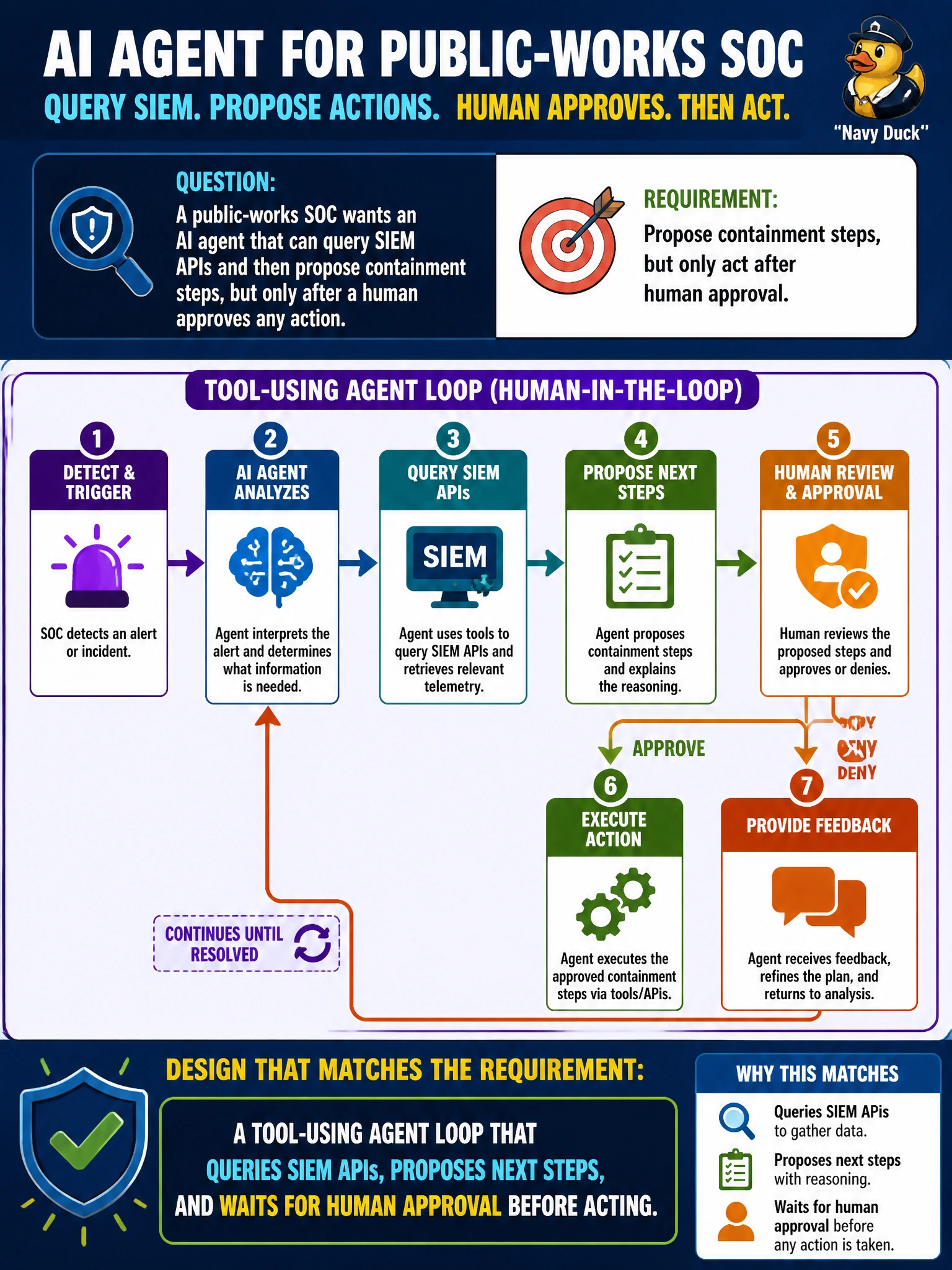
A public-works SOC wants an AI agent that can query SIEM APIs and then propose containment steps, but only after a human approves any action. Which design matches that requirement?
Select an answer to reveal the explanation.
Short Explanation
Picture an agent that looks up SIEM facts, writes a suggested play, then waits for the human thumbs-up before anything moves. That’s tool use plus a gate—not a single-shot RAG chain that can’t loop tools for you, a loop that only summarizes dashboards without querying APIs, or one that drafts summaries without proposing containment for you. Public works still owns the decision.
Full Explanation
Public-works SOCs that want an AI agent to query SIEM APIs and propose containment steps only after human approval need a tool-using agent loop with a hard governance gate. The agent may gather evidence through approved APIs and draft next steps, but impactful actions wait for an analyst. That design preserves automation’s speed for enrichment while keeping civic accountability on humans for containment that could affect services or accounts.
The correct design works because tool use and autonomy are separable. Querying SIEM APIs is relatively low impact when read-scoped; executing containment is high impact. Inserting human approval between proposal and action is the operational expression of least privilege for agentic IR.
A single-shot RAG chain that queries SIEM APIs, proposes next steps, and waits for human approval before acting fails because a single retrieval-generation pass is not a tool-using agent loop and cannot iteratively query SIEM APIs to drive the investigation.
A tool-using agent loop that summarizes SIEM dashboards, proposes next steps, and waits for human approval before acting fails because summarizing dashboards does not satisfy the requirement to query SIEM APIs for evidence gathering.
A tool-using agent loop that queries SIEM APIs, drafts incident summaries, and waits for human approval before acting fails because drafting summaries alone does not propose containment steps for approval as the stem requires.
Exam caveat: Prefer “tool-using agent + human approval before action” when stems combine API queries with containment proposals.
Operational check: Scope SIEM credentials to read/query where possible, render proposals in a queue requiring explicit approve/deny, and ensure no containment API can be called until approval is recorded.
Prefer to study offline? Printable PDF study book + test engine ($7.50, unofficial). These questions stay free here.