
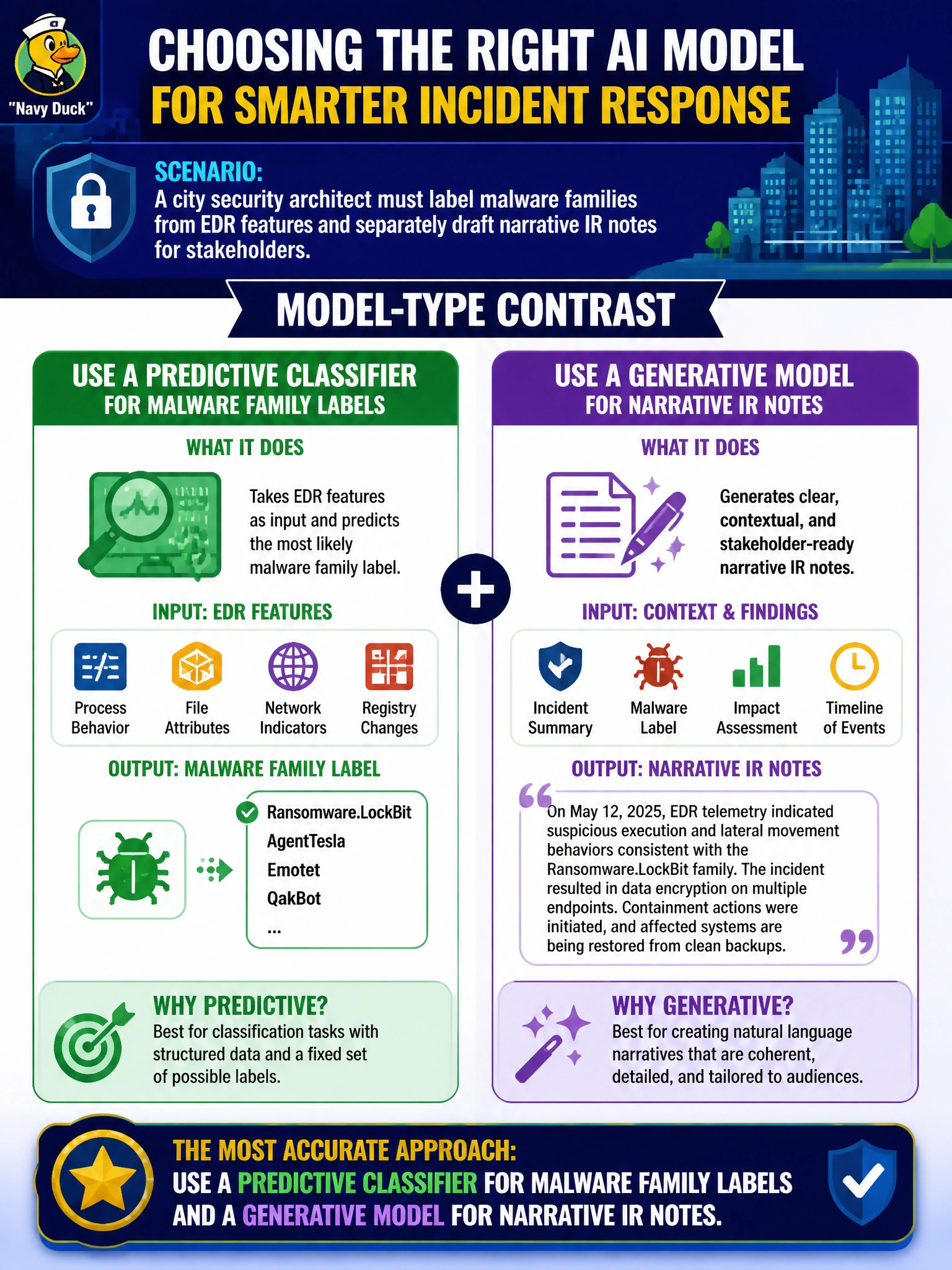
A city security architect must label malware families from EDR features and separately draft narrative IR notes for stakeholders. Which model-type contrast is most accurate?
Select an answer to reveal the explanation.
Short Explanation
Classifiers are the sorting hat for malware families; generative models are the storyteller for IR notes. Pick the tool that matches the job—don't make the novelist do the barcode scan or flip a coin for labels. Right model, right task.
Full Explanation
City security architects facing two distinct jobs—labeling malware families from EDR features and drafting narrative IR notes for stakeholders—should match model type to task: a predictive classifier for discrete family labels and a generative model for narrative notes. Classification maps feature vectors to a closed label set with measurable precision/recall; generation produces free-form text suitable for stakeholder communication. Using the right paradigm for each problem improves accuracy on labels and clarity on narratives.
The correct contrast works because discrete labeling and open-ended writing have different error modes and evaluation methods. Classifiers are judged on confusion matrices; narratives are judged on completeness, tone, and factual alignment with the ticket. Municipal programs that conflate the two often get confidently wrong family tags or stilted, unusable stakeholder prose.
Using a generative model for malware family labels and a predictive classifier for narrative IR notes drafts fails when stable, auditable family codes are required. Generative labeling drifts and invents family names, while classifiers cannot produce the coherent free-form prose stakeholders need.
Using a regression model for malware family labels and a translation model for narrative IR notes reverses the strengths of each approach. Regression fits continuous outcomes, not discrete family tags, and translation moves text between languages instead of drafting stakeholder prose from ticket details.
Using an anomaly detector for known malware family labels and a captioning model for narrative IR notes fails outright: anomaly detectors flag outliers rather than assign known family codes to a closed set, and captioning describes images rather than drafting stakeholder narratives from ticket fields.
Exam caveat: Look for “classifier for labels, generative for narrative” when stems split discrete tagging from prose drafting.
Operational check: Route EDR feature bundles through the classifier with a reviewed label taxonomy; draft IR notes with a generative model grounded in ticket fields; never let generative free-text become the system of record for malware family codes without a closed-set mapping.
Prefer to study offline? Printable PDF study book + test engine ($7.50, unofficial). These questions stay free here.