
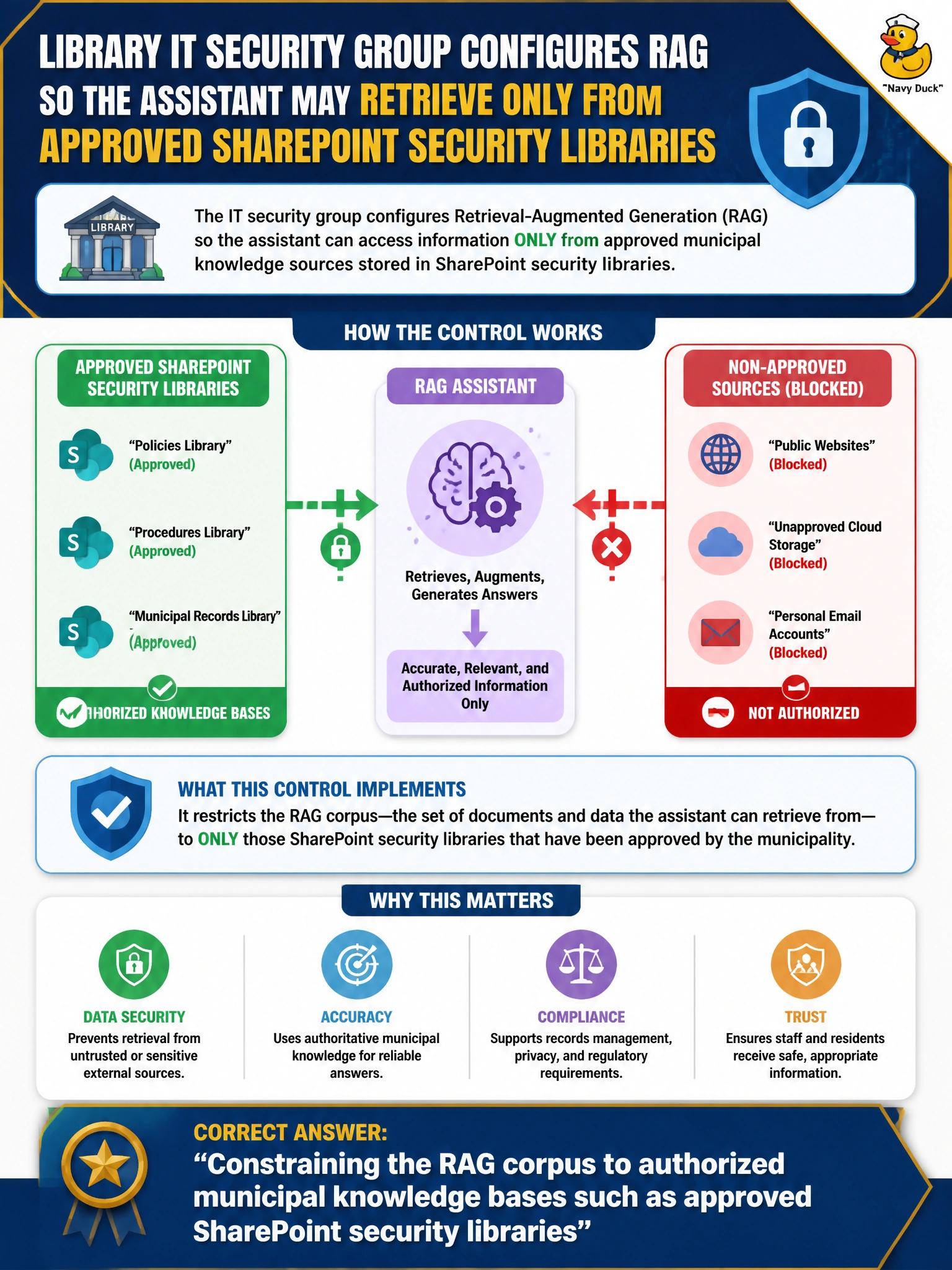
A library IT security group configures RAG so the assistant may retrieve only from approved SharePoint security libraries. What control does that implement?
Select an answer to reveal the explanation.
Short Explanation
Think of approved SharePoint libraries as the only shelves the assistant is allowed to pull books from. You'll keep answers inside authorized municipal knowledge—not requestor-level permission filters, encryption with municipal key services, or logging requests and answers for audit review. Scope the corpus on purpose.
Full Explanation
Library IT security groups that configure RAG so the assistant may retrieve only from approved SharePoint security libraries are implementing corpus constraint: generative answers are limited to authorized municipal knowledge bases. Corpus control is a primary RAG governance lever—what can be retrieved largely determines what can be said. Approved SharePoint security libraries have ownership, access control, and review processes that requestor-level permission filtering, encryption with municipal key services, and recording retrieval requests and generated answers for municipal audit review do not substitute for.
The correct control works by narrowing the retrieval allowlist to vetted collections. That prevents reliance on requestor-level permission filtering, encryption with municipal key services, or recording retrieval requests and generated answers for municipal audit review to define the corpus, and keeps answers aligned with library-system security standards.
Enforcing requestor-level SharePoint permissions to filter chunks from approved SharePoint security libraries fails because it controls who can see a chunk after retrieval, not which libraries the assistant may retrieve from in the first place; it does not constrain the corpus to approved municipal knowledge bases.
Encrypting the search index and vector store for approved SharePoint security libraries with municipal key services fails because encryption protects data at rest but does not limit retrieval to approved libraries. It is a confidentiality control, not a corpus-scoping control.
Recording retrieval requests and generated answers from approved SharePoint security libraries for municipal audit review fails because it provides after-the-fact visibility for audit, not a preventive limit on retrieval; it does not constrain the corpus to approved municipal knowledge bases.
Exam caveat: RAG governance items frequently test corpus scoping. “Approved SharePoint/security libraries” beats requestor-level permission filtering, encryption with municipal key services, and recording retrieval requests and generated answers for municipal audit review as the governing control.
Operational check: Maintain the allowlist of approved SharePoint security libraries in change control, verify retrieval is scoped to those collections, and confirm that requestor-level permission filtering, encryption with municipal key services, or recording retrieval requests and generated answers for municipal audit review are layered on top of—not substitutes for—corpus constraint.
Prefer to study offline? Printable PDF study book + test engine ($7.50, unofficial). These questions stay free here.