
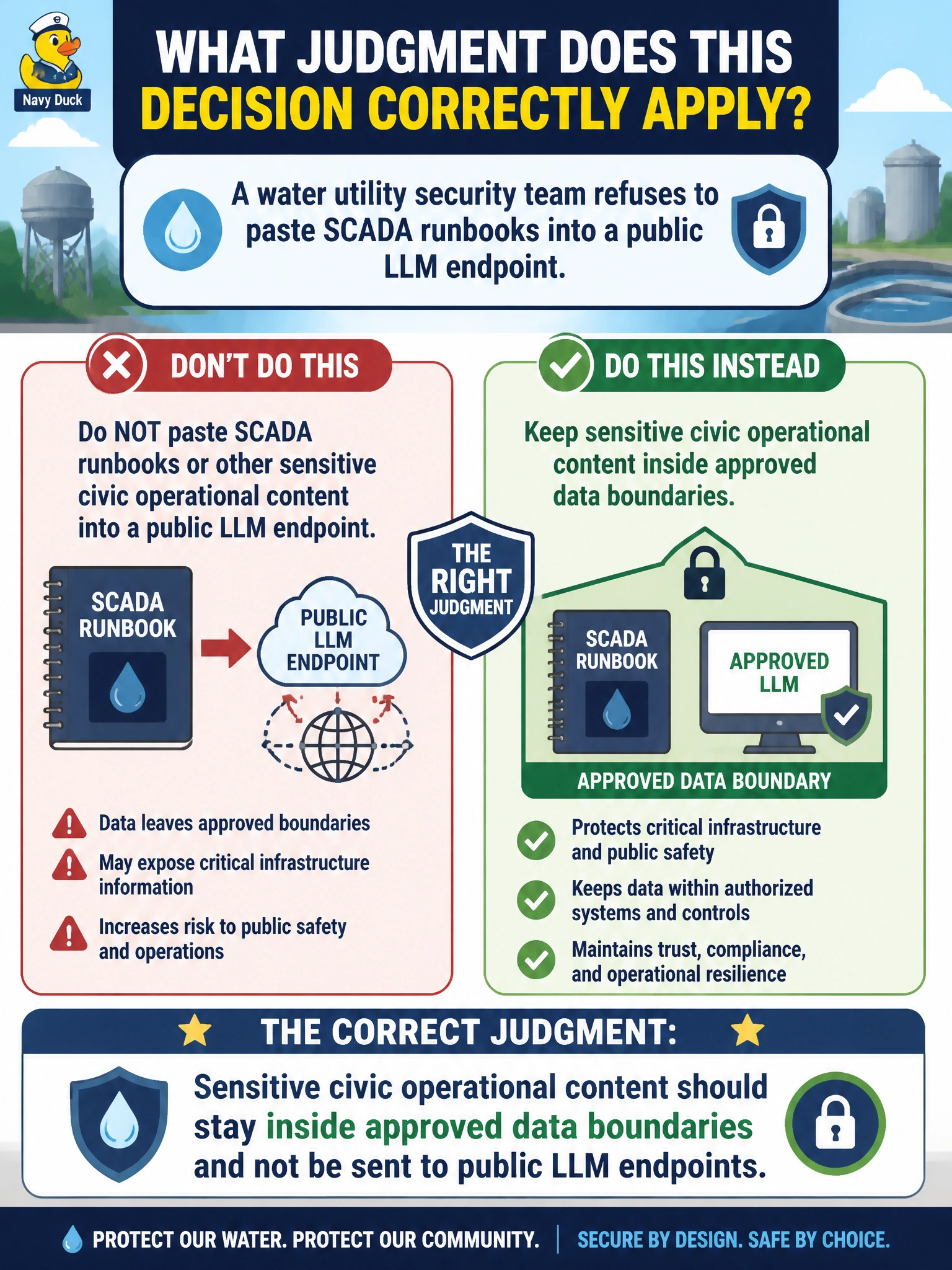
A water utility security team refuses to paste SCADA runbooks into a public LLM endpoint. What judgment does that decision correctly apply?
Select an answer to reveal the explanation.
Short Explanation
SCADA runbooks are the utility's private playbook—you don't mail them to a stranger's clipboard just because the chatbot is handy. Keeping them inside approved boundaries is the right call. Banning a private VPC deployment, an enterprise tenancy, or an isolated enclave misses the point since you'll still be inside approved boundaries using those.
Full Explanation
Water-utility security teams correctly refuse to paste SCADA runbooks into public LLM endpoints because sensitive civic operational content must remain inside approved data boundaries. OT procedures describe control logic, recovery steps, vendor tooling, and network detail that adversaries and unauthorized parties should not receive. Public generative endpoints typically retain or process prompts under provider terms that are unsuitable for critical-infrastructure operational documents—even when staff intend “just a quick rewrite.”
The correct judgment works because it treats data classification and boundary enforcement as prerequisites to any AI assist. If generative help is still desired, the approved path is a private, contracted, or on-premises deployment with retention controls, access logging, and clear prohibition on exporting OT corpora to the public internet.
Claiming sensitive civic operational content should stay inside approved data boundaries and not be sent to private VPC LLM deployments fails because a private VPC deployment with retention controls, access logging, and contractual safeguards can serve as an approved data boundary. It overextends the correct refusal of public endpoints into a ban on an approved private path where OT content can remain under agency control.
Claiming sensitive civic operational content should stay inside approved data boundaries and not be sent to enterprise LLM tenancies fails because a contracted enterprise tenancy with retention controls and access logging can be an approved boundary. That option confuses the public-endpoint prohibition with a ban on enterprise handling that keeps prompts inside controlled systems.
Claiming sensitive civic operational content should stay inside approved data boundaries and not be sent to isolated agency LLM enclaves fails because an isolated agency enclave is a core example of an approved data boundary. Banning that enclave removes the very agency-controlled path the correct judgment preserves for any needed AI assist.
Exam caveat: Stems about refusing public paste of OT or SCADA content are testing data-boundary judgment, not anti-AI absolutism. The right answer keeps sensitive civic content inside approved systems.
Operational check: Inventory where runbooks live, block paste into public chat via DLP or policy, and if AI drafting is needed, route only through an approved private endpoint with logging and a documented exception process.
Prefer to study offline? Printable PDF study book + test engine ($7.50, unofficial). These questions stay free here.