
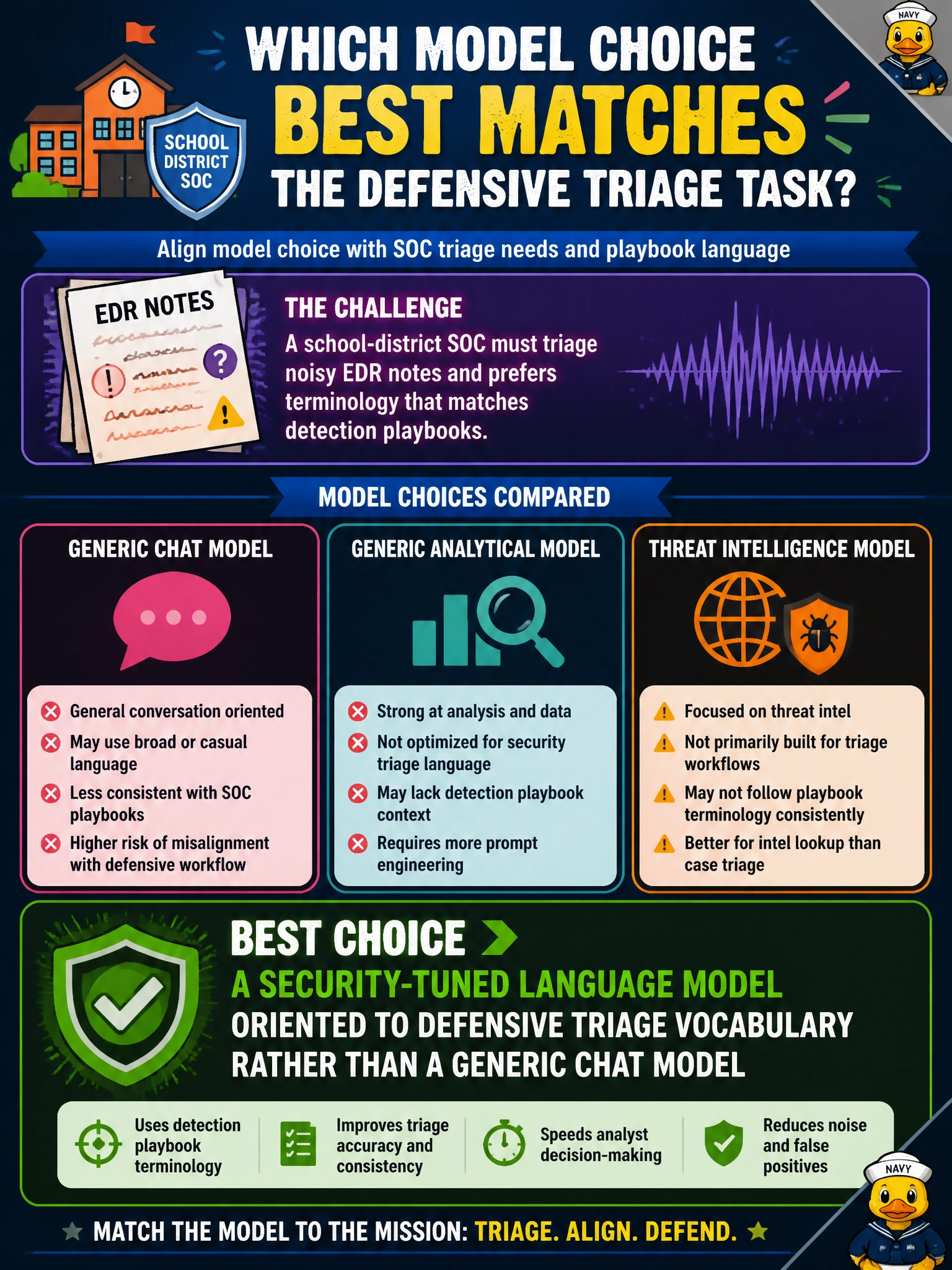
A school-district SOC must triage noisy EDR notes and prefers terminology that matches detection playbooks. Which model choice best matches that defensive triage task?
Select an answer to reveal the explanation.
Short Explanation
EDR notes are full of detection jargon—think of a security-tuned model as a tech who already knows the shop slang, while an offensive-tuned model is still stuck on attacker-side wording. A forensic-tuned model digs into post-incident detail and an executive-tuned model speaks leadership lingo, so they don't speak your playbook language. Match the model to the triage job.
Full Explanation
School-district SOC triage of noisy EDR notes is a domain-language task: alerts, severities, process trees, and detection playbook terms must map cleanly into analyst workflows. A security-tuned language model oriented to defensive triage vocabulary is the best fit because it is optimized for that terminology and for summarization or classification patterns that mirror how municipal detection playbooks are written. Domain fit improves consistency when the assistant restates alerts, proposes playbook steps, or groups related detections.
The correct choice works by matching model capability to the data modality and the job. EDR notes are primarily text with security jargon; a model that already “speaks” that defensive jargon reduces mislabeling and avoids reframing alerts in offensive triage vocabulary centered on attacker-side actions rather than district-approved defensive playbook language.
A security-tuned language model oriented to offensive triage vocabulary rather than a generic chat model fails for this triage task because its vocabulary is built around attacker-side actions and exploit concepts, not defensive EDR alert terminology and playbook steps. It tends to restate alerts in offensive triage vocabulary rather than defensive playbook terms, and it is not optimized for the defensive-triage classification patterns the SOC needs.
A security-tuned language model oriented to forensic triage vocabulary rather than a generic chat model fails by task focus. Using forensic triage vocabulary is a post-incident investigation activity, not a defensive triage vocabulary task, so it does not help an analyst restate noisy EDR notes using the district’s playbook terminology.
A security-tuned language model oriented to executive triage vocabulary rather than a generic chat model fails by orientation. Its language is built around high-level executive summaries and leadership-level triage wording, not the defensive triage vocabulary that detection playbooks use, so it steers triage notes away from the terminology analysts need.
Exam caveat: When a stem emphasizes terminology that matches detection playbooks, look for security-tuned or domain-oriented language models—not “any AI” and not models that never see the text.
Operational check: Pilot the security-tuned model on a sample of real (sanitized) EDR notes, score terminology alignment against playbook language, verify district data-handling controls, and reject any path that routes raw endpoint notes to an offensive-triage-vocabulary model.
Prefer to study offline? Printable PDF study book + test engine ($7.50, unofficial). These questions stay free here.