
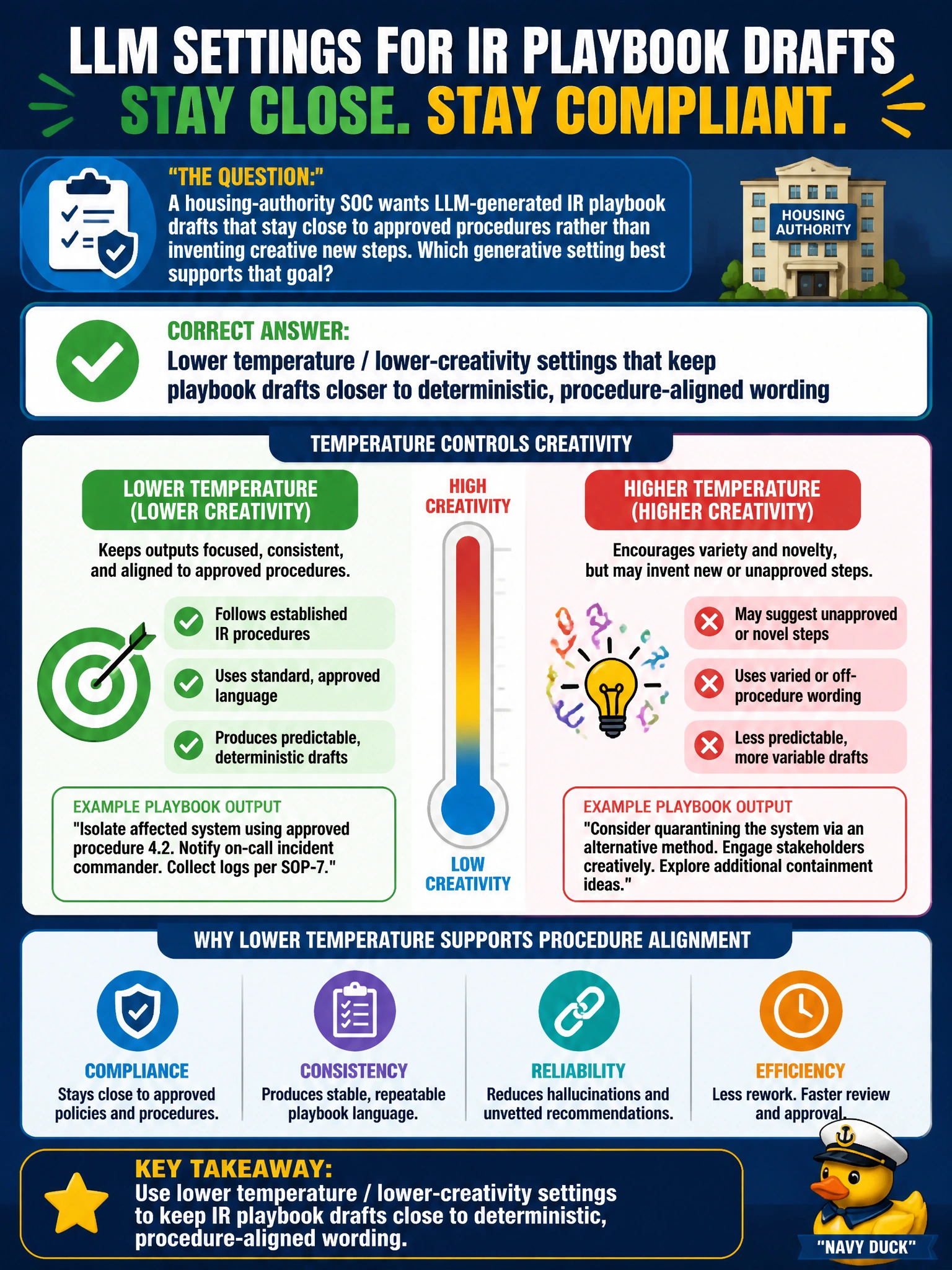
A housing-authority SOC wants LLM-generated IR playbook drafts that stay close to approved procedures rather than inventing creative new steps. Which generative setting best supports that goal?
Select an answer to reveal the explanation.
Short Explanation
Playbook drafts need the steady hand, not the jazz solo. Lower temperature keeps the wording closer to what your approved procedures already say. Raising top-p and top-k cutoffs still loosens token choice, trimming token limits just makes it shorter, and pinning chunk size and vectors doesn't tame creativity, so you'll still drift into unapproved steps nobody authorized.
Full Explanation
Housing-authority SOC drafting of IR playbooks with an LLM should favor lower temperature and related low-creativity decoding settings so wording stays close to approved procedures. Temperature and similar knobs control how exploratory versus deterministic sampling is: higher settings increase novelty and paraphrase drift; lower settings favor steadier, more repeatable phrasing. For civic playbooks, inventiveness is a liability because unauthorized steps can become operational dogma if staff treat the draft as authoritative.
The correct setting works because procedure-aligned drafting is a constrained generation task. The goal is faithful restatement and structuring of existing policy—not creative invention of containment ideas. Lower creativity settings support that goal when paired with grounding in approved source documents.
Raise top-p and top-k cutoffs for low-creativity outputs that keep playbook drafts closer to deterministic, procedure-aligned wording fails by optimizing for the wrong objective. Raising those cutoffs increases sampling randomness and paraphrase drift despite the low-creativity claim, so drafts drift away from deterministic, procedure-aligned wording and risk introducing steps that conflict with housing authority policy, union rules, vendor SLAs, or legal notice requirements.
Set lower output token limits for low-creativity outputs that keep playbook drafts closer to deterministic, procedure-aligned wording fails because it prioritizes length control over fidelity: shorter generation still allows paraphrase drift and invention within the budget and can omit required procedure steps, and conciseness alone creates false authority that auditors and responders cannot verify.
Pin RAG chunk size and vectors for low-creativity outputs that keep playbook drafts closer to deterministic, procedure-aligned wording fails because it stabilizes retrieval reproducibility rather than enforcing staying within approved housing-authority procedures at generation time. Pinned chunk size and vectors can make retrieved passages more repeatable, but they do not make sampling more deterministic, so drafts can still drift from procedure-aligned wording and strip the procedural guardrails municipal IR content requires.
Exam caveat: On GASAE items, “more creative” is rarely correct for policy or playbook drafting. Prefer low temperature, grounding, and procedure alignment.
Operational check: Generate the same playbook section at low versus high temperature against the approved source, require citations or retrieved procedure text, and reject drafts that introduce steps or policy titles absent from the official corpus.
Prefer to study offline? Printable PDF study book + test engine ($7.50, unofficial). These questions stay free here.