
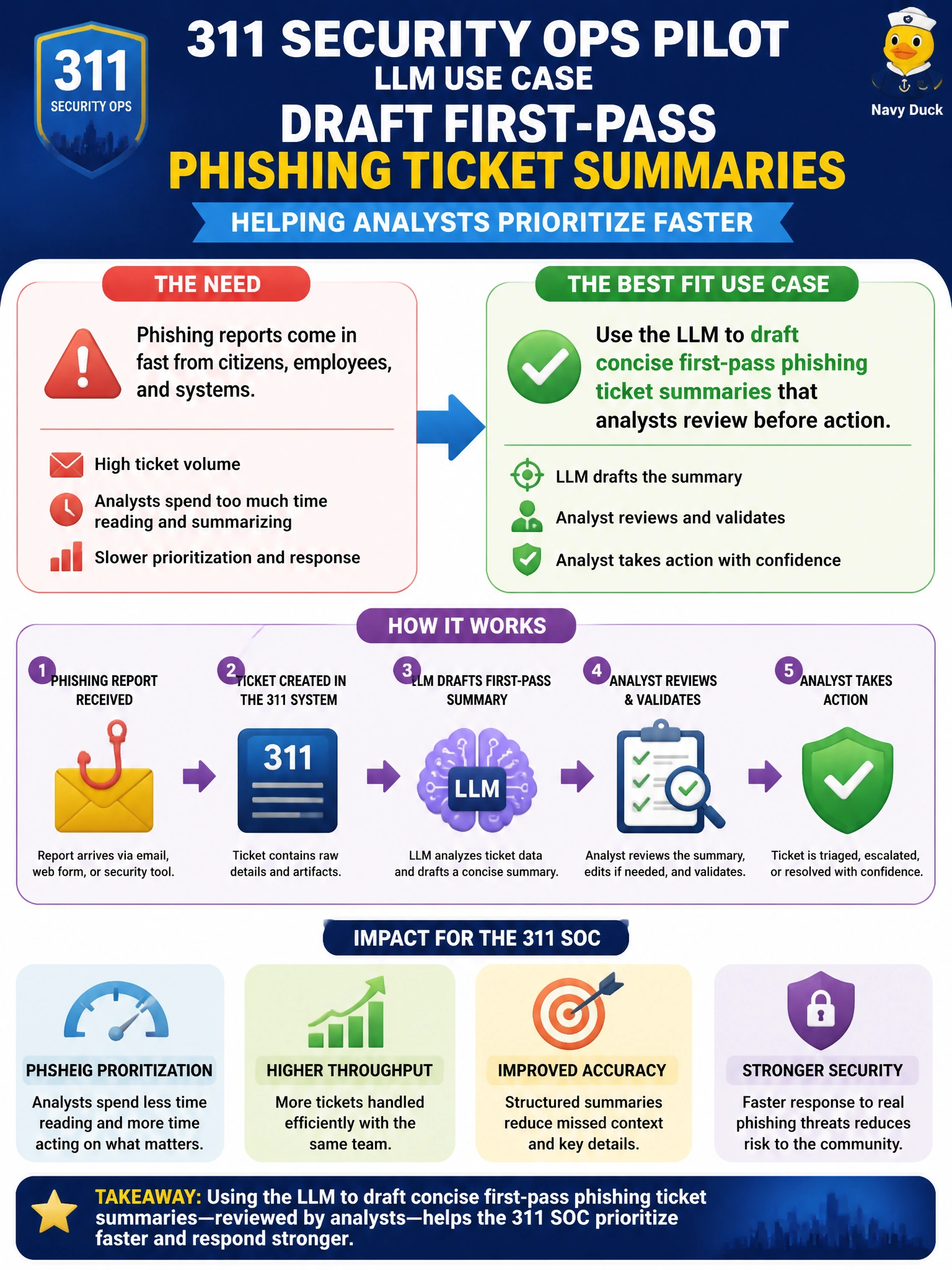
A 311 security ops pilot wants an LLM to draft first-pass phishing ticket summaries so analysts can prioritize faster. Which use case best fits that municipal SOC need?
Select an answer to reveal the explanation.
Short Explanation
Think of the LLM as a junior aide who sketches the ticket summary while the analyst still owns the call. You'll speed triage when you review first-pass drafts before you act, while final verdicts overstep your call and reviewing after action misses that timing. You'll also add risk if you're issuing blocks since that's enforcement, not an editable summary.
Full Explanation
In a municipal 311 security operations pilot, the highest-value LLM use case for phishing work is drafting concise first-pass ticket summaries that analysts still review before any action. That pattern matches how civic SOCs already use junior triage aides: the model accelerates reading and prioritization, while investigators retain ownership of evidence validation, severity, and disposition. Keeping humans in the loop is not optional when tickets may involve citizen PII, municipal email systems, or related fraud against public services.
The correct choice works because summarization is a bounded, reversible assistive task. Draft text can be edited, rejected, or discarded without changing production controls. Analysts gain speed on volume spikes without surrendering investigative authority.
Using the LLM to draft concise final phishing ticket verdicts that analysts review before action fails because it turns a reversible triage aid into an authoritative disposition, not a first-pass summary. The pilot’s need is to speed analyst reading and prioritization of incoming tickets, not to have the model decide the final verdict that requires evidence validation, severity assignment, and disposition ownership. Letting the LLM frame the final call risks automation bias and surrenders investigative authority even if analysts still glance at it before action.
Using the LLM to draft concise first-pass phishing ticket summaries that analysts review after action fails because it reverses the human-in-the-loop timing to after the decision, not review before action. The SOC pilot aims to accelerate internal prioritization of active tickets, not to document tickets that analysts have already acted on. Reviewing after action cannot help analysts decide which incoming ticket to prioritize next and leaves any model error uncaught until impact has already occurred.
Using the LLM to issue concise first-pass phishing ticket blocks that analysts review before action fails because it changes a reversible drafting assist into an enforcement action, not a summary for review. The pilot needs first-pass summaries for incoming tickets to speed prioritization, not model-issued blocks that would change production email controls and require deep indicator correlation. Even with review before action, issuing blocks adds containment risk and leaves analysts triaging from enforcement proposals rather than editable evidence summaries.
Exam caveat: GASAE-style items often tempt candidates with “full automation” or “more AI power.” Prefer assistive drafting plus human review before action over drafting final verdicts, reviewing after action, or issuing blocks.
Operational check: Confirm the pilot’s output lands in the ticketing UI as editable drafts reviewed before action, that drafting final verdicts, reviewing after action, and issuing blocks are kept out of the triage workflow, and that a sample of summaries is spot-checked against original ticket evidence before analysts act.
Prefer to study offline? Printable PDF study book + test engine ($7.50, unofficial). These questions stay free here.