
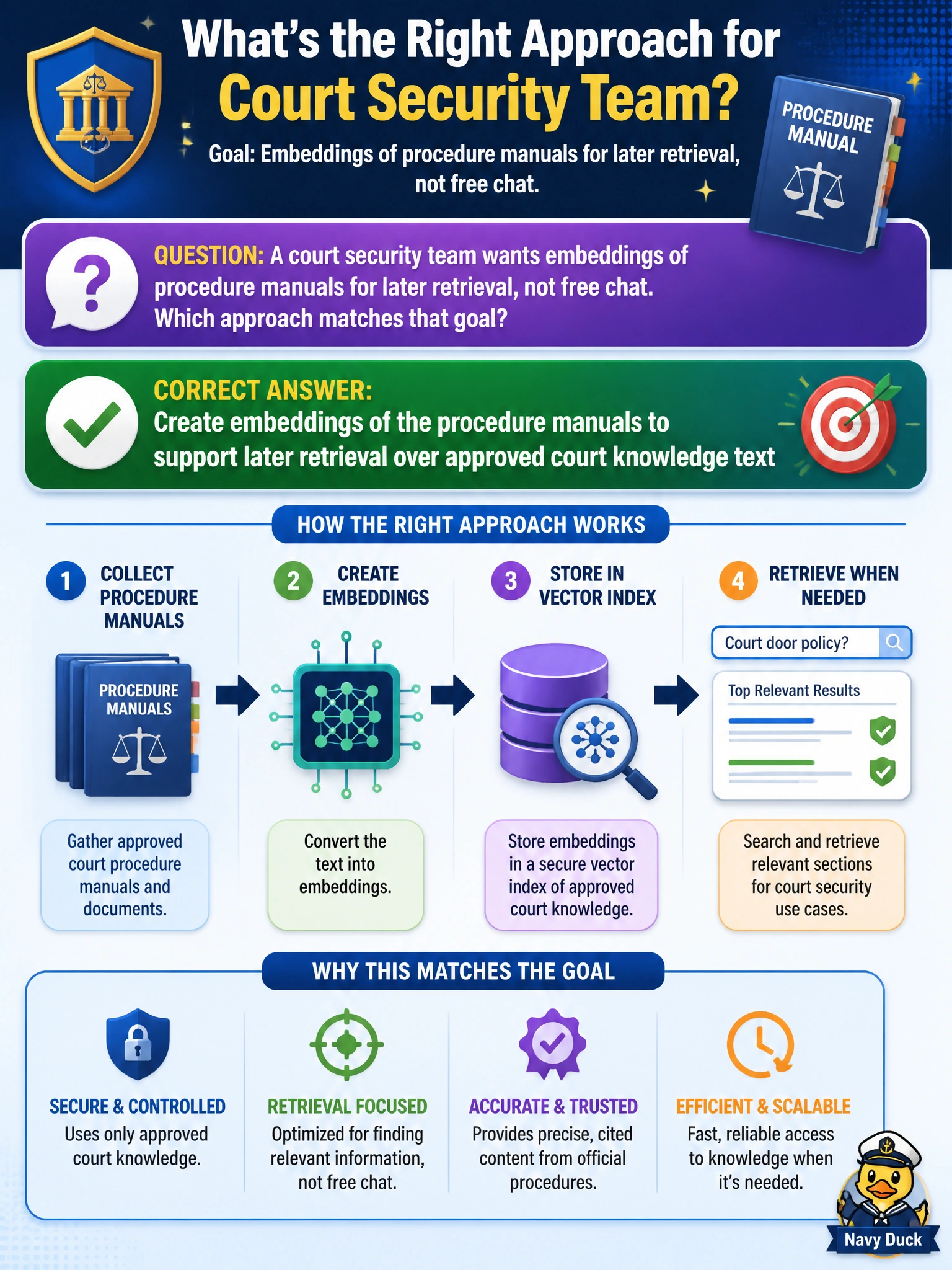
A court security team wants embeddings of procedure manuals for later retrieval, not free chat. Which approach matches that goal?
Select an answer to reveal the explanation.
Short Explanation
Embeddings are like library call numbers for chunks of the procedure binder—built so you can retrieve the right section later, and you'll miss paraphrased steps if you expect exact-match lookup because they're made for meaning, not identical words. Embedding the manuals for model fine-tuning won't help you, since you'll bake the text into weights and lose the searchable index you'll need for governed retrieval. Pulling those embeddings from chat memory won't help you, since you won't have a durable, access-controlled index you can search later.
Full Explanation
A court security team that wants embeddings of procedure manuals for later retrieval—not free chat—should create embeddings of those manuals to support retrieval over approved court knowledge text. Embeddings index chunks for semantic lookup so responders pull the right municipal procedure section for governed retrieval, not creating embeddings of the procedure manuals to support later exact-match lookup over approved court knowledge text, which misses paraphrased procedures because embeddings are built for semantic similarity rather than exact keyword matching. The goal is governed retrieval over an approved corpus, not creating embeddings of the procedure manuals to support later model fine-tuning over approved court knowledge text as the primary interface, which would bake procedures into model weights instead of keeping a searchable retrieval index.
Creating embeddings of the procedure manuals to support later model fine-tuning over approved court knowledge text still shifts the task to training weights rather than retrieval, losing citable lookup and making updates harder when manuals change. Creating embeddings of the procedure manuals to support later retrieval from chat memory over approved court text does not create a durable retrieval index and shifts the task to ephemeral conversation storage rather than governed lookup.
Exam caveat: embeddings enable retrieval quality only if chunking, access control, and corpus freshness are maintained; stale or overly broad indexes can surface wrong procedures. Operational check: embed approved court procedure manuals into an access-controlled index, test retrieval questions against known sections, avoid using those embeddings to support later exact-match lookup over approved court knowledge text that misses differently worded procedures, and re-embed when manuals are updated under change control.
Prefer to study offline? Printable PDF study book + test engine ($7.50, unofficial). These questions stay free here.