
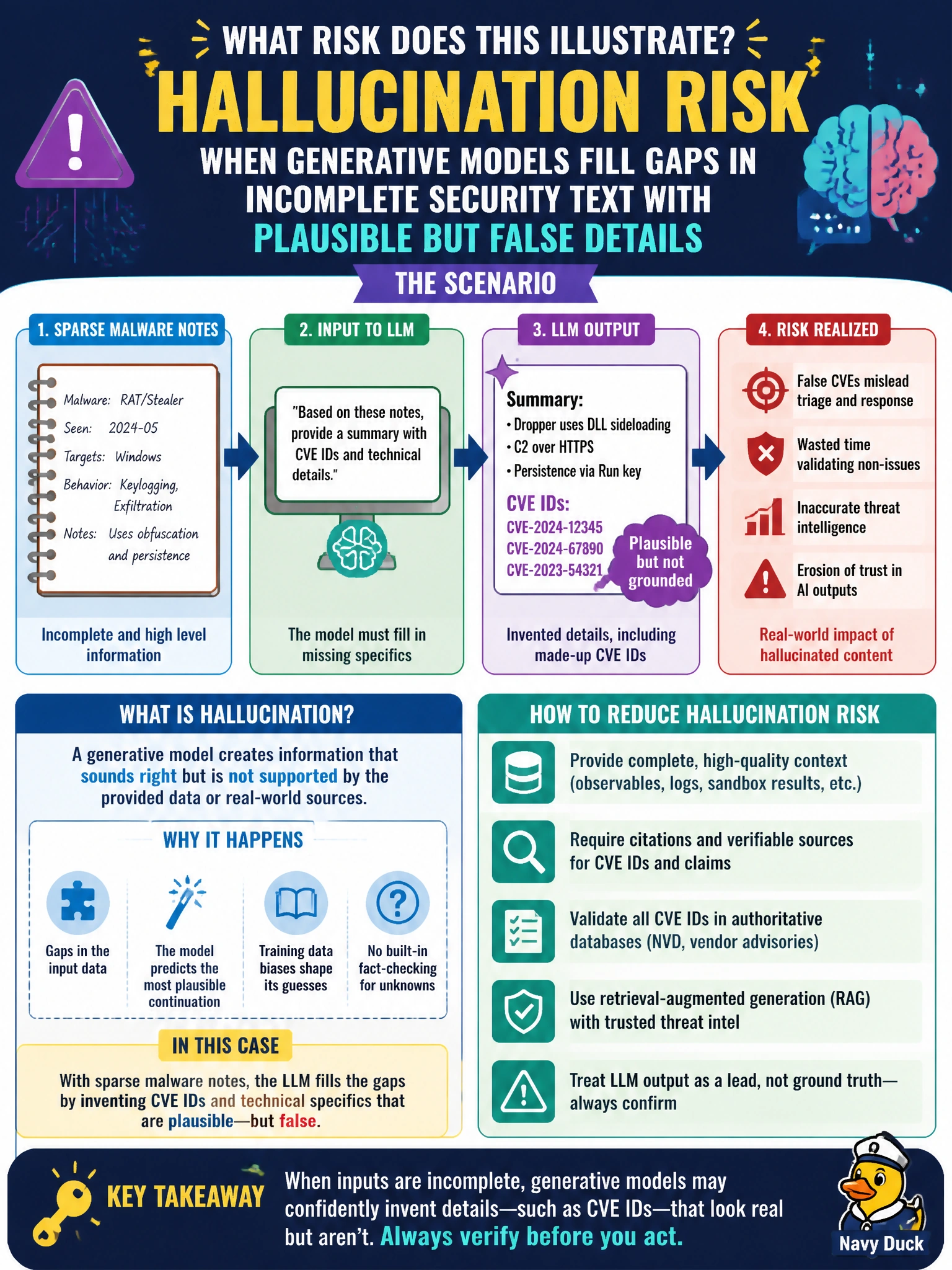
A public-health SOC sees an LLM invent CVE IDs when given sparse malware notes. What risk does that illustrate?
Select an answer to reveal the explanation.
Short Explanation
When the notes are thin, the model may paint in fake CVE numbers like a confident intern guessing ordinance cites. Sparse malware text plus generation equals hallucination risk—verify before you act.
Full Explanation
A public-health SOC that sees an LLM invent CVE IDs from sparse malware notes is observing hallucination risk: generative models fill gaps in incomplete security text with plausible but false details. Fluent CVE-looking strings can appear without grounding in the notes or a vulnerability database, which is dangerous if civic IR acts on them. Sparse input plus unconstrained generation is a classic municipal AI assurance failure mode.
Concluding that the invented CVE IDs reflect training cutoff risk draws the wrong lesson: the model is fabricating identifiers from sparse notes, not merely referencing outdated vulnerability knowledge rather than current NVD publications. This is also not a data poisoning problem: the issue is not compromised threat feeds corrupting model training with fabricated historical CVE mappings, but the model generating false CVE IDs from incomplete input. It is likewise not prompt injection: nothing in the scenario indicates hidden instructions in the malware notes steering the model toward attacker-chosen summaries.
Exam caveat: retrieval-augmented grounding and allow-listed vuln databases reduce but do not eliminate hallucination; unverifiable IDs must still be checked. Operational check: require CVE claims from AI assistants to resolve against an authoritative vulnerability source before public-health containment actions, flag sparse-note prompts as high hallucination risk, and keep analyst verification mandatory for exploitability decisions.
Prefer to study offline? Printable PDF study book + test engine ($7.50, unofficial). These questions stay free here.