
A housing authority evaluates continuous BAS agents versus scheduled campaign runs on shared workstations. Which operating model best fits low-disruption municipal environments?
Select an answer to reveal the explanation.
Short Explanation
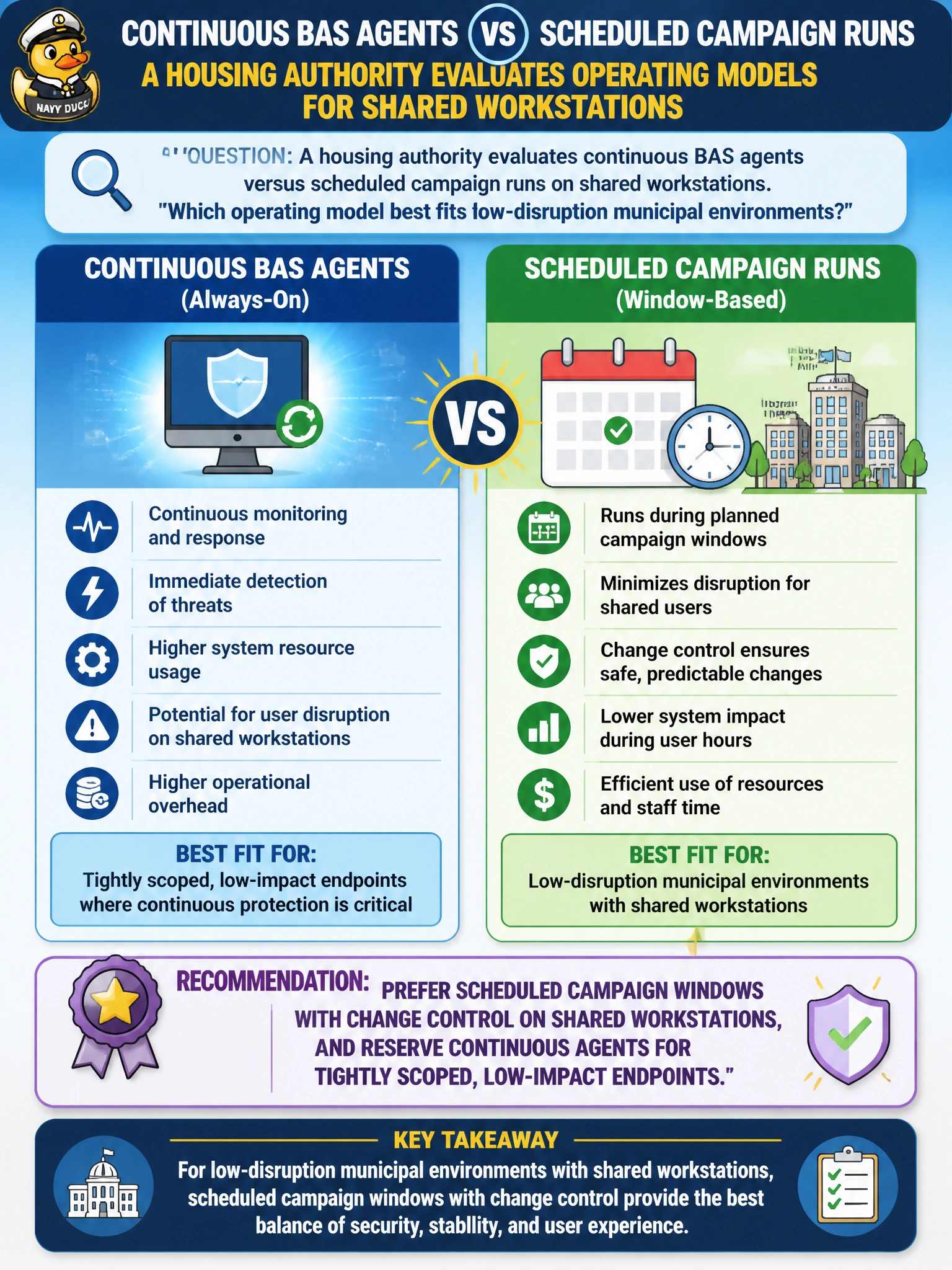
Shared housing workstations are like a busy front counter—you'll schedule controlled campaign windows there, but you won't park continuous agents on privileged auth servers, broad citizen portals, or production backups since they're too critical for steady validation. Schedule controlled campaign windows, and only park light continuous agents where disruption stays tiny.
Full Explanation
A housing authority choosing between continuous BAS agents and scheduled campaign runs on shared workstations should prefer scheduled campaign windows with change control on shared endpoints, reserving continuous agents for tightly scoped, low-impact systems that tolerate steady validation. Reserving continuous agents for tightly scoped, privileged authentication servers still fails low-disruption fit because authentication servers are high-impact identity infrastructure where steady validation risks service contention, lockouts, and expanded privilege blast radius, even when tightly scoped. Reserving continuous agents for tightly scoped, production backup systems also misses low-disruption fit because production backup systems are recovery-critical and not low-impact, where steady validation risks backup corruption, restore contention, and loss of recovery assurance. Scheduled windows keep municipal disruption low while still producing defensive-readiness evidence.
Preferring scheduled campaign windows with change control on shared workstations, and reserving continuous agents for broadly deployed citizen-service portals still fails low-disruption fit because broadly deployed portals have wide blast radius and citizen-facing availability needs that cannot tolerate steady validation, even with change control — so broad deployment is not tightly scoped, low-impact use.
Exam caveat: “scheduled” still requires monitoring for collateral impact, and “continuous” is not forbidden everywhere—only where disruption and blast radius are acceptable and approved. Operational check: classify housing endpoints by shared vs dedicated use, place campaign runs in change windows on shared PCs, limit continuous agents to approved low-impact hosts, and confirm housing operations is notified before any destructive or high-intensity scenario.
Prefer to study offline? Printable PDF study book + test engine ($7.50, unofficial). These questions stay free here.