
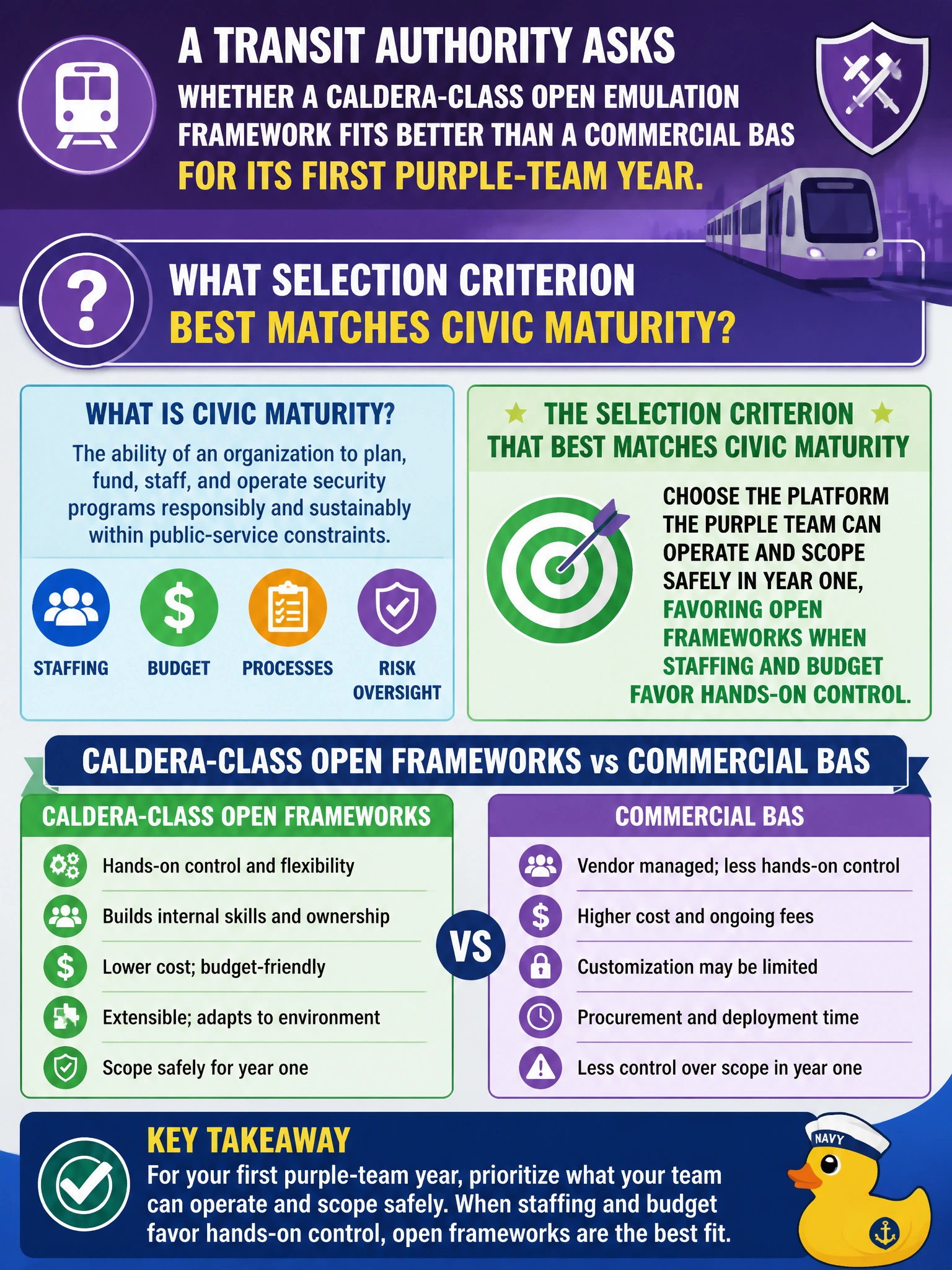
A transit authority asks whether a Caldera-class open emulation framework fits better than a commercial BAS for its first purple-team year. What selection criterion best matches civic maturity?
Select an answer to reveal the explanation.
Short Explanation
First-year purple team is like learning the bus yard before buying the full fleet telemetry package. If you pick for a bigger procedure library, SIEM and EDR links, or scheduled playbooks, you'll still stall if your crew can't run and scope it safely, since content updates and automation can't replace hands-on control in year one.
Full Explanation
A transit authority choosing between a Caldera-class open emulation framework and commercial BAS for its first purple-team year should pick the platform the team can operate and scope safely in year one, favoring open frameworks when staffing and budget favor hands-on control. Civic maturity is about safe, repeatable exercise of authorized scenarios—not brochure feature counts. An open framework the transit purple team can maintain, scope to approved segments, and map to ATT&CK often beats an unused commercial console in year one.
Why the other options fail by concept: Selecting the platform with the larger prebuilt ATT&CK procedure library to broaden coverage in year one, preferring commercial BAS where dedicated content teams sustain updates optimizes for breadth of canned content over the team's actual ability to run and scope it safely—a large library with sustained updates is worthless if the transit team cannot operate the tool inside approved segments. Prioritizing the platform with native SIEM and EDR telemetry links for centralized scoring in year one, favoring commercial BAS when automation outweighs hands-on tuning needs fits a mature, well-staffed program; for a first-year team, that automation overhead can exceed available staffing before any exercise runs safely, and hands-on tuning is what builds safe operation. Favoring the solution with scheduled continuous validation playbooks to maintain cadence in year one, preferring commercial BAS where limited staff need automated repeat testing assumes a staffing-light continuous model works from day one, when the real year-one constraint is whether the team can safely operate any platform at all.
Exam caveat: year-one fit can change—open tools may later be complemented or replaced by BAS when continuous coverage and staffing justify the cost; selection is maturity- and capability-based, not absolute. Operational check: score candidate platforms against transit staff skill, change-control workflow, ATT&CK mapping needs, and ability to keep scenarios inside approved VLANs before signing a year-one purchase or deployment plan.
Prefer to study offline? Printable PDF study book + test engine ($7.50, unofficial). These questions stay free here.